Every ingredient sold as a fat burner that has been pooled in a meta-analysis produces a small effect, a non-significant effect, or an effect the reviewers themselves decline to call clinically important. Berberine is the sharpest illustration: two meta-analyses published in 2020 asked the same question of the same literature and reached opposite answers, one finding −0.11 kg and not significant, the other −2.07 kg and highly significant (Xiong 2020; Asbaghi 2020). Neither is wrong; the field is genuinely unsettled. This article goes ingredient by ingredient through what the pooled trials report, what the most common misreadings are, and what the word "natural" on a label does and does not tell you.
"Fat burner": a marketing category, not a regulatory or pharmacological one. Nothing about the phrase implies a mechanism, a dose, a tested product or an approved use. Products sold under it in Singapore may sit under food regulation, under health-product regulation, or outside lawful supply altogether, depending on their form and contents.
Caffeine: the easiest number in this field to misread
A 2019 systematic review and dose-response meta-analysis pooled 13 randomised trials in 606 participants. Its headline finding, verbatim: "For every doubling in caffeine intake, the mean reduction in weight, BMI, and fat mass increased 2 Beta-fold… which corresponding to 22, 17, and 28 percent, respectively" (Tabrizi 2019).
Read that sentence carefully, because it is almost always quoted wrong. Those are percentage increases in the size of a reduction, not percentages of body weight. A 22% larger reduction is 22% more than whatever the reduction already was — and the review does not report an absolute kilogram figure at all, so there is no way to convert it. When a product page claims caffeine produces "22% more weight loss", it is quoting this paper and stripping out the denominator.
Two further limits. Heterogeneity was extreme (I² of 91 to 94% across the three outcomes), meaning the included trials disagreed sharply with each other. And the authors' own conclusion uses a hedge: caffeine intake "might promote weight, BMI and body fat reduction". The abstract does not state the caffeine doses used, the participants' ages, sex split or BMI.
Conjugated linoleic acid: a real effect that does not extrapolate
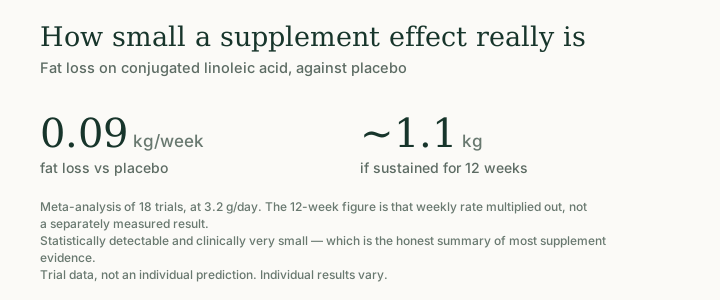
CLA has a 2007 meta-analysis of 18 randomised, double-blind, placebo-controlled trials, all with body composition assessed by a validated technique. At the median dose of 3.2 g/day, CLA produced a fat-mass reduction of about 0.09 ± 0.08 kg per week versus placebo (P<0.001). The dose effect was −0.024 kg per gram of CLA per week (P=0.03). The authors' conclusion: "Given at a dose of 3.2 g/d, CLA produces a modest loss in body fat in humans" (Whigham 2007).
The temptation is to multiply. Do not: the same paper reports the effect as linear for up to about six months and then flattening, approaching an asymptote at around two years, so a weekly rate cannot be run out over a year. Note also that the standard deviation (±0.08) is nearly as large as the estimate itself. And this is a 2007 analysis — old enough that it should be quoted with its date rather than as current best evidence.
Berberine: two meta-analyses, opposite answers
Berberine is the ingredient most often marketed as a plant-derived stand-in for prescription weight-loss medication. Its evidence base contradicts itself on the primary outcome.
- Xiong and colleagues, 2020, pooled 10 randomised trials in a dose-response meta-analysis. Body weight: weighted mean difference −0.11 kg (95% CI −0.99 to 0.76, p=0.79) — not significant. BMI fell 0.29 kg/m² (p=0.006) and waist circumference 2.75 cm (p=0.01) (Xiong 2020).
- Asbaghi and colleagues, 2020, pooled 12 randomised trials and found berberine "moderately but significantly decreased body weight (WMD = −2.07 kg, 95% CI −3.09, −1.05, P < 0.001)", along with BMI, waist circumference and C-reactive protein. Liver enzymes ALT and AST showed no significant change (Asbaghi 2020).
Both are peer-reviewed, both were published in 2020, and they are asking the same question. Picking one and presenting it as the answer would be a choice dressed up as a finding.
NIH's National Center for Complementary and Integrative Health takes the same position from the outside. On whether berberine aids weight loss: "Some studies suggest that it might, but the evidence is not conclusive." On the 2022 review that found decreases in weight and BMI: "Many of the studies included in this review had a high risk of bias, and the outcomes of individual studies were inconsistent." The page also names the practical limitations — widely differing dosages and formulations, most participants having existing health conditions, and research concentrated in Asian countries (NCCIH 2023).
The same page lists what berberine does reliably do: "nausea, abdominal pain, bloating, constipation, or diarrhea". It records an interaction with cyclosporine. And it states that berberine "is likely to be unsafe for infants and may also be unsafe for use during pregnancy or while breastfeeding because of possible effects on the fetus or infant".
One thing NCCIH does not do is comment on the nickname. The phrase that pairs a plant extract with a prescription medicine's brand name appears in commercial and media pages only; it has no peer-reviewed or regulatory source behind it, and NIH's berberine page does not mention it at all.
Green tea extract: the clearest safety signal in the category
Green tea appears in fat-burner formulations more often than any other single ingredient. Its efficacy evidence is covered in more detail in our review of supplements, detoxes and TCM; the short version is that Cochrane's 14-trial review found a small, statistically non-significant weight loss that its own authors judged not likely to be clinically important (Jurgens 2012).
The safety side carries more weight than the efficacy side. NIH's LiverTox database assigns green tea extract a likelihood score of "A (well established cause of clinically apparent liver injury)" — its top category. More than 100 instances of clinically apparent liver injury attributed to green tea extract are documented in the literature, typically presenting one to six months after starting as an acute hepatitis-like syndrome with markedly elevated liver enzymes. Most people recover after stopping, but the monograph states that fatal instances of acute liver failure have been described, and it references case series involving urgent liver transplantation (LiverTox).
The distinction that matters clinically: the signal attaches to concentrated extracts, especially in weight-loss products, not to the beverage. No incidence rate can be attached to it, because this is case-report literature rather than a cohort study.
What "natural" tells you about a product
Nothing about the contents. That is a finding, not an opinion, and Singapore's regulator has published the cases.
HSA describes a two-part regimen sold on social media as a "health sculpting programme", labelled "all-natural" and carrying manufacturing-standard logos it was not entitled to. On analysis, the morning product contained sibutramine and the night product contained sennosides — a laxative. A woman who took them had chest pains. A separate herbal product labelled "100% natural ingredients" also contained sibutramine; a consumer reported "insomnia, illusions, heart palpitations and trembling of limbs". A companion product in the same range contained diclofenac and phenolphthalein (HSA 2026).
Sibutramine, in HSA's own words, "has been disallowed for sale in Singapore since 2010 due to increased risk of heart attacks and strokes". Phenolphthalein has not been registered here since 2011. HSA's general framing of the category is worth quoting: product claims "are often exaggerated or unsubstantiated by any scientific evidence and impossible to verify. You cannot be sure what these products contain, and where and how they were made."
None of that means every supplement is adulterated. These are specific enforcement findings about specific products. What it does mean is that "natural" is a claim about marketing positioning and carries no analytical content.
The scale problem
Supplement effect sizes are frequently placed next to prescription-medication figures without the difference in magnitude being stated, which is where the misleading happens.
The larger of the two berberine estimates is 2.07 kg (Asbaghi 2020). In the pivotal trials of prescription GLP-1 medication, mean weight change was −14.9% of body weight at 68 weeks for semaglutide 2.4 mg and −20.9% at 72 weeks for tirzepatide 15 mg on the treatment-regimen estimand (Wilding 2021; Jastreboff 2022). Berberine's larger estimate is roughly a seventh of that magnitude.
Even that comparison has to be qualified. The supplement figures are kilograms; the trial figures are percentages of body weight. The populations, durations, blinding and monitoring are different. This is a statement about order of magnitude, not a head-to-head result, and no trial has compared any of these supplements against a prescription medicine. Individual results vary in every one of these studies.
What a doctor would want to know
Three questions come up in a consultation, and none of them is about efficacy.
What are you already taking? Berberine has a documented interaction with cyclosporine (NCCIH 2023), and a supplement with undeclared diclofenac or sibutramine in it interacts with whatever those ingredients interact with — which nobody can anticipate, because they are not on the label.
Are you pregnant, planning to be, or breastfeeding? NIH states berberine is likely unsafe for infants and may be unsafe during pregnancy or breastfeeding (NCCIH 2023).
Has anything changed in how you feel since starting? Green tea extract's liver injury typically appears one to six months in, as fatigue, nausea, dark urine or jaundice (LiverTox). Those are symptoms worth raising with a doctor rather than waiting out.
If you are weighing a supplement against a medical route, the useful next step is a clinical assessment of where you actually stand — you can check your eligibility and ask a doctor whether a medical programme is suitable for you.
A licensed medicine that predates the GLP-1 class is a different question from an unlicensed supplement, and three of them are still registered in Singapore. We compare them in what actually changed.
Common questions
Is there a natural alternative to prescription weight-loss medication?
No supplement has been shown to produce anything close to the same magnitude. The largest pooled estimates in this field run to about 2.1 kg, and several of the best-designed reviews return results that are not statistically significant at all (Xiong 2020; Jurgens 2012). The nickname that borrows a prescription medicine's brand name for a supplement is a marketing phrase from social media; no peer-reviewed paper or regulator uses or assesses it.
Does berberine reduce body weight?
Two meta-analyses published in the same year reached opposite answers on that exact outcome. One pooled ten randomised trials and found a weighted mean difference of −0.11 kg, p=0.79 — not significant (Xiong 2020). The other pooled twelve trials and found −2.07 kg, p<0.001 (Asbaghi 2020). Both are peer-reviewed, and neither settles it.
Do caffeine supplements burn fat?
The dose-response meta-analysis most often quoted found that each doubling of caffeine intake was associated with reductions in weight, BMI and fat mass that were 22%, 17% and 28% larger. Those are percentage increases in the size of a reduction, not percentages of body weight, and heterogeneity between the 13 included trials was extreme at I² 91 to 94%. The authors' own verb is might (Tabrizi 2019).
Is a supplement labelled natural safer than a medicine?
The label carries no information about the contents. HSA has published cases of weight-loss products sold in Singapore as all-natural or 100% natural ingredients that were found on analysis to contain sibutramine, a prescription weight-loss medicine banned here since 2010 for increased risk of heart attack and stroke, along with undeclared diclofenac, phenolphthalein and laxatives (HSA 2026).
Which fat-burner ingredient carries the clearest safety signal?
Green tea extract. NIH's LiverTox database gives it the highest likelihood score for drug-induced liver injury — a well-established cause of clinically apparent liver injury — with more than 100 documented cases, typical onset one to six months after starting, and described fatal cases of acute liver failure (LiverTox). The signal attaches to concentrated extracts in weight-loss products, not to drinking tea.