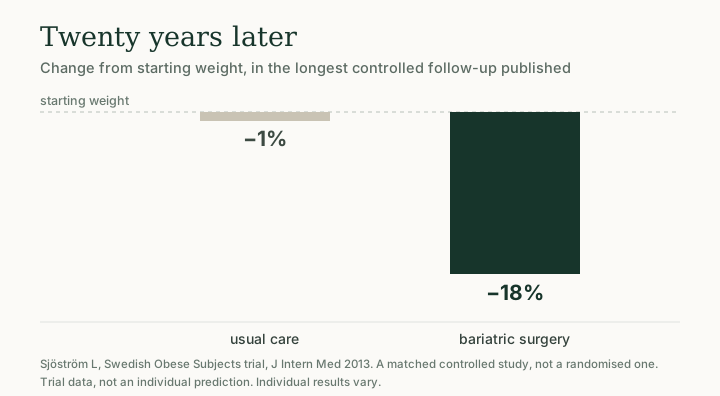
Bariatric surgery takes off more weight than the category we work in, and a comparison that does not start there is not worth reading. Pooling 30 randomised trials through a common lifestyle comparator, surgery produced about ten percentage points more total weight loss than GLP-1 medication under two years, and about nine points more beyond two years (Sabatella 2026). In the longest controlled follow-up published, surgical patients were about 18% below their starting weight at twenty years against about 1% in matched usual-care controls (Sjöström 2013). Perioperative mortality across 3.6 million operations is 0.08% (Robertson 2021). And in Singapore, bariatric surgery is named on MOH's MediSave-claimable list while weight-management medication is not (MOH TOSP 2026; MOH Medisave).
What follows is what the published evidence shows for each of the main routes considered in Singapore. Every comparison is between studies of a method, in the populations those studies enrolled.
Percent total weight loss (%TWL) versus percent excess weight loss (%EWL): two denominators that are constantly mixed up. %TWL is the share of whole starting weight that has gone; %EWL is the share of the weight above a reference healthy weight — a smaller denominator, so the number comes out roughly twice as large for the same person. A 43.5% %EWL figure and a 20.9% %TWL figure are not on the same scale.
Bariatric and metabolic surgery
The largest and most durable reductions in the published evidence, and the only route with twenty-year controlled follow-up.
The ten-percentage-point figure comes from a 2026 network meta-analysis of 30 randomised trials in 20,015 adults, which found surgery superior on percent total weight loss by 10.3% under 104 weeks and 9.1% beyond it. One structural fact governs how it reads: every surgery-versus-medication estimate in it is indirect, assembled through a shared lifestyle comparator, because no randomised trial has put the two head to head (Sabatella 2026).
The long-run figure comes from the Swedish Obese Subjects study — 2,010 surgical patients and 2,037 matched controls, with mean body-weight change of −23% at two years, −17% at ten and −18% at twenty (Sjöström 2013). It was not randomised — patients chose surgery and controls were matched contemporaneously, so self-selection is its central limitation — and its procedure mix is historical: about two-thirds had vertical banded gastroplasty, an operation no longer performed. For a modern comparison, the ten-year SLEEVEPASS randomised trial reported a median 43.5% excess-weight loss after sleeve gastrectomy and 50.7% after gastric bypass, at a median baseline BMI of 44.6 (Salminen 2022). Routine practice shows a wider gap still: in a US cohort of 44,025 adults with BMI 35 or above, intention-to-treat one-year total weight loss was 5.4% on semaglutide, 9.1% on tirzepatide, 24.4% after sleeve gastrectomy and 29.8% after gastric bypass; among those with a full year of continuous medication orders the medication figures were 7.2% and 11.7% — observational, with medication columns dominated by discontinuation and sub-maximal dosing (Brown 2026).
On risk, the pooled mortality figure is low: 0.08% across 58 studies and more than 3.6 million patients, from 0.03% for gastric banding to 0.41% for duodenal switch, in a meta-analysis that exists specifically to argue that perceived surgical risk exceeds the measured risk (Robertson 2021). Mortality is not the whole picture: SLEEVEPASS recorded reflux oesophagitis in 31% of sleeve patients against 7% after bypass at ten years (Salminen 2022).
Where surgery differs from medication is in what it asks of a person rather than in what it achieves. It alters anatomy under general anaesthesia and is largely irreversible. Singapore's MOH primary-care protocol sets its indications for Asian patients at BMI 37.5 or above, or 32.5 or above with a condition such as type 2 diabetes, hypertension, a lipid disorder, fatty liver, polycystic ovarian syndrome or obstructive sleep apnoea — well above the thresholds it sets for medication (MOH BMI Control protocol). And it carries a substantial first-year lean-mass cost: pooling 59 studies, lean body mass fell 8.13 kg at twelve months and skeletal muscle mass 3.18 kg, roughly 55% of it in the first three months (Nuijten 2022). Those surgical kilograms and the medication literature's percentages cannot be ranked against each other, and no study has compared the two routes on composition. GLP-1 or bariatric surgery works through each figure and each limit.
What each scheme covers
This is the part of the comparison that runs against medication.
Six bariatric entries appear on MOH's Table of Surgical Procedures, which the document itself describes as an exhaustive list — anything not listed is not claimable. Sleeve gastrectomy sits at table 5B, and gastric banding, biliopancreatic diversion and gastric reduction and bypass at 5C. Listing means MediSave and MediShield Life can be claimed against a surgical withdrawal limit, in the region of $2,660 to $2,770 for those tables under CPF's April 2025 limits — not that an operation is free or automatically approved, since MediSave is a capped withdrawal from the patient's own account and clinical eligibility is decided separately (MOH TOSP 2026).
Weight-management medication sits on the other side of that line. It is not among Medisave's listed claimable outpatient uses, and obesity is not one of the 23 conditions in the Chronic Disease Management Programme (MOH Medisave). MediShield Life is a hospitalisation and day-surgery scheme, so an outpatient medicine falls outside its scope (CPF exclusions). Medication is absent from an enumerated list rather than named as an exclusion — a real distinction, with the same consequence: it is paid for out of pocket.
At GetLean the out-of-pocket figure is one monthly fee, from S$388 a month, all-in — consultation, medication, the plan, the reviews and delivery — and the monthly price depends on the dose prescribed. Before that there is a S$20 first video consultation with Dr Quek, and there is no lock-in. Our pricing page sets it out in full.
Diet and lifestyle alone
Real early losses, hard to hold, and better evidenced than its reputation.
The largest and longest lifestyle-intervention trial found that an intensive programme of calorie reduction and physical activity produced a mean weight loss of about 4.7% at eight years, well below the losses achieved in its first year (Look AHEAD 2014). Part of why is measurable. One year after a 13.5 kg diet-induced weight loss in 50 adults, ghrelin was still up, leptin and peptide YY still down, and subjective hunger still significantly higher than before the loss — a single-arm study, but a direct measurement of something usually described as willpower (Sumithran 2011).
The figure that dominates this conversation is a provenance problem rather than a statistic. "95% of diets fail" appears in no paper. It traces to a 1959 review plus 100 consecutive patients at one New York hospital clinic, who were, in the practice of the day, handed a diet sheet and followed up (Stunkard & McLaren-Hume 1959). In Stunkard's own later account, his literature review found 25% losing more than 20 pounds and 5% losing more than 40; his own series found 12% and 1%, and two years later only 2% had held a 20-pound loss (Stunkard 1983). There is no 95% anywhere — the number is a rounded complement of one of those figures, cut loose from its denominator, its era, and a sample of 100 people given a diet sheet before behavioural treatment, pharmacotherapy or bariatric surgery existed.
The figure that belongs beside it: roughly 20% of people with overweight achieve and hold a loss of at least 10% of body weight for at least a year, on that specific definition (Wing & Phelan 2005). Diet also sets the composition floor for everything else — roughly 14% of weight lost was fat-free mass on standard low-calorie diets, rising to about 23% on very-low-calorie diets (Chaston 2007). Why diets fail, and where the 95% statistic came from traces the number to its source.
Older prescription medication
Orlistat is the main older prescription option, and the evidence places it at the modest end. A meta-analysis found a placebo-subtracted mean weight loss of about 2.89 kg over 12 months (Li 2005); a later network meta-analysis found about 2.6 kg and ranked it lowest among the approved anti-obesity agents of the time (Khera 2016). For a small gap to the 5% threshold it may be enough on its own; for a substantial change in body composition, unlikely.
GLP-1 medication
The largest reductions of any drug class studied for weight, with three caveats.
In the journal report of STEP 1, mean body weight fell 14.9% at 68 weeks against 2.4% on placebo (Wilding 2021); in the journal report of SURMOUNT-1, 20.9% at 72 weeks on tirzepatide 15 mg against 3.1% on placebo (Jastreboff 2022). Both are journal-abstract figures. The European regulator publishes different numbers for the same trials using a different statistical analysis, and figures from the two sources must never be combined in one comparison.
The first is that routine practice does not look like a trial. In a US cohort of 7,881 adults, 80.8% ended up on a lower-than-maximal maintenance dose and average one-year weight loss was 8.7% — while those who stayed on treatment at a high maintenance dose reached 13.7% on semaglutide and 18.0% on tirzepatide (Gasoyan 2025). It is observational. The second is that the effect holds only while treatment continues: adults who stopped semaglutide after 68 weeks regained roughly two-thirds of what they had lost within a year (Wilding 2022), and pooling six cessation trials in 3,236 people, about 60% of the lost weight was back within a year on a decelerating trajectory modelled to settle below the pre-treatment starting weight (Budini 2026). The third is composition: in the SURMOUNT-1 body-composition sub-study, roughly a quarter of the weight lost was lean mass — the same ratio as the diet-alone placebo arm (Look 2025).
One Singapore point of accuracy: registered indications differ by product here. The registered semaglutide 2.4 mg product carries a weight-management indication; tirzepatide's current registrations carry both a type 2 diabetes and a weight-management indication, while the 2023 injection registration SIN16718P carries type 2 diabetes only (NDF indications). Tirzepatide figures above are trial results — what GLP-1 medication does, and what it does not covers the mechanism, the dose schedule and what is registered here.
Intermittent fasting
No better than ordinary dieting for fat loss, and slightly worse for fat-free mass.
Pooling 28 randomised trials of time-restricted eating, alternate-day fasting and 5:2 protocols against continuous energy restriction, intermittent restriction produced −0.42 kg of body weight (P=0.132, not significant) and −0.31 kg of fat mass (P=0.362, not significant). What reached significance was a small extra loss of fat-free mass: −0.20 kg, confidence interval −0.39 to −0.01 (Schroor 2024). The upper bound is one hundredth of a kilogram, so the finding supports "no fat-loss advantage, and if anything slightly worse for fat-free mass" and does not support "fasting burns muscle".
The gap that matters more is an absence. As of July 2025, no randomised trial had tested intermittent fasting combined with GLP-1 medication; the only published treatment of the combination is a narrative review proposing a framework, saying it "may preserve lean mass", and calling for trials (Cozma 2025). A proposed framework is not a protocol, and compressing an eating window while appetite is already suppressed is the situation in which protein and energy targets fail. Intermittent fasting and GLP-1 covers both literatures.
Keto and low-carbohydrate diets
The first week is glycogen and water, and separating that from fat loss is the point.
The strongest design on this question is a metabolic-ward crossover study in 17 overweight and obese men: four weeks on a high-carbohydrate baseline diet, then four weeks on an isocaloric ketogenic diet with protein held constant. Energy expenditure rose by roughly 100 to 150 kcal/day. Scale weight accelerated in the first week of the ketogenic diet — and body fat loss slowed, coinciding with increased protein utilisation and loss of fat-free mass (Hall 2016). Seventeen men, four weeks, supervised feeding: a small study, and the only one that controlled energy and protein.
The broader literature answers a different question. Across 33 randomised trials in 2,821 adults, ketogenic and low-carbohydrate diets reduced body weight, BMI and body-fat percentage, with fat mass reaching significance only in longer or more carbohydrate-restricted subgroups (Leung 2025). Those comparisons are not energy- and protein-matched, which is why the two bodies of evidence belong together. On training, six randomised trials in 131 resistance-trained people found no significant impairment of maximal squat or bench press over 8 to 12 weeks — though both point estimates favoured the control arm and the squat interval ran to −18.55 kg, an underpowered null rather than a demonstration of equivalence (Vargas-Molina 2024). Keto and low-carb on GLP-1 sets out both.
Training, on its own and alongside medication
Aerobic exercise has a clean dose-response for weight, and a separate and stronger case for what weight loss is made of.
Across 116 randomised trials and 6,880 adults, aerobic exercise reduced body weight by about 2.79 kg at 150 minutes a week and about 4.19 kg at 300 minutes a week (Jayedi 2024). Calorie restriction was a co-intervention in some of those trials, so it is not a clean exercise-alone figure, and setting those kilograms beside a medication trial's percentages would compare different metrics in different populations.
Where exercise earns its place is in protecting lean tissue, which protein and resistance training covers in full. Pooling 34 randomised trials, adding exercise to a calorie-restricted diet prevented roughly 46% of the fat-free mass otherwise lost. By mode, mixed training gave +1.20 kg (p<0.001) and strength training +0.83 kg (p=0.013), while endurance training alone gave +0.51 kg and fell just short at p=0.067 — and the paper states plainly that subgroup testing found no significant differences between training modes (Deller 2026). A network meta-analysis of 62 trials agrees: dieting without exercise was the only arm whose lean-body-mass loss reached significance (Xie 2025). So resistance and combined training are the modes with demonstrated fat-free-mass protection, and aerobic training has not been shown to be worse for muscle — two different statements, only the first supported. Across 114 trials, lean mass was statistically unchanged where resistance training accompanied caloric restriction (Lopez 2022).
Only one randomised trial has put exercise, GLP-1 medication and both together in the same design. After an eight-week low-calorie run-in, 195 adults were randomised for a year to exercise plus placebo, liraglutide 3.0 mg plus usual activity, both, or neither. All three active arms beat placebo; the combination reduced body-fat percentage by 3.9 points against 1.7 for exercise and 1.9 for liraglutide, and was the only arm to improve cardiorespiratory fitness. The asymmetry worth naming is that it significantly beat exercise alone but did not significantly beat medication alone (P=0.13), and the drug was liraglutide (Lundgren 2021). Training alone, medication alone, or both works through each arm.
Body contouring and slimming treatments
These are localised procedures evaluated on localised measures. The error runs in both directions.
Pooled trial data show cryolipolysis reduces fat-layer thickness (mean difference −3.56) and treated-area circumference (−3.45) — and no statistically significant change in body weight (−1.81 kg, 95% CI −3.93 to 0.31, P=0.09), with heterogeneity at I²=95% for fat thickness (Hakami 2025). A systematic review of 45 studies of high-intensity focused ultrasound reports circumference reductions of about 2.5 to 4.5 cm, no weight or total-fat outcome at all, and unstandardised protocols with no data beyond 12 months (Haykal 2025).
The accurate and useful sentence is that a smaller fat layer in one treated area is not less body fat. Local thickness and whole-body fat mass are different quantities, and the trials that measured both found the local one moved and the whole-body one did not.
On the Singapore picture: the medical regulator lists external lipolysis by heat, cold or ultrasound as a non-invasive aesthetic procedure with defined training requirements, and requires that aesthetic advertising not be misleading — a listing that governs who may perform a procedure and where, not whether it works (SMC aesthetic guidelines). HSA regulates medical devices by risk class and requires registration before sale, while placing general well-being products such as body-toning equipment outside the medical-device definition (HSA medical devices). Body contouring and slimming treatments covers the trial outcomes in detail.
Supplements, herbal medicine and "natural" alternatives
Statistically significant, clinically trivial effects — with one genuine safety signal and one live adulteration problem underneath.
Chinese herbal medicine has the largest evidence base of the group. A systematic review pooling 34 randomised trials found a signal as an adjunct to medication or lifestyle change, with no serious adverse events in the herbal groups, while stating that most included studies carried a high or unclear risk of bias (Wong 2021). A positive adjunct signal in a low-quality evidence base is a different statement from either "it works" or "it does not".
On single ingredients the numbers are small, and they belong with their scale. Cochrane's review of 14 randomised trials found green tea preparations produced −0.04 kg outside Japan, non-significant and judged unlikely to be clinically important (Jurgens 2012). Garcinia extract pooled to −0.88 kg with the confidence interval touching 0.00, nulled when only rigorous trials were counted (Onakpoya 2011). Conjugated linoleic acid at 3.2 g/day produced about 0.09 kg of fat loss per week, with a standard deviation nearly as large as the estimate and the effect flattening towards an asymptote, so the rate does not extrapolate (Whigham 2007). Caffeine's figures are the easiest here to misread: each doubling of intake was associated with about a 22% larger reduction in weight and a 28% larger reduction in fat mass — percentage increases in the size of a reduction, not percentages of body weight — with extreme heterogeneity and the authors' own verb being "might" (Tabrizi 2019).
Berberine, marketed under a nickname borrowed from a prescription medicine, has two 2020 meta-analyses that reach opposite answers: ten randomised trials found no significant change in body weight (−0.11 kg, p=0.79) (Xiong 2020), twelve found −2.07 kg (p<0.001) (Asbaghi 2020). Both are citable and neither settles it; NIH's complementary-health centre states the evidence is not conclusive and that the supporting review's studies carried a high risk of bias with inconsistent outcomes (NCCIH 2023). At its most favourable, 2.07 kg is roughly a seventh of what the semaglutide trial reported.
Two things sit behind the category. Green tea extract — not the beverage — is classified by NIH's LiverTox as a well-established cause of clinically apparent liver injury, with more than 100 reported cases and described fatal cases of acute liver failure (LiverTox). And HSA has published named cases of weight-loss products sold online here as "all-natural" that were found on analysis to contain sibutramine — disallowed for sale in Singapore since 2010 because of increased heart-attack and stroke risk — alongside undeclared diclofenac, phenolphthalein and laxatives, with consumers left symptomatic or hospitalised (HSA 2026). TCM, detoxes and weight-loss supplements and fat burners and "natural" alternatives go through each ingredient.
How the options line up
Each row is one study or pooled analysis, on the measure it reported. The measures are not interchangeable and the populations differ.
| Method | What the study measured | Source |
|---|---|---|
| Bariatric surgery | ~10 points more total weight loss than GLP-1 medication (indirect, 30 RCTs); ~18% below starting weight at 20 years vs ~1% in controls | Sabatella 2026; Sjöström 2013 |
| GLP-1 medication, trials | semaglutide 2.4 mg −14.9% at 68 weeks vs −2.4% placebo; tirzepatide 15 mg −20.9% at 72 weeks vs −3.1% (journal reports) | Wilding 2021; Jastreboff 2022 |
| GLP-1 medication, routine practice | 8.7% average at 1 year; 13.7% / 18.0% among high-dose non-discontinuers | Gasoyan 2025 |
| Orlistat | ~2.6–2.9 kg placebo-subtracted at 12 months | Li 2005; Khera 2016 |
| Intensive lifestyle programme | ~4.7% at 8 years | Look AHEAD 2014 |
| Aerobic exercise | ~2.8 kg at 150 min/week; ~4.2 kg at 300 min/week | Jayedi 2024 |
| Intermittent vs continuous restriction | −0.42 kg body weight, not significant; −0.20 kg fat-free mass, significant | Schroor 2024 |
| Cryolipolysis | Fat-layer thickness and treated-area circumference down; body weight unchanged | Hakami 2025 |
What actually decides the choice
Effectiveness alone does not decide it. The axes that separate these routes are invasiveness, reversibility, the BMI at which each is indicated, cost and coverage, and what happens to lean tissue on the way down.
On that last axis every method that produces substantial weight loss costs lean tissue — 14% to 23% of the weight lost in ordinary dieting (Chaston 2007), about a quarter on GLP-1 medication and in its diet-alone comparator (Look 2025), around 8 kg in the first year after surgery (Nuijten 2022) — and adding a training stimulus is the intervention with the clearest effect on that number (Deller 2026; Lopez 2022).
At GetLean, our philosophy is that GLP-1 medication should act as a catalyst — not something to depend on indefinitely — and the comparison above is why the plan around the medicine matters as much as the medicine. Which route suits any individual is a clinical judgement no article can make. Clinical-trial figures describe the populations that were studied; individual results vary and are not guaranteed. Nothing here is a recommendation for or against any treatment, and decisions about surgery, medication or any other option belong with a doctor who has assessed you. If you are considering treatment, check your eligibility and speak to a doctor about whether it is suitable for you.
Common questions
What produces the most weight loss?
Bariatric surgery. Pooling 30 randomised trials through a common lifestyle comparator, surgery produced about ten percentage points more total weight loss than GLP-1 medication both under and over two years (Sabatella 2026), and surgical patients were about 18% below their starting weight at twenty years against about 1% in matched controls (Sjöström 2013). No randomised trial has compared the two directly. Surgery is also more invasive, largely irreversible and indicated at higher BMI thresholds.
Is any weight-loss treatment claimable in Singapore?
Bariatric surgery is; weight-management medication is not. Six bariatric procedures are named on MOH's Table of Surgical Procedures, which the document itself describes as exhaustive (MOH TOSP 2026). Weight-management medication is not among Medisave's listed claimable outpatient uses, and obesity is not one of the 23 conditions in the Chronic Disease Management Programme (MOH Medisave).
Is it true that 95% of diets fail?
No source states 95%. The figure traces to a 1959 paper — a literature review plus 100 consecutive patients at one New York clinic (Stunkard & McLaren-Hume 1959) — and in Stunkard's own later account of it, 12% lost 20 pounds, 1% lost 40 pounds and 2% were still holding a 20-pound loss two years later (Stunkard 1983). Roughly 20% of people with overweight achieve and hold a loss of at least 10% of body weight for at least a year (Wing & Phelan 2005).
Do fat-freezing and body-contouring treatments reduce body fat?
They are measured on a different outcome. Pooled trial data show cryolipolysis reduces fat-layer thickness and treated-area circumference while producing no statistically significant change in body weight (Hakami 2025); a review of 45 studies of high-intensity focused ultrasound reports circumference reductions of about 2.5 to 4.5 cm and no weight or total-fat outcome at all (Haykal 2025). A smaller fat layer in one treated area is not less body fat.
Do weight-loss supplements work?
The measured effects are mostly real and mostly tiny. Cochrane found green tea preparations produced a small, statistically non-significant weight loss its authors judged not clinically important (Jurgens 2012); garcinia extract produced 0.88 kg more than placebo, nulled when only rigorous trials were counted (Onakpoya 2011). Berberine has two 2020 meta-analyses that disagree — no significant weight change in one (Xiong 2020), about 2.07 kg in the other (Asbaghi 2020) — and NIH's complementary-health centre calls the evidence not conclusive (NCCIH 2023).
Is intermittent fasting better than ordinary dieting?
Not for fat loss. Pooling 28 randomised trials, intermittent energy restriction produced no more weight or fat loss than continuous dieting, and a small but statistically significant extra loss of fat-free mass of 0.20 kg (Schroor 2024). No randomised trial has combined it with a GLP-1 medication; the only published treatment of the combination is a narrative review proposing a framework and calling for trials (Cozma 2025).