In the STEP 1 trial extension, participants who stopped semaglutide regained about two-thirds of the weight they had lost within a year (Wilding 2022). That figure gets quoted a great deal and is usually stripped of everything that makes it useful: it is a group average with wide variation, the regain decelerates rather than continuing indefinitely, and the group still ended up lighter than they started. This article covers what the withdrawal trials actually measured, and what the maintenance literature says about the people the average does not describe.
Withdrawal trial: a study where people who have lost weight on a medication are switched to placebo, so the effect of stopping can be measured against continuing.
What do the withdrawal trials show?
Three large trials tested the same question in slightly different ways, and they agree.
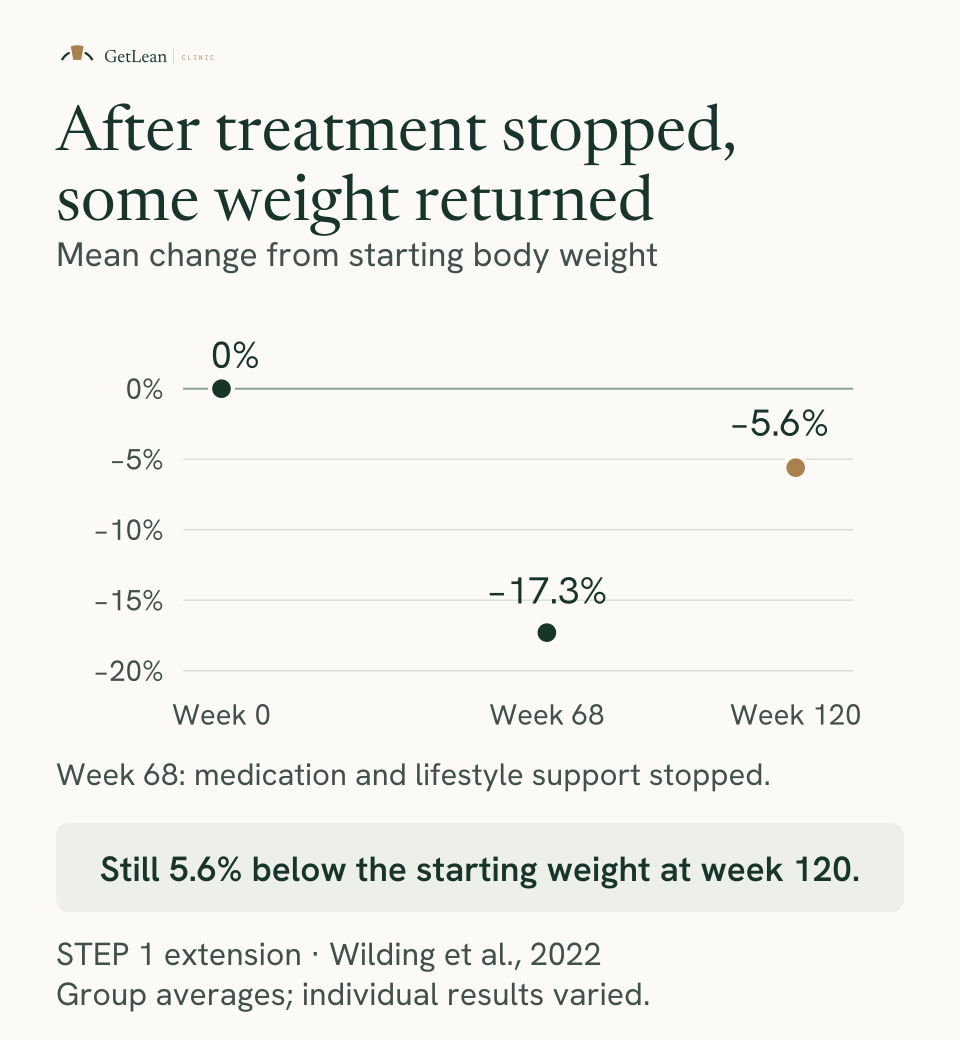
In the STEP 1 extension, participants lost 17.3% of body weight over 68 weeks on semaglutide. In the year after stopping, they regained 11.6 percentage points of that loss, finishing at 5.6% below their starting weight (Wilding 2022). Cardiometabolic improvements made during treatment "reverted towards baseline at week 120 for most variables".
In STEP 4, participants had a 20-week run-in on semaglutide and lost a mean 10.6%. Those switched to placebo then gained 6.9% of body weight over the next 48 weeks, while those who continued lost a further 7.9% — a swing of 14.8 percentage points between the two groups (Rubino 2021).
In SURMOUNT-4, a 36-week lead-in on tirzepatide produced 20.9% weight loss. Over the following year, the group switched to placebo gained 14.0% while those continuing lost another 5.5% (Aronne 2024).
Pooling eight randomised trials, stopping a GLP-1 medication produced significant regain across the board — a mean 9.69 kg for semaglutide and tirzepatide, and 2.20 kg for liraglutide (Berg 2025).
The direction is not in dispute. Stop the medication and weight returns.
Why does it come back?
Because the medication was doing something, and when it stops, that something stops.
GLP-1 medication works by changing appetite signalling — reducing hunger and the intrusive preoccupation with food that patients often describe. It is not a one-off intervention that resets a set point. When the drug clears, the appetite signalling it was modifying returns to how it behaved before.
This is how medication for a chronic condition behaves. Blood-pressure medication lowers blood pressure while it is being taken, and stopping it raises blood pressure again.
There is also a physiological headwind independent of the drug. After weight loss, total energy expenditure falls by more than the change in body size alone predicts — measured in people who had been obese and in people who never had (Leibel 1995) — as part of a coordinated set of responses that defend the reduced weight (Rosenbaum 2010). That response operates whether the weight came off through a medication, a diet or anything else.
The parts of the number that get dropped
Three things about "two-thirds" are routinely lost in the retelling, and all three matter.
It is an average with wide spread. The STEP 1 extension reported a standard deviation of 7.7 percentage points around the regain figure (Wilding 2022). Some participants regained far more than two-thirds; some regained far less. An average describes the group, not the person reading about it.
Regain slows down. Pooling six trials in a nonlinear meta-regression, about 60% of lost weight returned within the first year — but the curve decelerates, with a modelled half-life of 23 weeks (95% CI 17.3–34.3) rather than a straight line back to the start (Budini 2026). The same modelling projects a plateau at around 75% of the weight lost, still below pre-treatment weight. That plateau figure is an extrapolation beyond the observed data rather than a measurement, and should be read as such.
People end up lighter than they started. In SURMOUNT-4 the placebo-switched group was still 9.9% below their baseline weight at week 88 (Aronne 2024). "You put it all back on" is not what the trials found.
What separates the people who keep it off?
Here the honest answer is that the evidence is weaker than the regain evidence, and it comes from a different place: observational registries of people who have already succeeded, rather than randomised trials.
The National Weight Control Registry tracked 784 people who had lost at least 13.6 kg and kept it off for five years, with a mean loss of 30 kg. They reported a low-fat diet — 24 ± 9% of energy from fat — and a high level of physical activity, around 2,828 kcal a week, which is roughly an hour a day (Klem 1997).
Following registry members for a year, 59% maintained their loss and 35% regained. Regain was more likely in those whose loss was recent rather than established, those who had lost a larger share of their maximum weight, and those with higher levels of depression, dietary disinhibition and binge eating. Those who regained showed decreases in energy expenditure and restraint, and increases in dietary fat and disinhibited eating (McGuire 1999).
Two caveats are essential. This is a self-selected registry of people who already succeeded, so it cannot tell you what causes success — only what successful people report doing. And these findings predate GLP-1 medication entirely.
What the registry does support is that maintenance gets easier with time. Once a loss has been held for two to five years, the chance of longer-term success rises substantially (Wing 2001).
What this means for how a programme should be built
At GetLean, our philosophy is that GLP-1 medication should act as a catalyst — not something to depend on indefinitely. The regain data is where that philosophy comes from.
If stopping reliably returns most of the weight, then the only thing that changes the outcome is what was built while the medication was working: the muscle that was protected, the eating pattern that became ordinary, the training that became a habit. Those are the things that do not stop when the prescription does.
That is also why the exit is worth planning from the start rather than confronting at the end. We cover what that involves in tapering off GLP-1 and in treatment length on GLP-1.
Individual results vary, and clinical-trial figures describe the populations studied. Stopping or changing any prescribed medication is a decision to make with your doctor.
Common questions
How much weight do you regain after stopping GLP-1?
In the STEP 1 trial extension, participants regained about two-thirds of their lost weight in the year after stopping, finishing 5.6% below their starting weight (Wilding 2022). A pooled analysis of six trials put it at around 60% within a year (Budini 2026). Individual results vary widely around both figures.
How fast does the weight come back?
Quickly at first, then more slowly. Pooled trial data model a half-life of about 23 weeks, with the curve decelerating rather than returning at a constant rate (Budini 2026).
Do you end up heavier than when you started?
The trial data do not show that. In SURMOUNT-4 the group switched to placebo was still 9.9% below their starting weight a year later (Aronne 2024), and pooled modelling projects a plateau below pre-treatment weight (Budini 2026).
Does everyone regain the weight?
No. These are group averages with wide variation — the STEP 1 extension reported a standard deviation of 7.7 percentage points (Wilding 2022). An average is a statement about a trial population, not a prediction about an individual.
What separates the people who keep it off?
Registry data points to a low-fat diet and a high level of physical activity, around an hour a day (Klem 1997), and to time — people who had already held a loss for two years were less likely to regain over the following year (McGuire 1999). That evidence is observational and predates GLP-1 medication, so it describes what maintainers do rather than proving what works.