Stopping is the part of GLP-1 treatment with the clearest evidence behind it and the least planning around it. Three large randomised trials have measured what happens when the medication is taken away, and they agree: most of the lost weight returns over the following year, fast at first and then more slowly, ending below the original starting weight rather than above it. Those same trials measured almost nothing else — not appetite, not what the returning weight is made of, and not whether reducing the dose gradually would have changed the result. This guide sets out what has been measured, what has not, and what can reasonably be planned around an evidence base shaped like that.
Randomised withdrawal trial: a study in which everyone is treated first, then randomly assigned either to continue or to switch to a placebo. It measures the effect of stopping against the effect of carrying on — and says nothing about how the stopping is done.
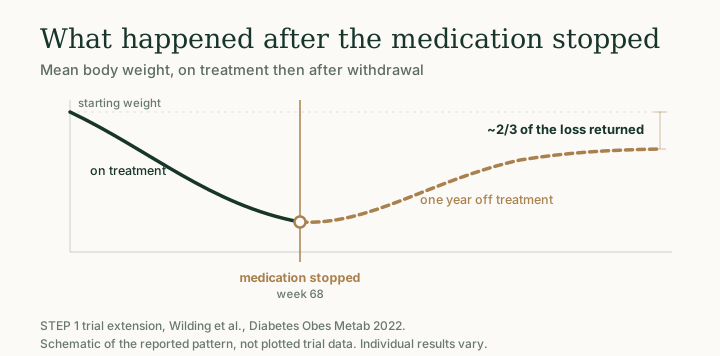
What the withdrawal trials measured
Three trials, three designs, one direction of travel.
In the STEP 1 extension, 327 adults who had lost 17.3% of body weight over 68 weeks on semaglutide were followed for a year off treatment. They regained 11.6 percentage points of that loss, finishing 5.6% below their original weight, and cardiometabolic improvements made during treatment "reverted towards baseline at week 120 for most variables" (Wilding 2022). In STEP 4, participants had a 20-week run-in and were then randomised: those switched to placebo gained 6.9% of body weight over 48 weeks while those continuing lost a further 7.9% (Rubino 2021). In SURMOUNT-4, a 36-week lead-in on tirzepatide produced 20.9% weight loss; over the following year the placebo group regained 14.0% and the continuing group lost another 5.5% (Aronne 2024).
Pooling eight of these trials across 2,372 participants confirms the pattern across the drug class (Berg 2025). A nonlinear meta-regression across six cessation trials adds the shape: about 60% of the lost weight was back at one year, with a modelled half-life of 23.0 weeks, and the regression projects a plateau at around 75% of the weight lost — still below pre-treatment weight, and an extrapolation beyond the observed data rather than a measurement (Budini 2026).
Three things get dropped when the two-thirds figure is retold, and each of them changes what it means. It is a group average with a standard deviation of 7.7 percentage points around it. The regain decelerates rather than running at a constant rate. And the trial groups ended lighter than they began — in SURMOUNT-4 the placebo-switched group was still 9.9% below baseline at week 88. Why two-thirds of the weight comes back works through each of those in full.
In Singapore tirzepatide's current registrations carry both a type 2 diabetes and a weight-management indication, while the 2023 injection registration SIN16718P carries type 2 diabetes only (Singapore NDF). Every tirzepatide figure above is reported as a trial result rather than as an outcome to expect.
What the withdrawal trials did not measure
Two absences matter more than anything the trials found, because both are routinely filled in with confident claims.
Appetite was never measured. The STEP 1 extension, STEP 4 and SURMOUNT-4 recorded body weight and cardiometabolic markers. None of them recorded hunger, craving or food intake after stopping. "Appetite comes back when you stop" is a reasonable inference from the medicine clearing the system — semaglutide has an elimination half-life of about a week and is present in the circulation for roughly five to seven weeks after a last 2.4 mg dose, tirzepatide's is about five to six days (product information) — but a half-life describes drug concentration, not how long a downstream effect lasts. Nobody has measured the time course of appetite return, so there is no timeline to plan around. Appetite after stopping separates what was inferred from what was observed.
The composition of the regained weight was never measured either. The largest meta-analysis of withdrawal trials pooled body weight, waist circumference and BMI, and contains no fat-mass or lean-mass data at all (Berg 2025). "It comes back as fat" is an extrapolation from a different literature — severe semi-starvation refeeding — and it has not been demonstrated after GLP-1 treatment. What regained weight is actually made of sets out why the extrapolation is plausible and why plausible is not the same as measured.
The case for protecting muscle does not need that claim, and it is weaker for borrowing it. It rests on the composition of the weight lost, which is well evidenced: in the SURMOUNT-1 body-composition sub-study, roughly 75% of the weight lost was fat and about 25% lean mass — the same ratio in the tirzepatide arm and the placebo arm (Look 2025).
Why the weight returns
Two forces, and only one of them is the medicine.
The first is straightforward. The medication changes appetite signalling while it is being taken, and when it clears, that signalling returns to how it behaved before. This is how a medicine for a chronic condition behaves, and it is not a comment on the person taking it.
The second operates whether weight came off through a medication, a diet or anything else. After weight loss, total energy expenditure falls by more than the change in body size alone predicts — measured in people who had been obese and in people who never had (Leibel 1995) — as one part of a coordinated metabolic, neuroendocrine and behavioural response that defends the reduced weight (Rosenbaum 2010). No withdrawal trial has separated the two forces from each other. The maintenance phase covers what actually changes on the day the prescription ends, which is narrower than most people assume: the appetite effect stops, and everything built around it carries on.
Is a taper better than stopping abruptly?
Nobody knows, because it has never been tested.
This is the single most important fact in the topic and the one most often skipped. Every published GLP-1 withdrawal trial used an abrupt switch to placebo. No randomised trial has compared a gradual dose reduction against an abrupt stop, or against continued treatment. Confident advice on this question exists in volume and has nothing behind it.
What does exist is one retrospective cohort from a commercial digital clinic, in which tapering was offered as a clinician-guided personal choice rather than randomised. It reported a mean weight loss of 16.7% at week 64 on individualised dosing (Seier 2025). There is no control group, and the clinic that produced the data also sells the programme being evaluated. It establishes that clinics do this. It does not establish that it works. Tapering off GLP-1 goes through that evidence and the reasoning that survives it.
The principle a prescriber works to is the lowest effective dose: the smallest dose that still achieves the clinical goal, rather than the highest dose a person can tolerate. It is general prescribing practice rather than a trial finding, and it is a principle rather than a number, because the dose that fits one patient will not fit another. Dose changes depend on how someone has responded, what side effects they have had, what else they take and what the goal is — which is why no article can supply a schedule, and one that offered a schedule would be inventing it.
At GetLean, dose changes are made at the monthly check-in with Dr Quek. A patient can raise a change at any check-in, and any change is his decision, taken on how the person has responded and what they can tolerate.
How long should someone stay on it?
There is no evidence-based answer, and the reason is structural rather than an oversight.
Every published trial either runs to a fixed endpoint — 68 weeks, 72 weeks, 104 weeks, 208 weeks — or randomises people to continue versus stop. Nobody has randomised people to a shorter course against a longer one, so the comparison that would produce a duration rule has not been run. What exists instead is the longest exposure data in the field and a well-described curve, and both get misread.
The longest continuous exposure published is about four years, from a trial that was not a weight-loss trial: weight loss continued to about week 65 and was then sustained to a mean −10.2% at week 208 against −1.5% on placebo (Ryan 2024). Everyone enrolled was aged 45 or over with established cardiovascular disease, and diabetes was an exclusion (Lincoff 2023), so that figure describes a secondary-prevention population rather than a weight-management one.
The curve flattening is not a signal to stop. In a two-year trial in adults with obesity and without diabetes, weight loss plateaued at around week 60 and the reduced weight was then held for another full year on treatment, ending at −15.2% (Garvey 2022). The only formal time-to-plateau analysis is for tirzepatide, where median times ran from about 24 to 36 weeks by starting BMI class and roughly nine in ten responders had plateaued by week 72 — an analysis restricted to adherent participants who reached at least 5% loss, and authored largely by the manufacturer (Horn 2025). A plateau marks the point where weight stops falling, not the point where the medicine stops acting.
The two-year figure people quote is a funding decision. England's NHS guidance recommends semaglutide for weight management only if it is used for a maximum of two years within a specialist service (NICE 2023). That is a health-technology assessment reflecting cost-effectiveness modelling, not a safety or efficacy finding, and it has no standing in Singapore. How long should you stay on GLP-1 traces each of these numbers to its source, and sets out the two legitimate positions — staying on, and planning to come off — without pretending the evidence picks one.
Designing the exit at the start
At GetLean, our philosophy is that GLP-1 medication should act as a catalyst — not something to depend on indefinitely. Designing the exit from the first consultation follows from that philosophy and from the regain data. It is a reasoned approach rather than a proven one, and the distinction is worth being exact about: no study has compared a programme built around a planned exit against one that is not, so there is no evidence that the design itself changes outcomes.
The reasoning is a scheduling problem. Regain pressure is at its maximum in the months immediately after stopping — that is what the 23-week modelled half-life means (Budini 2026). The things meant to blunt it are slow. Maintenance appears to become more durable only with time held: once a loss has been kept for two to five years, the chance of longer-term success rises substantially (Wing and Hill 2001). A plan that starts when the prescription ends begins the slow process at the moment the fast one starts.
What goes into it has its own evidence, separate from the exit argument. Resistance training is the strongest component: across 114 trials and 4,184 people, lean mass was statistically unchanged when resistance training accompanied caloric restriction (Lopez 2022). Muscle that is still there when the medication stops carries on doing its job.
The behavioural components are weaker and mostly observational. The National Weight Control Registry — a self-selected registry of volunteers who had already succeeded, not a random sample — recorded 784 people who had kept at least 13.6 kg off for five years, reporting a low-fat diet and around an hour a day of physical activity (Klem 1997). Following registry members for a year, 35% regained and 59% maintained, with recent rather than established losses among the risk factors (McGuire 1999). Registry members who reduced how often they weighed themselves regained 4.0 kg over a year against 1.1 kg in those who weighed themselves more often (Butryn 2007). Survivorship bias is built into all three: they describe what maintainers report doing, not what causes maintenance, and they predate GLP-1 medication entirely. The habits that predict keeping weight off reads that literature with its limits attached, and planning your exit from day one sets out what a taper-oriented programme is made of.
At GetLean the taper is planned from the first consultation and set at the monthly reviews as the response comes in, rather than written as a fixed schedule on day one. The intention to end is fixed at the start; the pace follows what has actually happened.
Stopping, regaining, restarting
Stopping and restarting is the normal pattern in practice rather than the exception. Among 125,474 US adults, 64.8% of those without type 2 diabetes had stopped within a year, and about 36% of those who stopped had restarted within the following year, with weight regain after stopping strongly associated with restarting (Rodriguez 2025). That is observational data from a US insurance and access context that does not transfer to Singapore.
How well a second course works has not been published. Reinitiation is well counted; the weight outcome of a restart after stopping and regaining is not reported in any human study. The only direct experiment is in animals: in male mice with diet-induced obesity, restarting semaglutide did produce weight loss, but the cycled animals "failed to reach the prior weight nadir achieved during cycle 1", and the authors state that validation in females and in human populations is essential before drawing any translational conclusion (Son 2026). A second course has not been shown to work less well in people, and it has not been shown to work as well either.
Whether the cycling itself does harm is contested, and the literature changed direction recently. A meta-analysis of 23 cohort studies covering 441,199 people associated body-weight fluctuation with roughly 35–50% higher relative risks of all-cause mortality, cardiovascular mortality, cardiovascular disease and hypertension (Zou 2019). A 2026 Lancet Diabetes & Endocrinology Personal view reappraised the same body of work and concluded that current evidence does not support a causal link between weight cycling itself and clinical harm in people with obesity, attributing the associations to ageing, unintentional weight loss and reverse causality (Magkos 2026). Those are observational cohorts against an argued appraisal by two authors. Both are citable; neither settles it. Restarting after a rebound works through what is counted, what is contested and what is unknown.
A former GetLean patient who wants to restart has a review consultation with Dr Quek first. The previous dose can usually be continued where it is clinically appropriate; that is his decision at the review, not an automatic resumption.
Micro-dosing and dose-stretching
This comes up constantly as a gentler alternative to stopping, and it has no evidence base in either direction.
The complete indexed medical literature on micro-dosing is two letters and one brief report, none of which reports original data; the only peer-reviewed characterisation calls the practice subtherapeutic and unsupervised, driven by cost and tolerability (microdosing literature). There is no trial, no pharmacokinetic study, no regulator position and no obesity professional body statement. That absence cuts both ways: nobody has shown it works, and nobody has shown it does not.
The product information does not sanction it. Both medicines' labels set a minimum interval between two doses, permitting the weekly injection day to be moved, and the only upper bound anywhere is the missed-dose rule — which instructs skipping the dose rather than adopting a longer interval (product information). The FDA warning most often cited in this discussion runs the other way as well: its concern is compounded semaglutide and tirzepatide used at doses beyond the approved label — more product in a single dose, doses taken more frequently, or titration increased more quickly — not smaller ones (FDA). It is a US statement about compounded product, not about the licensed pens a Singapore prescription is filled with.
The nearest real-world signal points against the practice. In a cohort of 7,881 US adults, 80.8% ended up on a lower-than-maximal maintenance dose, and the cohort's average one-year weight loss was 8.7%, against 13.7% and 18.0% among those who stayed on treatment at a high maintenance dose (Gasoyan 2025). It is observational, its "low" category means ordinary titration doses rather than the sub-therapeutic fractions people mean by micro-dosing, and people on lower doses may be there because of side effects, cost or a clinician's judgement — what is common on GLP-1 medication, what is uncommon but serious, and when to stop and call a doctor covers the first of those. Micro-dosing and dose-stretching sets out the labels, the searches and what stays unknown. Any change to a prescribed dose is a decision for the prescribing doctor.
What this adds up to
The regain evidence is strong and narrow. Stopping returns most of the weight, the direction is not in dispute, and the group ends lighter than it started. Almost everything a person would want to know beyond that — how appetite behaves, what the returning weight is made of, whether a taper helps, how long to treat, how a second course performs — has not been studied.
What follows from a gap that size is not paralysis. It is that the parts under a patient's control deserve the attention: the muscle protected while the medication is doing its work (the subject of protecting muscle on GLP-1), the eating pattern that stops requiring effort, the training that becomes ordinary. Those are the things that do not stop when a prescription does, and the evidence behind them is separate from, and better than, the evidence for any particular way of coming off.
Clinical-trial figures describe the populations that were studied; individual results vary and are not guaranteed. Never change or stop a prescribed medicine on your own — that is a conversation with the doctor who prescribed it. If you are considering treatment, check your eligibility and speak to a doctor about whether it is suitable for you.
Common questions
How much weight comes back after stopping GLP-1 medication?
Most of it, in the trials. The STEP 1 extension recorded about two-thirds of the lost weight back within a year of stopping, leaving participants 5.6% below their starting weight (Wilding 2022). Pooled data from six cessation trials put it at about 60% at one year, decelerating afterwards (Budini 2026). Those are group averages with wide individual spread, and clinical-trial figures describe the populations studied.
Is tapering off better than stopping suddenly?
Nobody has tested it. Every published GLP-1 withdrawal trial switched participants abruptly to placebo (Berg 2025), so no randomised comparison of a gradual reduction against an abrupt stop exists. The only taper data is one commercial clinic's retrospective cohort with no control group (Seier 2025). Dose decisions belong to the prescribing doctor.
How long should you stay on GLP-1 medication?
There is no evidence-based answer, because no trial has randomised people to a shorter course versus a longer one. Every published trial runs to a fixed endpoint or compares continuing against stopping. A plateau is not the signal to stop either: in STEP 5 the curve flattened around week 60 and the reduced weight was then held for another year on treatment (Garvey 2022).
Does the weight come back as fat?
Nobody has measured it. No GLP-1 withdrawal trial or meta-analysis reports the fat-versus-lean split of the weight that returns — the largest pooled analysis recorded body weight, waist circumference and BMI only (Berg 2025). What is well measured is the composition of the weight lost, which is where muscle protection earns its place.
Is it bad to stop and start again?
The evidence disagrees with itself. A meta-analysis of 23 cohorts covering 441,199 people associated body-weight fluctuation with a 35–50% higher relative risk of death and cardiovascular disease (Zou 2019); a 2026 Lancet Diabetes & Endocrinology Personal view reappraised that literature and concluded it does not support a causal link (Magkos 2026). Restarting is common — about a third of US adults who stopped had restarted within a year (Rodriguez 2025) — and no human study has published how well a second course works.
Does micro-dosing let you come off more gently?
There is no evidence either way, which is the whole answer. The complete indexed literature on micro-dosing is two letters and one brief report, none carrying original data, and no regulator or obesity professional body has published a position on it (microdosing literature). The product information sets a minimum interval between doses and never a maximum (product information).
Is weight regain after stopping a willpower problem?
No. The appetite suppression is pharmacological, and the medicine clears over weeks after a last dose (product information). The withdrawal trials measured weight and cardiometabolic markers, and weight returned at a population level regardless of how motivated participants were. None of those trials measured appetite or craving after stopping, so the expectation that hunger reasserts itself is an inference from the drug leaving the system rather than a trial finding. Either way, regain is what the pharmacology predicts rather than a lapse in character.