Two things are worth separating here. The first is a widely reported experience: people on GLP-1 medication often say they want to drink less, and researchers have started testing whether that is real. The second is a safety question that gets far less attention, and where the honest answer is that the product information says nothing at all about alcohol — which is not the same as saying it is fine. This article covers both, and is clear about which parts are evidence and which are absence of evidence.
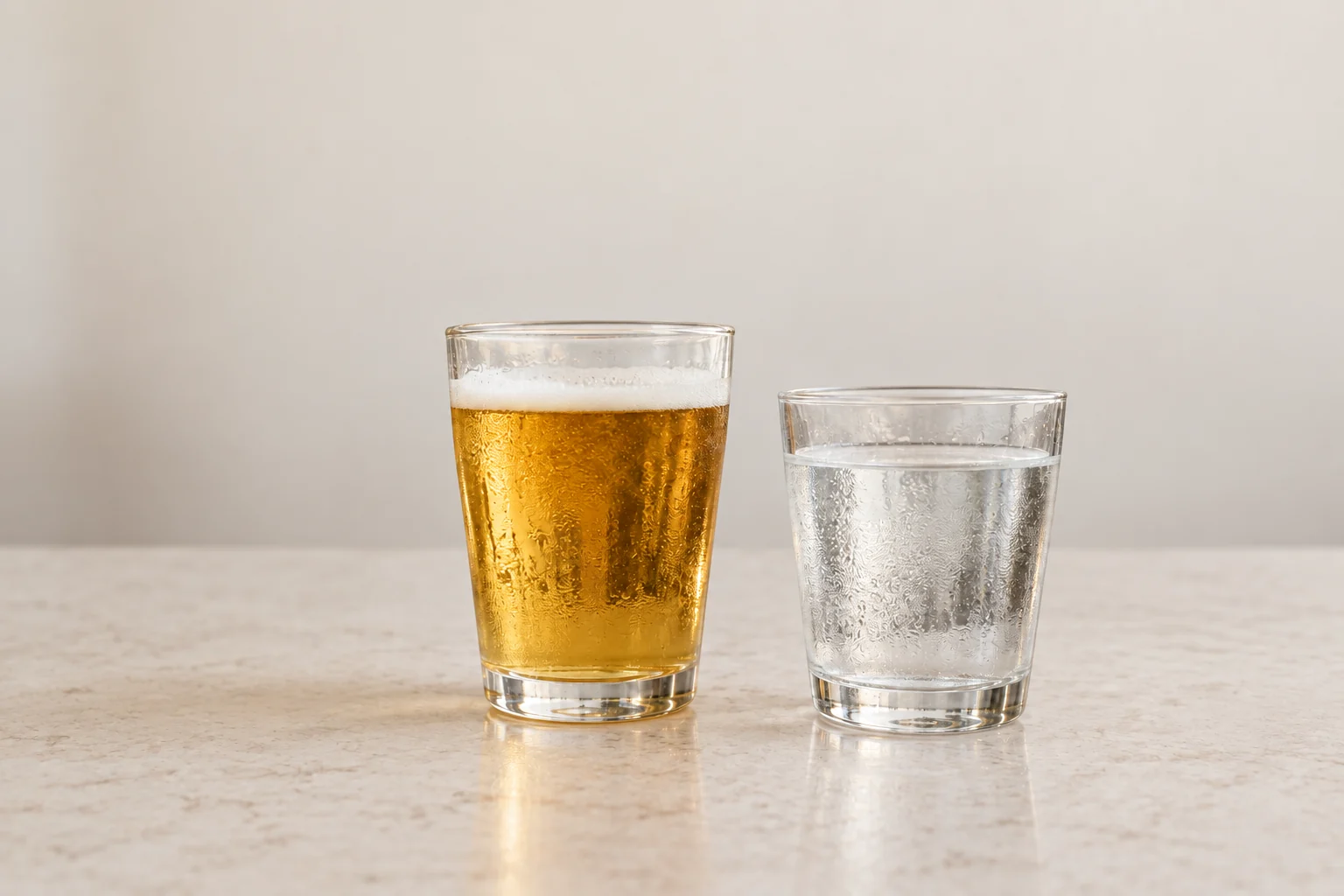
Alcohol use disorder: the clinical diagnosis used in the trials described below. The participants were not people drinking socially, which matters when reading the results.
Does it make you want to drink less?
There is early trial evidence pointing that way, and it is genuinely early.
The most relevant study randomised 48 adults with alcohol use disorder to semaglutide or placebo for nine weeks. Semaglutide significantly reduced laboratory-measured alcohol self-administration in grams (β −0.48, 95% CI −0.85 to −0.11), peak breath alcohol concentration, drinks per drinking day, and weekly craving (Hendershot 2025). What it did not significantly change was average drinks per calendar day or the number of drinking days.
An earlier and larger trial gives a more sobering picture. Exenatide — a different, older GLP-1 medicine — was tested in 127 adults with alcohol use disorder over 26 weeks, and on its primary endpoint of heavy drinking days it showed no significant difference from placebo. A subgroup with a BMI over 30, numbering 30 people, did show a reduction of 23.6 percentage points (Klausen 2022). A subgroup of 30 after a null primary result is a hypothesis, not a finding.
So: a plausible signal, one small positive trial in a specific clinical population, one larger null trial in a different medicine. This is not an approved use of GLP-1 medication anywhere, and nobody should start or continue treatment expecting it to address drinking. If alcohol is a problem, that deserves its own care rather than being folded into a weight-management prescription.
What the labels say about alcohol
Nothing. That is the actual finding.
The word "alcohol" does not appear in the current US prescribing information for either semaglutide or tirzepatide (labels). The hypoglycaemia warning in those documents names concomitant insulin or insulin secretagogues, not alcohol.
It would be easy — and wrong — to translate that into "so alcohol is safe with these medicines". Absence of a label warning is not a clinical clearance. It reflects what was studied and what regulators chose to state, not a positive finding of safety.
Where the real caution sits
Pancreatitis. Acute pancreatitis is a listed warning and precaution for GLP-1 medication (prescribing information). Separately, alcohol is an established risk factor for pancreatitis: pooling six studies covering 146,517 people, risk rose approximately exponentially with intake, with no significant elevation below roughly four standard drinks a day (Irving 2009).
Two independent associations with the same condition is a reasonable thing to be careful about. It is also not a quantified combined risk, because no study has tested the two together. What the two findings jointly support is that heavier drinking is a conversation to have with your doctor before starting, not an afterthought.
Low blood sugar, specifically for anyone also taking insulin or a sulfonylurea. That combination already carries a raised hypoglycaemia risk in the labels (Medication Guides). This is a discuss-with-your-doctor item rather than a general one.
Dehydration, if drinking coincides with a period of vomiting or diarrhoea. The Medication Guides are explicit that fluid loss from these side effects may cause kidney problems (Medication Guides).
The straightforward part: calories
Alcohol provides about 7 kcal per gram, and in moderate drinkers those calories are typically additional to other food rather than replacing it (NASEM 2025).
On the bigger question — does moderate drinking actually affect body weight — the National Academies' 2025 evidence review concluded there was "insufficient evidence to draw a conclusion". That is worth quoting accurately in both directions. Anyone telling you alcohol definitely wrecks fat loss at moderate intake is going beyond the evidence, and so is anyone telling you it makes no difference.
What is not in dispute is the arithmetic. Alcohol calories are real, they are usually on top, and on a suppressed appetite they can crowd out food you actually needed — which in practice most often means protein. That is the mechanism by which drinking tends to work against a body-recomposition goal, and it is more mundane than the metabolic explanations that circulate.
The practical version
There is no general prohibition in the product information, and there is also no evidence base saying a particular amount is fine on this medication. Given that, the sensible position is the one you would take anyway, with two additions: raise your actual drinking honestly at your consultation, and raise it specifically if you have any history of pancreatitis, gallbladder disease, liver problems, or if you take insulin or a sulfonylurea.
At GetLean, our philosophy is that the medication is the catalyst and what you build around it decides the result. Alcohol is not a moral question here. It is a question of whether the calories and the appetite crowding are working with the plan or against it.
Individual circumstances vary, and this is a conversation to have with the doctor who prescribed your medication rather than a decision to make from an article.
Common questions
Can you drink alcohol on GLP-1 medication?
The prescribing information contains no alcohol-specific warning or interaction statement (labels). That silence is not a clearance — absence of a label statement is not evidence of safety. Discuss it with your own doctor, particularly if you have any pancreatic, gallbladder or liver history.
Does GLP-1 medication make you want to drink less?
Many people report it, and early trial evidence points that way. A 9-week trial of 48 adults with alcohol use disorder found semaglutide reduced craving and laboratory-measured drinking versus placebo (Hendershot 2025), while a larger 26-week trial of a different GLP-1 medicine found no significant effect on its primary endpoint (Klausen 2022). This is not an approved use.
Is alcohol riskier because of the pancreatitis warning?
Both are independently associated with pancreatitis — it is a listed warning for GLP-1 medication (prescribing information), and pancreatitis risk rises steeply with heavier drinking, though not significantly below about four drinks a day (Irving 2009). The combined risk has not been studied, so no figure exists for it.
Does alcohol slow down fat loss?
Alcohol supplies about 7 kcal per gram and is usually additional rather than substituted energy (NASEM 2025). On whether moderate drinking changes weight outcomes, that review found the evidence insufficient to conclude in either direction.
Does alcohol affect blood sugar on GLP-1 medication?
The hypoglycaemia warning in the labels names insulin and insulin secretagogues rather than alcohol. If you take either of those alongside GLP-1 medication, raise alcohol with your doctor specifically.