Most side effects of GLP-1 medication are gastrointestinal, cluster around the weeks when a dose steps up, and ease once it holds steady. A short list is uncommon and serious. A shorter list still means stopping the medicine and contacting a doctor the same day. And one thing shapes everything below: the safety document most readers find online is the American one, and it is not the document governing a prescription filled in Singapore. This guide organises what is known by how a reader actually needs it — common and settling, uncommon but serious, hard exclusions, and urgent — and says where the evidence is contested rather than resolving it for effect.
Contraindication: a formal instruction that a medicine must not be used in a defined situation. It is a different category from a warning or precaution, which flags a risk requiring clinical judgement rather than an automatic no.
Which label you are reading changes the answer
Singapore's registered product information for both medicines lists a single section 4.3 contraindication: hypersensitivity to the active substance or to any of the excipients. Neither product lists medullary thyroid carcinoma or MEN 2 (National Drug Formulary). The US prescribing information for both contraindicates them in a personal or family history of those conditions, alongside prior serious hypersensitivity (semaglutide, tirzepatide).
Two consequences follow, and the second is the one people miss. A Singapore patient reading a US health site is reading a document their doctor is not working from. And the absence of medullary thyroid carcinoma from Singapore's section 4.3 is not clinical reassurance: Singapore's warnings-and-precautions section is not published on the public formulary portal, and neither is its interactions section (NDF confirmation). An absence in the one section that is public tells you about that section.
The divergence is not confined to contraindications, though it is narrower than it looks. For semaglutide the missed-dose instruction is a different calculation in each jurisdiction — Singapore's registered instruction counts days since the missed dose, the US rule counts days to the next scheduled one. For tirzepatide the same rule applies in all three regions, so this one is a semaglutide problem (Singapore NDF). Same topic, different arithmetic, and the awkward cases sit exactly at the boundary. What to do about a missed dose works through both, and who should not take GLP-1 medication sets out the two contraindication lists side by side and what a doctor screens for beyond them.
These medicines are Prescription Only in Singapore (HSA register), which is why none of this is settled by a form or an article.
What is common, and what it does over time
Gastrointestinal symptoms, and they are common enough that they should be expected rather than treated as a complication.
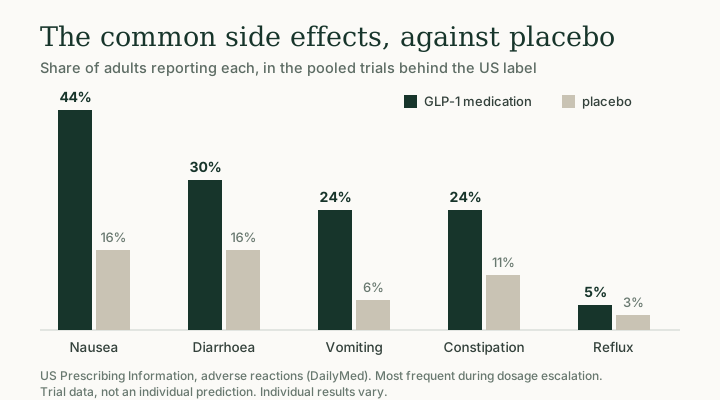
In the pooled trials behind the US semaglutide injection label, nausea occurred in 44% of treated adults against 16% on placebo, diarrhoea in 30% against 16%, vomiting in 24% against 6% and constipation in 24% against 11%; the label states these reactions were most frequently reported during dosage escalation (prescribing information). Tirzepatide's figures in the equivalent US label run lower — nausea 25 to 29% against 8%, vomiting 8 to 13% against 2% — and that document states outright that the majority of nausea, vomiting and diarrhoea events occurred during dose escalation and decreased over time (prescribing information). The explicit reassurance about time appears in the tirzepatide label and not the semaglutide one — and the escalation schedule those figures attach to is set out in what GLP-1 medication does, and what it does not.
They do not settle for everyone. Gastrointestinal events are the most common reason people stop: in the same US label, 4.3% of semaglutide-treated adults discontinued permanently for one, against 0.7% on placebo (prescribing information). Constipation and reflux are the unglamorous half of the picture — those US labels record reflux at 5% against 3% on semaglutide (prescribing information) and 4 to 5% against 2% on tirzepatide (prescribing information) — and a cohort study in people with type 2 diabetes found a modestly higher relative risk of reflux against a comparator drug class, with small absolute differences (Noh 2025).
The management advice deserves a caveat that is almost never attached to it. Small frequent meals, avoiding fatty or spicy food, eating slowly: none of that has been tested in people on GLP-1 medication. The nearest evidence is from chemotherapy-induced nausea, and that systematic review rates its own evidence very low to moderate (Gala 2022). It is practical experience, not an evidence base. Constipation is the exception — fibre, and psyllium specifically, carries a graded recommendation in a dietetic guideline built on four systematic reviews of 75 randomised trials (BDA 2025), and a conditional, low-certainty recommendation in the gastroenterology guideline (AGA-ACG 2023).
One correction worth making, because it circulates constantly: the term added to the postmarketing experience section of the US labels is ileus and intestinal obstruction, not gastroparesis (postmarketing experience). The full tiered picture of side effects sets out the incidences, managing nausea covers what helps and what is guesswork, and constipation and reflux covers the half nobody mentions.
The common ones people are not warned about
Two are listed in the labels and rarely discussed; one is discussed constantly and listed nowhere.
Hair shedding is a listed, quantified adverse reaction in both current US labels — roughly two to four times more common on drug than placebo, and the tirzepatide label records it as far more common in women than in men, at 7.1% against 0.5%. Both labels attribute it to weight reduction itself rather than to a pharmacological action of the medicine (prescribing information). It is telogen effluvium, the shedding pattern that follows a physiological stress, and it is usually self-limiting. Nothing has been tested to prevent or treat it.
Fatigue is also listed and quantified in both US labels (prescribing information). Muscle cramps are not — a full-text search of both current US labels returns no muscle-cramp or myalgia term at all. That is a narrower statement than it sounds: absence from a label means the symptom was not identified at a rate distinguishable from placebo in the pivotal trials, not that it never happens. A symptom can be real, common in clinic, and absent from a label, and there is no figure to print for it. Hair shedding on GLP-1 covers the time course, and cramps, fatigue and training performance covers what the labels do and do not record, and where those symptoms meet the protein and resistance training that protect muscle.
Uncommon but serious: the gallbladder
Gallstones are a recognised consequence of losing weight quickly, by any method, and the labels frame them that way.
For the injection cohort, the US semaglutide label reports cholelithiasis in 1.6% of treated adults against 0.7% on placebo, and cholecystitis in 0.6% against 0.2% (prescribing information). The US tirzepatide label reports cholelithiasis at near-parity with placebo, 1.1% against 1%, with cholecystitis somewhat more frequent on drug, and attributes gallbladder events to weight reduction rather than to a drug-specific effect (prescribing information). Those figures belong to specific drugs and specific presentations and are not interchangeable with each other.
The clearest evidence that the mechanism is weight loss rather than the medicine comes from dieting. In a matched cohort of 6,640 adults, a more aggressive very-low-calorie diet produced roughly three-fold higher rates of hospital-treated gallstones than a more moderate one, on a difference in total weight lost of only about 3 kg (Johansson 2013) — which points at the severity of the restriction rather than at the kilograms alone. The randomised drug evidence agrees that the signal is real: in a pooled analysis of 113 trials, gallstones were significantly elevated, odds ratio 1.30 (Monami 2017).
Persistent upper-abdominal pain, particularly after eating, jaundice, fever or clay-coloured stools are what the Medication Guides tell patients to report (Medication Guides). GLP-1 and your gallbladder sets out the figures by drug and formulation.
Pancreatitis: the gap between the headline and the evidence
The large randomised safety data does not support an elevated pancreatitis risk. Reading the sources in the order they are usually quoted gets this backwards.
The nine-fold figure comes from a retrospective claims-based cohort: an adjusted hazard ratio of 9.09, with a 95% confidence interval running from 1.25 to 66.0 (Sodhi 2023). The interval is the finding. A range from "barely elevated" to "sixty-six times" is what very small event counts look like expressed as a ratio, and the outcomes were diagnosis codes rather than objective testing.
The randomised evidence reads differently. Pooling 113 trials in adults with type 2 diabetes, the odds ratio for pancreatitis was 0.93 (95% CI 0.65–1.34) and for pancreatic cancer 0.94 — neither significant, in the same analysis that did detect the gallstone signal (Monami 2017). A 2025 meta-analysis of 62 trials found a significant unadjusted relative risk of 1.44, which lost significance once trials were stratified by background diabetes medication (Wen 2025). The US labels themselves report near-parity: 4 adjudicated cases against 1 on placebo for semaglutide, in very small absolute numbers on both sides (prescribing information), and 0.14 against 0.15 per 100 patient-years for tirzepatide (prescribing information).
One null meta-analysis, one signal that dissolved under its own sensitivity analysis, and two labels showing little separation from placebo. A body of evidence pointing at a large risk looks nothing like that, and it also falls short of a clean bill of health — which is why both labels keep the warning and why the symptom instruction matters more than the epidemiology. Pancreatitis and GLP-1 works through each source.
The thyroid warning, taken apart
Three separate things get collapsed into one here: the animal finding, the contraindication written around it, and the human research.
The finding is rodent. In mice and rats for semaglutide, and in a two-year rat study for tirzepatide, these medicines caused dose- and duration-dependent thyroid C-cell tumours — and the same US documents state that the human relevance has not been determined (semaglutide, tirzepatide). It appears in the US labels as a boxed warning, the most prominent category that document has. The European and Singapore product information carry no boxed-warning equivalent and record the rodent finding in the non-clinical section instead. The difference is document structure, not different science.
The human research is where it would be settled, and it disagrees with itself. Four of the five substantial analyses are summarised here. A French nested case-control study of 2,562 thyroid cancer cases and 45,184 controls found an adjusted hazard ratio of 1.58 (95% CI 1.27–1.95) overall and 1.78 (1.04–3.05) for medullary thyroid cancer, and drew published disagreement in the same journal (Bezin 2023). A randomised-trial meta-analysis found an odds ratio of 1.52 (95% CI 1.01–2.29), with a number needed to harm of 1,349 over five years — as marginal as a significant result gets (Silverii 2024). Against those, an active-comparator cohort across Denmark, Norway and Sweden following 145,410 initiators against 291,667 comparators found a hazard ratio of 0.93 (0.66–1.31) (Pasternak 2024), and an integrated analysis of 93 trials, more than 18 million patient-years of post-marketing exposure and a real-world database concluded the totality of the data does not suggest an association — while its own all-trials estimate against placebo, a hazard ratio of 1.70 (95% CI 0.99–3.03), sits just under significance and should not be dropped when quoting that conclusion (Vilsbøll 2026).
Reported together: the largest and best-designed observational studies do not find an association, the trial-level evidence is equivocal, and the two positive findings carry structural caveats the literature has named. Anyone presenting this as settled in either direction is going past what the studies support. A personal or family history of medullary thyroid carcinoma or MEN 2 is something to raise before starting, either way. The thyroid warning explained sets out all five analyses in order.
When to stop and call a doctor
The list below is drawn from the US Medication Guides, which are the patient-facing section of the American prescribing information. It is a starting point rather than a complete account, and the leaflet supplied with your own medicine plus your doctor's instructions come first.
Stop and seek help right away. Severe pain in the stomach area that will not go away, with or without nausea and vomiting, sometimes felt from the abdomen through to the back — the labelled warning sign for pancreatitis. Signs of a serious allergic reaction: swelling of the face, lips, tongue or throat, severe rash or itching, a very rapid heartbeat, problems breathing or swallowing, fainting or dizziness (Medication Guides).
Contact your doctor promptly. Upper-abdominal pain, jaundice, fever or clay-coloured stools. Vomiting or diarrhoea that does not settle, because fluid loss can cause kidney problems. Symptoms of low blood sugar, particularly for anyone also taking insulin or a sulfonylurea. Vision changes, an instruction the Medication Guides frame for patients with type 2 diabetes. A lump in the neck, difficulty swallowing, shortness of breath or persistent hoarseness, which are the thyroid counselling symptoms (Medication Guides).
Before any procedure with sedation or anaesthesia, tell the team in advance. Guidance changed here: the 2023 advice to withhold weekly GLP-1 medication for a week before a procedure was superseded in October 2024 by multi-society guidance that most patients should continue, with a 24-hour liquid diet or other measures for those at highest risk (multi-society guidance 2024). The instruction is to tell them early, not to stop.
Ordinary nausea, constipation and reflux are not on this list. Persistence and severity are what separate an unpleasant side effect from an urgent one. Red flags on GLP-1 is the full version, worth reading once early rather than at the moment something happens.
Between consultations, a GetLean patient messages the clinic's WhatsApp number. Someone replies between 9am and 9pm, seven days a week, and anything clinical goes to Dr Quek. Outside those hours a symptom on the list above does not wait for a reply: go to an emergency department, or call 995 if it is an emergency.
What needs a conversation before starting
Most of what people worry about is a warning rather than a contraindication — a flagged risk requiring judgement, not an automatic no. Several topics deserve naming because the documents themselves disagree.
Pregnancy and contraception. The product information instructs discontinuing when pregnancy is recognised, and semaglutide should be stopped at least two months before a planned pregnancy under both the US and EU documents; the EU document gives one month for tirzepatide and the US document gives no pre-conception window for it (pregnancy sections). Semaglutide's figure does not transfer to tirzepatide. The contraceptive question splits the two regulators from near-identical data: the US label advises switching to a non-oral method or adding a barrier for four weeks after initiation and after each dose escalation (US label), while the EU SmPC reports peak contraceptive-hormone concentrations falling 55 to 66% after a single dose and concludes no dose adjustment is required (EU SmPC). Pregnancy-outcome studies after inadvertent exposure disagree on direction, and a systematic review of 36 studies found no consistent malformation, growth or mortality signal alongside heterogeneous maternal-outcome findings (Ozbek 2026) — an absence of a consistent signal, which is weaker than a demonstration of safety. GLP-1, pregnancy and fertility covers the washout, the contraception split and the contradictory literature.
Mental health. Suicidal ideation is not a current label warning. EMA's PRAC concluded on 12 April 2024 that available evidence does not support a causal association for five named substances, tirzepatide not among them (EMA PRAC 2024); FDA acted separately on 13 January 2026 on a meta-analysis of 91 placebo-controlled trials covering 107,910 patients, naming three products including tirzepatide (FDA 2026). Both are absence-of-signal findings rather than proof of no risk, and the pharmacovigilance literature is not unanimous — one replication study found increased reporting odds for suicidal ideation alongside decreased odds for attempts and completed suicide, with its authors stating that causation cannot be established either way (McIntyre 2025). Any change in mood is worth telling your doctor about. If you are having thoughts of harming yourself, get help immediately rather than waiting for an appointment: contact a doctor, go to the nearest emergency department, or call a crisis helpline. Who should not take a GLP-1 covers the cautions to raise before starting.
Anyone in immediate danger should call 995, Singapore's emergency line, rather than wait for a reply from the clinic.
Alcohol. The US prescribing information for both medicines contains no alcohol-specific warning or interaction statement at all (prescribing information). Silence in a label is not clinical clearance. Alcohol on GLP-1 covers what is established, what is early, and what the labels leave open.
Other medicines. Slowed stomach emptying can change how oral medicines are absorbed, and the four source documents — US and EU, for each drug — give four slightly different instructions. Singapore's own interactions section is not published (NDF confirmation), so nothing here can be presented as the local rule. Your full medicine and supplement list belongs with your doctor and pharmacist rather than being filtered by an article; GLP-1 drug interactions explains why.
Diabetes. In Singapore, registered indications differ by product: the registered semaglutide 2.4 mg product carries a weight-management indication, the registered semaglutide 1 mg product carries a type 2 diabetes indication only, and tirzepatide's current registrations carry both a type 2 diabetes and a weight-management indication (Singapore NDF). GetLean is a weight-management service. Anyone with diabetes has that condition managed by their own doctor, and the combination is where hypoglycaemia risk concentrates: the US tirzepatide label reports hypoglycaemia in 4.2% of treated patients against 1.3% on placebo in its trial in people with type 2 diabetes, rising to 10.3% among those also taking a sulfonylurea against 2.1% among those not — and it states that hypoglycaemia has also been associated with this medicine class in adults without type 2 diabetes (prescribing information). Any change to insulin or a sulfonylurea is a decision for the doctor managing it. Why the weight-loss numbers differ with and without diabetes explains the gap in the trial figures.
What is known about the long run
Three outcome trials carry the longest randomised exposure, and each enrolled a deliberately narrow population.
SELECT randomised 17,604 adults aged 45 and over with established cardiovascular disease and a BMI of 27 or above, excluding diabetes, and found a 20% relative reduction in cardiovascular death, heart attack or stroke over a mean 3.3 years (Lincoff 2023). FLOW enrolled 3,533 adults who already had both type 2 diabetes and chronic kidney disease within specified thresholds, and found a 24% reduction in major kidney-disease-progression events (Perkovic 2024). Two 52-week trials in 469 adults with obesity and moderate-to-severe obstructive sleep apnoea found tirzepatide reduced the apnoea-hypopnoea index by roughly 20 to 24 more events per hour than placebo (Malhotra 2024).
Those are real findings in the groups enrolled, and they do not transfer to a general weight-management patient with no cardiovascular history, normal kidney function and no sleep apnoea. Beyond roughly four years, randomised evidence in this drug class does not exist. Long-term effects of GLP-1 covers what has and has not been followed, and who was actually in each trial.
The practical layer
Storage and travel rules are pen-specific, and the single most common error is repeating a figure from a different pen. In the US labelling, the semaglutide single-dose pen or syringe is refrigerated and may be kept between 8 and 30°C for up to 28 days, discarded if frozen or exposed above 30°C (prescribing information). The tirzepatide multi-dose presentation is discarded at the earliest of 30 days at room temperature, 30 days after first use, or the fourth weekly dose (prescribing information). Those two rules do not convert into each other, and the leaflet in your own box is the reference. Injection sites, storage and travel covers the presentations and what Singapore allows a traveller to carry.
Clinical-trial and label figures describe the populations that were studied; individual results vary and are not guaranteed. This guide is not a substitute for the product information supplied with your medicine or for your doctor's instructions, and in an emergency the right destination is a hospital emergency department rather than a clinic appointment. If you are considering treatment, check your eligibility and speak to a doctor about whether it is suitable for you.
Common questions
What are the most common GLP-1 side effects?
Gastrointestinal ones. In the pooled trials behind the US semaglutide injection label, nausea occurred in 44% of treated adults against 16% on placebo, diarrhoea in 30% against 16%, vomiting in 24% against 6% and constipation in 24% against 11% (prescribing information). Tirzepatide's figures were lower, with nausea at 25 to 29% against 8% (prescribing information). Both labels record these as clustering around dose increases.
Do GLP-1 side effects go away?
For most people the gastrointestinal ones ease once a dose is held steady — the tirzepatide label states that the majority of nausea, vomiting and diarrhoea events occurred during dose escalation and decreased over time (prescribing information). They do not settle for everyone: 4.3% of semaglutide-treated adults stopped treatment permanently because of a gastrointestinal reaction, against 0.7% on placebo (prescribing information).
Does GLP-1 medication cause pancreatitis?
The large randomised evidence does not show an elevated risk. Pooling 113 trials, the odds ratio was 0.93 with a confidence interval of 0.65 to 1.34 (Monami 2017). The widely quoted nine-fold figure comes from a small claims-based study whose confidence interval ran from 1.25 to 66.0 (Sodhi 2023). The labels still carry a pancreatitis warning, and the symptom instruction is worth knowing.
Is the thyroid cancer warning real?
The warning is real and it comes from rodents. The US labels record dose- and duration-dependent thyroid C-cell tumours in rodents and state in the same document that the human relevance has not been determined (semaglutide, tirzepatide). The human research disagrees with itself: a French case-control study found a raised relative risk (Bezin 2023) while a three-country active-comparator cohort found none (Pasternak 2024).
Who should not take GLP-1 medication?
Singapore's registered product information gives one formal contraindication: hypersensitivity to the medicine or its excipients (NDF). The US prescribing information adds a personal or family history of medullary thyroid carcinoma or MEN 2 (prescribing information). Pregnancy and planning a pregnancy are separate stopping instructions (pregnancy sections), and a doctor screens for a considerably wider set of factors than either list.
When should you stop and call a doctor?
The clearest instruction in the US Medication Guides is for severe pain in the stomach area that will not go away, with or without nausea and vomiting, sometimes felt through to the back — stop the medicine and contact a healthcare provider right away. Signs of a serious allergic reaction carry the same urgency (Medication Guides). That is a starting point rather than a complete list, and anything that worries you is a reason to call.