Nausea gets the attention. Constipation is the one people actually complain about six months in, and it affects around a quarter of patients on semaglutide. Reflux is less common but real. Both are consequences of the same mechanism that makes the medicine work — food moving more slowly — and both have a small evidence base that is worth reading before you spend money on remedies. This article covers what the trials recorded, what the guidelines actually support, and where the line is between a nuisance and a problem.
Ileus: a stoppage of normal bowel movement. Listed in the postmarketing section of the product information alongside intestinal obstruction and severe constipation.
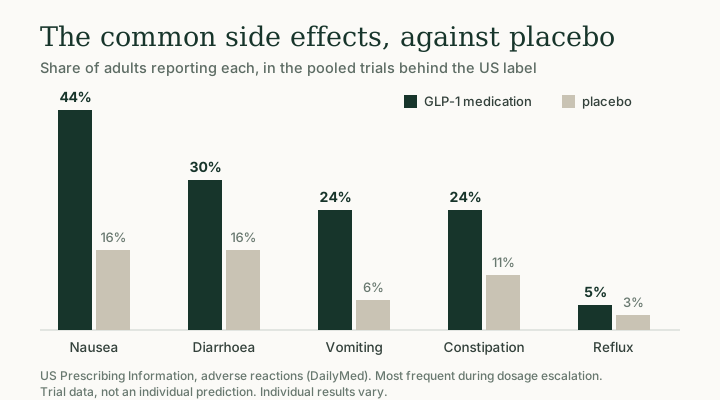
How common are they?
Constipation is common enough to plan for. In pooled trials it affected 24% of adults on semaglutide 2.4 mg against 11% on placebo (prescribing information). For tirzepatide the figures ran 17% at 5 mg, 14% at 10 mg and 11% at 15 mg, against 5% on placebo (prescribing information) — an unusual pattern, in that constipation did not rise with dose the way nausea did.
Reflux is less common but consistently above placebo: 5% versus 3% for semaglutide (prescribing information), and 4–5% versus 2% for tirzepatide (prescribing information).
Both sit alongside a longer list of digestive effects. For semaglutide the same table records abdominal pain at 20% against 10% on placebo, dyspepsia 9% against 3%, abdominal distension 7% against 5%, and eructation — the label's word for burping — at 7% against under 1% (prescribing information). That last one is rarely mentioned and quite frequently the thing people find most annoying.
What actually helps constipation
Fibre, and specifically psyllium. This is the one with a real evidence base. The British Dietetic Association's 2025 guideline, built on four systematic reviews covering 75 randomised trials, gives psyllium a strong recommendation on low-certainty evidence, and identifies fibre doses above 10 g a day as optimal (BDA 2025). The AGA-ACG guideline reaches a similar place from the pharmacological side: fibre supplementation, conditional recommendation, low certainty (AGA-ACG 2023).
Two practical notes. Increase fibre gradually — going from very little to a lot in one step tends to produce bloating, which is not what anyone wants on top of this. And ask your doctor or pharmacist before adding a supplement, particularly if you take other medicines by mouth.
Movement, probably. Pooling 13 cohort studies covering 119,426 people, higher physical activity was associated with lower constipation risk, with a relative risk of 0.69 (95% CI 0.58–0.83) (Cui 2024). That is association rather than proof — people who are unwell move less, which could explain part of it — and the authors note that randomised evidence is limited. It is a reasonable thing to do anyway.
Water, less clearly than you would think. This is the advice everybody gives, and the evidence for it is thinner than its popularity suggests. The dedicated dietary guideline did not evaluate fluid intake at all, and the pharmacological guideline mentions it only in passing alongside fibre, with no independent graded recommendation (BDA 2025, AGA-ACG 2023). Adequate hydration matters for other reasons, particularly if you have had vomiting or diarrhoea. As a constipation treatment on its own, it is not well supported.
Whole-diet changes. The BDA guideline could make no recommendation here — insufficient evidence.
Reflux
The evidence here is genuinely mixed and worth reporting as such.
The trial data record reflux at roughly double the placebo rate for both medicines, which is real but small in absolute terms. A large population cohort study in the UK compared people with type 2 diabetes starting a GLP-1 medication against people starting a different drug class, and found a relative risk of 1.27 (95% CI 1.14–1.42) for reflux over about three years — an absolute difference of 0.7 per 100 patients (Noh 2025). Complications were rarer still, at 0.8 per 1,000.
Two caveats matter. That study was in people with type 2 diabetes, not in a weight-management population, and it is observational, so residual confounding cannot be excluded. It is the best available evidence rather than a settled answer.
The usual measures — not lying down soon after eating, smaller evening meals, raising the head of the bed — are reasonable and low-risk. As with the nausea advice, they have not been tested specifically in this population.
When it stops being a nuisance
Constipation has a serious end, and it is listed in the product information.
The postmarketing experience section for both medicines lists ileus, intestinal obstruction, and severe constipation including faecal impaction (prescribing information). These are uncommon, and they are the reason persistent constipation is not something to keep managing at home indefinitely.
Contact your doctor if constipation persists despite fibre, and seek medical attention if it comes with significant abdominal pain and bloating, vomiting, or no bowel movement at all. That combination is not a side effect to wait out.
The labels also state the medicine is not recommended in people with severe gastroparesis, which is a pre-existing condition rather than something these medicines are said to cause. One widely repeated claim is worth correcting: the term added to the postmarketing section was ileus, not gastroparesis. Some coverage has conflated the two.
At GetLean, our philosophy is that the medication is the catalyst and the plan around it decides the result — and the practical business of staying comfortable enough to eat properly is part of that plan rather than separate from it. Digestive side effects are one of the main reasons people stop eating in the pattern that protects their muscle.
Individual results vary. Ask your doctor before adding a supplement or laxative, particularly alongside other medicines.
Common questions
Does GLP-1 medication cause constipation?
It is a common side effect: 24% on semaglutide 2.4 mg versus 11% on placebo (prescribing information), and 11–17% on tirzepatide versus 5% (prescribing information).
What helps constipation on GLP-1?
Fibre has the strongest evidence — psyllium carries a strong recommendation, with doses above 10 g a day identified as optimal (BDA 2025). Build up gradually, and check with your doctor or pharmacist before adding a supplement.
Does drinking more water help constipation?
Less clearly than commonly assumed. The dedicated dietary guideline did not evaluate fluid intake, and the pharmacological guideline gives it no independent recommendation (BDA 2025, AGA-ACG 2023). Hydration matters for other reasons.
Does GLP-1 medication cause acid reflux?
Reflux appears in trial data at roughly double the placebo rate (prescribing information), and a cohort study in people with type 2 diabetes found a relative risk of 1.27 with a small absolute difference (Noh 2025). That study was observational and in a different population.
When is constipation a medical problem?
When it stops entirely, or comes with significant pain and bloating or vomiting. The postmarketing section lists ileus, intestinal obstruction and severe constipation including faecal impaction (prescribing information). That warrants medical attention rather than more fibre.