GLP-1 medication reduces how much you eat. It does not reduce how much protein your body needs to hold onto muscle, and that gap is the practical problem this article solves. The target during active weight loss is around 1.2–1.6 g of protein per kg of body weight per day (Leidy 2015) — a number that is straightforward on a normal appetite and genuinely difficult on a suppressed one. Below are twelve tactics that work, grouped by the reason they work.
Protein target: 1.2–1.6 g per kilogram of body weight per day during active weight loss. For a 70–90 kg person, roughly 85–145 g daily.
Why this is harder than it sounds
The medication is doing exactly what it is meant to do, and that is the difficulty.
In a crossover trial, semaglutide reduced total food intake across a single laboratory test day by about 24% compared with placebo (Blundell 2017). In a later trial at the 2.4 mg dose, intake at a single ad libitum test lunch was 35% lower than placebo (Friedrichsen 2021). Both figures come from measured test meals in a laboratory rather than from tracked daily eating, so they are a proxy for appetite suppression rather than a description of everyday intake — but the direction is unmistakable.
There is a second problem stacked on the first. Protein is the most satiating macronutrient per calorie: raising protein from 15% to 30% of calories reduced spontaneous energy intake by about 440 kcal a day in one study (Weigle 2005). On a normal appetite that is a feature. On a suppressed appetite it means the food you most need to eat is the food that fills you up fastest.
So the tactics that follow are not about willpower. They are about sequencing, density and format.
Tactics that work on sequencing
1. Protein first, always. At every meal, eat the protein source before anything else on the plate. When capacity runs out, it runs out on rice, noodles or vegetables rather than on the thing protecting your muscle. This single habit changes the composition of nearly every meal without changing what you order — eating and training lean in Singapore applies it to hawker ordering and to the local food data behind it.
2. Eat at your best window. Appetite suppression is rarely even across the week or the day. Whenever your own appetite is least suppressed, put the largest protein serving there rather than fighting for it at the worst moment.
3. Spread it across three occasions rather than saving it up. In a controlled-feeding crossover study, roughly 30 g of protein at each of three meals produced a 24-hour muscle protein synthesis rate 25% higher than the same daily total skewed heavily towards dinner (0.075 versus 0.056 %/h) (Mamerow 2014). That was a small study of eight people, so treat it as a sensible default rather than a law — but it points the same way as the practical logic: three moderate servings are easier to get down than one large one.
4. Do not skip a meal because you are not hungry. A missed eating occasion on a suppressed appetite is rarely made up later. If a full meal is impossible, a small protein-only portion still counts.
Tactics that work on density
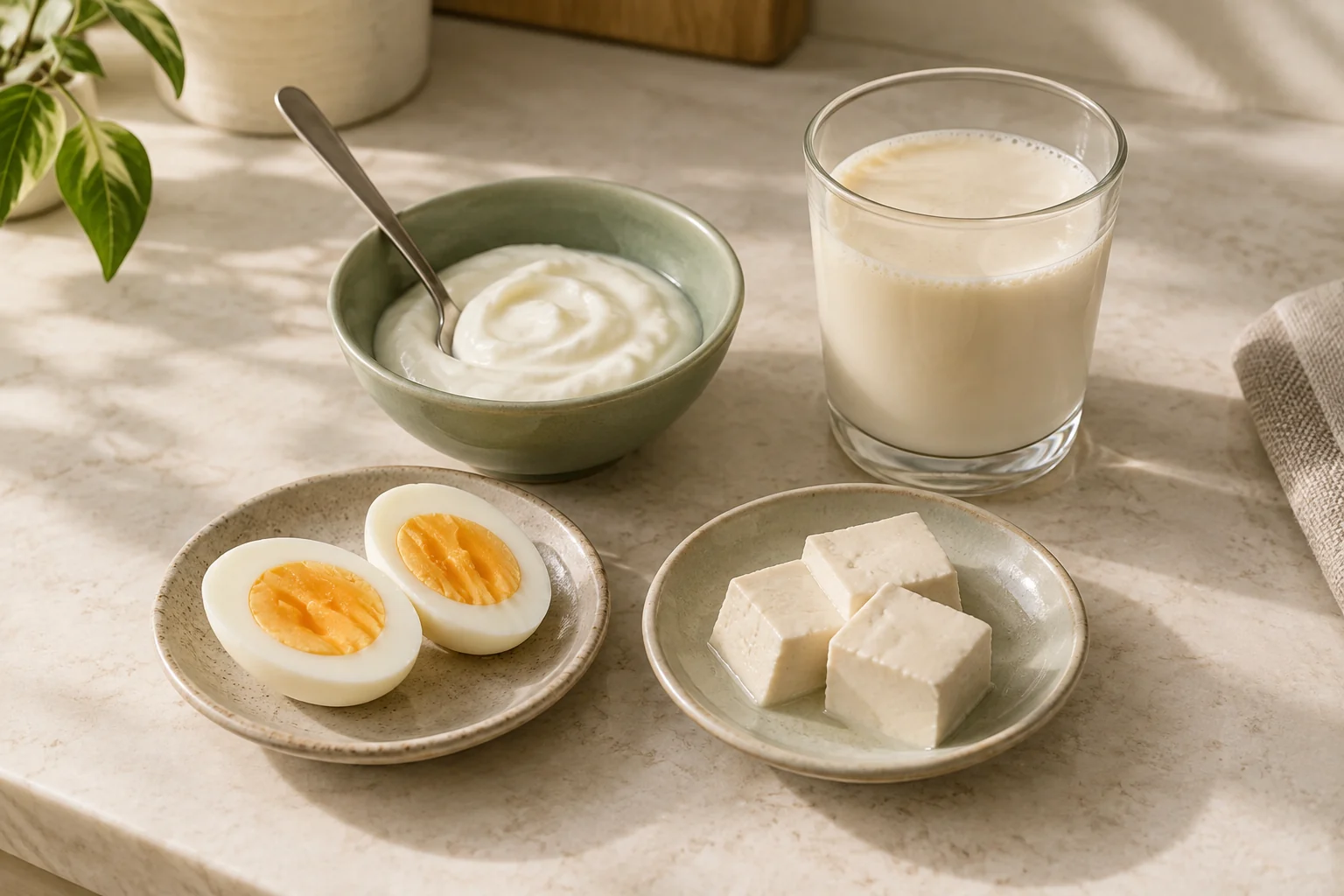
5. Choose the highest protein per mouthful. When total volume is the constraint, density is everything. Chicken breast, fish, eggs, prawns and Greek yoghurt deliver far more protein per bite than mixed dishes built around rice or noodles. Our ranking of hawker dishes by protein per calorie maps this onto local food.
6. Trim the low-value volume. Soup, salad and large portions of rice occupy stomach capacity you no longer have to spare. They are not bad foods; they are expensive in the currency that has become scarce.
7. Add protein to what you are already eating rather than adding another meal. An extra egg, a scoop of powder into oats, an extra portion of tau kwa. Additions survive a poor appetite better than new meals do.
8. Watch the fat that comes attached. Many people find leaner preparations sit better than fatty cuts and fried dishes when appetite is suppressed. If that is true for you, it also raises the protein per mouthful.
Tactics that work on format
9. Use liquids when solids are impossible. A protein drink delivers 20–30 g in a format most people tolerate when food does not appeal. This is the single most reliable rescue on a bad day. Supplementation adds a modest but real amount of fat-free mass on top of training, with no further gain in fat-free mass once total intake passes roughly 1.6 g per kg of body mass per day (Morton 2018) — so a shake is a bridge to the target, not a reason to exceed it.
10. Try cold and plain over hot and rich. Cold foods release less aroma than hot ones, and many people find them easier when food is unappealing. Greek yoghurt, cold chicken, cold tofu and chilled drinks are worth trying when a hot dish is not manageable.
11. Make it smaller and more frequent. Four or five small protein-containing occasions can total more than three attempted full meals, particularly in the first days after a dose.
12. Track for a fortnight, then stop. Two weeks of honest recording tells you where you actually are rather than where you assume you are, after which the pattern is usually learned and the tracking can go. Perfection is not the goal; knowing your baseline is.
What to do if you still cannot get close
Tell your doctor rather than quietly falling short. Persistent inability to eat is clinical information, not a personal failing, and it is the kind of thing that belongs in a consultation.
It is also worth being clear about what protein is for here. Protein supports the muscle that resistance training stimulates, and the training is what supplies the stimulus — across 114 trials and 4,184 people with overweight and obesity, lean mass was statistically unchanged when resistance training accompanied caloric restriction (Lopez 2022), and protein supplementation adds a further modest gain on top of training (Morton 2018). Hitting a protein target without training does less than the pair together. The minimum effective training routine covers the other half.
At GetLean, our philosophy is that the medication is the catalyst and what you keep is the result. Protein on a suppressed appetite is the least glamorous part of that and one of the most decisive.
Individual results vary. Anyone with a medical condition affecting diet, or who is struggling to eat at all, should raise it with their doctor rather than working around it.
Common questions
Why is it so hard to eat protein on GLP-1 medication?
Because the medication reduces how much food you want, and protein-rich foods are the most filling per calorie. In one trial, semaglutide 2.4 mg cut intake at a test lunch by 35% versus placebo (Friedrichsen 2021). The foods that protect muscle are the ones that fill you up fastest.
How much protein should you aim for?
Most guidance during active weight loss sits at 1.2–1.6 g per kg of body weight per day (Leidy 2015) — roughly 85–145 g daily for a 70–90 kg person. Where in that range suits you is worth discussing with a doctor or dietitian.
Is it better to spread protein across meals?
The evidence favours spreading it. In a controlled-feeding study, roughly 30 g at each of three meals produced 25% more 24-hour muscle protein synthesis than the same total concentrated into dinner (Mamerow 2014). That study had eight participants, so read it as a sensible default rather than a strict rule.
Are protein shakes necessary?
Useful, not necessary. Supplementation adds a modest amount of fat-free mass on top of resistance training, with no further gain in fat-free mass above about 1.6 g per kg of body mass per day (Morton 2018). On days when solid food is difficult, a shake is the most reliable way to reach the target.
Does eating more protein make the appetite problem worse?
It can, because protein is the most satiating macronutrient. Raising protein from 15% to 30% of calories reduced spontaneous intake by about 440 kcal a day in one study (Weigle 2005). On an already-suppressed appetite that works against you, which is exactly why eating protein first and spreading it across the day matters more than it otherwise would.