The 2023 international PCOS guideline does mention GLP-1 medication, and what it says is narrower than most summaries of it. The recommendation covers "the management of higher weight in adults with PCOS as per general population guidelines" — weight, in a woman who has PCOS, managed the way weight is managed in anyone else (2023 PCOS guideline 4.5). It carries the guideline's weakest grade, a consensus recommendation, which the same document defines as one made "in the absence of adequate evidence". No GLP-1 medication is registered for PCOS in any jurisdiction. This article sets out what the trials actually tested, what the most recent meta-analysis could and could not conclude, and the measurement this clinic most wants and nobody has taken.
Polycystic ovary syndrome (PCOS): a condition diagnosed from irregular menstrual cycles, clinical or biochemical signs of raised androgens, and polycystic ovarian morphology on ultrasound. Body weight is not one of the diagnostic criteria.
What the international guideline actually says
Recommendation 4.5.1 reads, in full: "Anti-obesity medications, including liraglutide, semaglutide, and both glucagon-like peptide-1 (GLP-1) receptor agonists and orlistat, could be considered, in addition to active lifestyle intervention, for the management of higher weight in adults with PCOS as per general population guidelines" (2023 PCOS guideline 4.5). Three details in that sentence do the work.
"Could be considered" is the guideline's softest verb, and the recommendation is tagged CR — a consensus recommendation, defined in the guideline's own legend as one made "in the absence of adequate evidence". "As per general population guidelines" means the medicine is being used on weight in the ordinary way, in a person who happens to have PCOS. And the named medicines are liraglutide, semaglutide and orlistat. Tirzepatide appears nowhere in that section.
The guideline is candid about the state of the field generally. Its own abstract says the evidence in PCOS "has generally improved in the past five years, but remains of low to moderate quality" (Teede 2023). PCOS affects an estimated 10–13% of women globally on Rotterdam criteria, and insulin resistance is a recognised underlying feature — though the same guideline says clinical insulin assays are of limited relevance and are not recommended in routine care.
Alongside the medication recommendation, the guideline recommends lifestyle intervention for all women with PCOS, and it is careful about the goal: weight maintenance and prevention of gain count, not only loss, and it states there are benefits to a healthy lifestyle even in the absence of weight loss (2023 PCOS guideline 3.1.1). It deliberately sets no weight-loss target.
Whose medicine was actually tested?
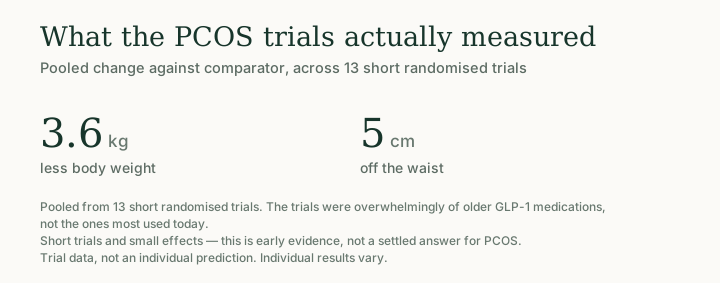
Mostly a medicine almost nobody in Singapore is taking today. The largest pooled analysis of randomised trials in PCOS covers 13 studies, and the drug split is the fact that matters: 308 participants received exenatide, 87 received liraglutide, 23 received semaglutide, and none received tirzepatide (Lin 2025). Trial durations ran from 12 to 32 weeks. Pooled, weight fell by about 3.6 kg and waist circumference by about 5 cm versus comparator.
Exenatide is a short-acting, twice-daily molecule structurally unlike the weekly medicines in current use, so a woman reading "GLP-1 medication works in PCOS" is reading a claim built mainly on a different drug taken on a different schedule. The largest dedicated randomised trial of a weight-management-dose GLP-1 in this population used liraglutide 3 mg: 5.7% weight loss against 1.4% on placebo over 32 weeks, with gastrointestinal side effects in 58% of those on the drug against 18.5% on placebo (Elkind-Hirsch 2022).
One 60-woman randomised trial in China has since tested tirzepatide with metformin against metformin alone over 16 weeks, with barrier contraception required throughout the active-drug phase (Yang 2026). One small short trial is not an evidence base, and tirzepatide has no Singapore weight-management indication.
What the most recent meta-analysis could not conclude
This belongs in the body of the article rather than a footnote, because it is the honest ceiling on everything above. The 2026 systematic review of randomised trials found a BMI reduction of about 1.38 kg/m² versus control — and graded that finding low certainty. For LDL cholesterol and triglycerides it found no difference. For glucose, insulin, hirsutism and menstrual regularity, it found the evidence insufficient to draw a conclusion, and it found no study at all on quality of life, mental health or cost-effectiveness (Forslund 2026).
The two meta-analyses disagree on one point and both should be reported. Lin 2025 found a significant improvement in HOMA-IR, a marker of insulin resistance; Forslund 2026 rated the insulin evidence insufficient (Lin 2025; Forslund 2026). Lin also reported that testosterone and sex-hormone-binding globulin were among the parameters that did not change.
So the claim that survives is narrow: in women with PCOS and excess weight, these medicines produced modest short-term weight loss. Anything beyond that — cycles, hair growth, androgens, metabolic markers — is currently an open question rather than a finding.
The measurement nobody has taken
For this clinic, this is the headline. No study has reported what a GLP-1 medication does to fat versus lean tissue in women with PCOS. Two of the randomised trials measured body composition by DXA and neither published the fat-mass and lean-mass split (Elkind-Hirsch 2022; Frøssing 2018). What was measured in the Frøssing trial was ectopic fat: 5.2 kg of weight loss, visceral adipose tissue down 18%, liver fat down 44% over 26 weeks. Useful, and not the same question.
That absence matters more here than it might elsewhere. A 1.38 kg/m² change in BMI is a change in a ratio of weight to height; it says nothing about what the body is made of. What is known from the general weight-loss literature applies unchanged: across 114 trials and 4,184 people, lean mass was statistically unchanged when resistance training accompanied caloric restriction (Lopez 2022). The muscle-protection case for a woman with PCOS rests on that general evidence, because a PCOS-specific version of it has never been generated.
Insulin resistance in PCOS is not simply a weight problem
Measured by the gold-standard clamp method and pooled across 28 studies, women with PCOS had about 27% lower insulin sensitivity than controls — and that reduction was independent of BMI. Higher BMI reduced insulin sensitivity by a further 15% on top of it (Cassar 2016).
Read that carefully, because it cuts both ways. It means weight is a real and separate contributor, so weight management is not beside the point. It also means a substantial part of the insulin resistance in PCOS is present regardless of body size, and losing weight does not remove it. So insulin resistance in PCOS is not a weight problem waiting to be solved — a substantial part of it sits outside body size, and the clamp studies are where that shows up.
The 2023 guideline also recommends metformin for adults with PCOS and BMI ≥25, graded on very low quality evidence, and instructs clinicians to tell women that metformin and active lifestyle intervention have similar efficacy (2023 PCOS guideline 4.3). It makes no head-to-head recommendation ranking metformin against GLP-1 medication.
Contraception is part of the same recommendation
The guideline attaches this to recommendation 4.5.1 rather than leaving it as general advice, and it is worth quoting exactly: "Healthcare professionals should ensure concurrent effective contraception when pregnancy is possible for women who take GLP-1 receptor agonists, as pregnancy safety data are lacking" (2023 PCOS guideline 4.5).
Two things sit behind it. Pregnancy safety data for these medicines are genuinely limited. And weight loss can restore ovulation in women who were not ovulating (BAMBINI post hoc 2026) — which is exactly the group most likely to have assumed pregnancy was unlikely. Fertility can return before anyone is expecting it, which is why the instruction is written as a requirement and not a suggestion. The article on GLP-1 medication, pregnancy and fertility covers the washout periods and what the pregnancy-outcome literature does and does not agree on.
The same guideline block adds two more practice points: gradual dose escalation to reduce gastrointestinal side effects, and shared decision-making that considers side effects, the high risk of weight rebound after stopping, and the absence of long-term safety data.
Where a weight-management service fits
We are a weight-management service. We do not diagnose PCOS, we do not manage it, and we do not treat it — that sits with the doctor who already looks after it, usually a GP, an endocrinologist or a gynaecologist. Fertility treatment and IVF sit entirely outside what we do. A woman with PCOS may be assessed for weight management the same way anyone else is, and her PCOS care continues where it is.
Two facts are worth keeping in view for a Singapore reader. The WHO expert consultation on Asian populations proposed additional public-health action points at BMI 23.0 and above, on the basis that risk rises below the standard international overweight threshold (WHO 2004) — the reasoning is covered in why Asian BMI thresholds are lower. And in a Singapore study of 389 women using that 23 kg/m² cut-off, higher body weight among women with PCOS was associated with more marked hair growth, with the highest scores in women with PCOS and high BMI (Neubronner 2021). That study is a cross-sectional sample, so it shows association rather than cause, and its proportion of participants with PCOS is a feature of how the sample was assembled — it is not a prevalence estimate for Singapore. No population prevalence figure for PCOS in Singapore was found in the sources this article rests on.
Common questions
Does GLP-1 medication treat PCOS?
No, and no GLP-1 medication is registered for PCOS in any jurisdiction. The 2023 international guideline's recommendation is for "the management of higher weight in adults with PCOS as per general population guidelines" — weight, in a woman who has PCOS, managed the way it is managed in anyone else (2023 PCOS guideline 4.5).
Which GLP-1 medications have actually been tested in women with PCOS?
Mostly exenatide and liraglutide. In the 13-trial meta-analysis, 308 participants received exenatide and 87 liraglutide, against 23 on semaglutide and none on tirzepatide, with no trial running longer than 32 weeks (Lin 2025). A reader on semaglutide should know the evidence is largely not about her medication.
Does GLP-1 medication improve periods, hirsutism or insulin resistance in PCOS?
The most recent systematic review of randomised trials rated the evidence insufficient to draw any conclusion about glucose, insulin, hirsutism or menstrual regularity, and rated the BMI reduction itself low certainty (Forslund 2026). An earlier meta-analysis did find an insulin-resistance improvement (Lin 2025); the two disagree, and the more recent review is the more conservative.
Do I need contraception if I have PCOS and I am taking GLP-1 medication?
The guideline treats it as a requirement, not a suggestion. Its practice point reads: "Healthcare professionals should ensure concurrent effective contraception when pregnancy is possible for women who take GLP-1 receptor agonists, as pregnancy safety data are lacking" (2023 PCOS guideline 4.5). Weight loss can restore ovulation in women who were not ovulating (BAMBINI post hoc 2026), so fertility may return before anyone expects it.
Does GetLean treat PCOS or offer fertility treatment?
No to both. We are a weight-management service. PCOS is diagnosed and managed by the doctor who looks after it — usually a GP, an endocrinologist or a gynaecologist — and fertility treatment sits entirely outside what we do.