The scale tells you one number, but that number hides two very different things: fat and muscle. Losing weight means losing both; getting lean means losing the fat while keeping the muscle, so your body composition actually improves. The difference between the two outcomes is not about how much you lose — it is about what you keep.
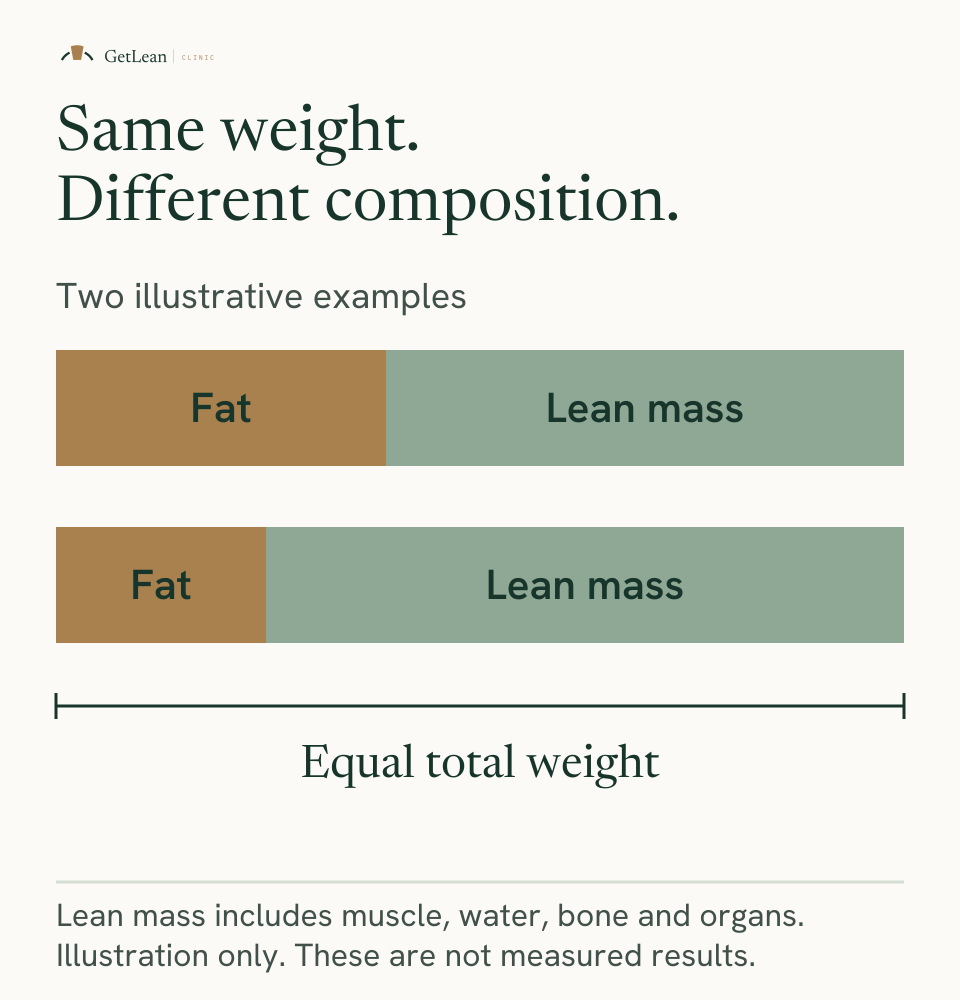
Body recomposition: losing fat while preserving (or building) muscle, so body composition improves even when the scale moves slowly.
Is losing weight the same as losing fat?
No. Body weight is the sum of everything inside you — fat, muscle, bone, water, and organs. When you restrict calories, your body draws on multiple stores, and lean mass is part of what gets used if it is not actively protected.
A DXA body-composition sub-study of tirzepatide from the SURMOUNT-1 trial found that, of the total body weight lost, approximately 75% was fat mass and roughly 25% was lean mass (Look 2025). That is a meaningful proportion of lean tissue lost even in a well-studied, medically supervised context. Individual results vary, and the proportion shifts depending on protein intake, resistance training, and the pace of weight loss.
The scale cannot tell you which of those two numbers moved. Two people can lose the same total weight and end up with entirely different bodies — one lighter but with a similar proportion of fat to muscle, the other genuinely leaner.
Why does the muscle you keep decide the result?
Muscle is metabolically active. It raises your resting metabolic rate, which means you burn more energy at rest when you have more of it. Lose significant lean mass during a period of weight reduction and your metabolism slows, making the result harder to hold once you come off a caloric deficit.
Beyond metabolism, muscle determines function: how you move, how strong you feel, how well you age. A lighter body that has also lost substantial lean mass can feel weaker and more fatigued than before — not what most people are aiming for. This is sometimes described informally as being "skinny-fat": a lower number on the scale, but a higher proportion of fat relative to muscle than you might expect.
Getting lean means shifting that ratio. The scale may move more slowly, but what remains is a better-composed body. That is the distinction this clinic is built around.
How do you lose fat without losing the muscle?
Two levers have good clinical evidence behind them: protein intake and resistance training.
Protein. Higher-protein diets during caloric restriction produce greater preservation of lean mass than lower-protein diets (Leidy 2015). The evidence points to a target of roughly 1.2 to 1.6 grams of protein per kilogram of body weight per day during active fat loss. At that level, the body has the raw material it needs to maintain muscle tissue even while losing fat. For most people, hitting that number consistently is harder than it sounds — especially on a GLP-1 medication, when appetite is suppressed and total food intake drops. Deliberate food choices matter more, not less. The article on protein on a GLP-1 medication in Singapore covers how to do that practically at a hawker centre and in a typical Singapore kitchen.
Resistance training. Exercise provides the signal that muscle tissue is needed. In a meta-analysis combining caloric restriction with resistance training, lean mass was largely maintained — mean change approximately −0.3 kg, a difference that was not statistically significant (Lopez 2022). Without that training stimulus, the body has less reason to preserve muscle when calories are restricted. Cardio burns energy; resistance training sends the preservation signal. Both have a role, but if you can only do one, resistance training has the stronger case for keeping lean mass intact.
These two levers work together. Neither is optional if getting lean — rather than just losing weight — is the goal.
What does "skinny fat" mean and how do you avoid it?
"Skinny fat" is an informal term for a body that appears slim, or registers as a normal or low weight on the scale, but carries a disproportionately high ratio of fat to muscle. It can result from losing weight quickly without protecting lean mass — the scale improves but body composition does not.
You can avoid it by treating the muscle side of the equation as seriously as the caloric deficit side. The number on the scale is not the measure of success. A person who loses 8 kg of fat while holding lean mass is in a meaningfully better position than one who loses 10 kg of mixed fat and muscle. The first person looks different, functions better, and has a more stable metabolic foundation to maintain the result.
This is the distinction the Asian context makes especially relevant. BMI thresholds for health risk are lower in Asian populations than in Western reference ranges, and "normal weight" on a scale can still mask an unfavourable body composition. What you are losing, and what you are keeping, matters more than the single number on a bathroom scale.
Where does GLP-1 medication fit?
GLP-1 medication is the most effective pharmacological tool yet studied for creating the sustained caloric deficit that fat loss requires. The medication is the catalyst — it reduces appetite, quiets food noise, and makes it significantly easier to eat less without the constant effort that willpower-only approaches demand.
What the medication does not do is protect your muscle. That is the patient's job, supported by the clinical team. The medication creates the conditions; protein and resistance training determine the composition of what you lose.
This is why GetLean is a weight-loss programme. The number on the scale falling is not the goal on its own. The goal is a body that is leaner, stronger, and in better condition to stay that way — and that requires attending to both sides of the equation from the start, not as an afterthought.
How a GLP-1 medication creates that deficit is covered in detail at how GLP-1 medications work. For patients over 40, where muscle preservation carries additional clinical urgency, getting lean after 40 covers the relevant considerations.
Common questions
Is losing weight the same as losing fat?
No. Body weight includes fat, muscle, water, bone, and organs. When you lose weight without protecting lean mass, a portion of what you lose will be muscle. A DXA sub-study of tirzepatide found roughly 25% of weight lost was lean mass (Look 2025). Individual results vary.
How much of weight loss is muscle?
In the SURMOUNT-1 DXA sub-study of tirzepatide, approximately a quarter of weight lost was lean mass and three-quarters was fat mass (Look 2025). That proportion can be shifted by higher protein intake and resistance training, but it cannot be eliminated entirely without those measures. Individual results vary.
What is body recomposition?
Body recomposition means losing fat while preserving — or building — muscle, so body composition improves even when the scale moves slowly. It is the goal that distinguishes a lean outcome from a simply lighter one.
Can you get lean without the gym?
Protein intake helps significantly, and is non-negotiable. But resistance training is the strongest single lever for preserving lean mass during caloric restriction. When resistance training is combined with a caloric deficit, lean mass is largely maintained — a finding from a meta-analysis on the topic (Lopez 2022). If gym access is limited, bodyweight resistance training produces a similar stimulus. Protein alone does not fully substitute.
Does GLP-1 medication build muscle?
No. GLP-1 medication drives fat loss by reducing appetite and food intake. It does not directly stimulate muscle growth or preservation. Muscle must be protected through adequate protein and resistance training — the medication creates the conditions for fat loss, and the patient's lifestyle choices determine what happens to lean mass in that deficit.