A body-recomposition plan has four working parts: a deficit that produces the fat loss, enough protein to give the body material, a resistance-training stimulus that tells it which tissue to keep, and a plan for what happens when the medication stops. Ask whether those four parts change for a woman of 52, a man of 34, a mother four months after giving birth, or a recruit at BMI 22, and they barely move. Ask whether the evidence behind them was collected in any of those people, and the picture changes completely. This guide sets out both halves — what is genuinely different for each group, and where the research has simply not been done.
Subgroup analysis: a re-examination of a trial's results within a slice of its participants — women, over-65s, one reproductive stage. It can only look at people the trial already enrolled, it is rarely designed to detect a difference between slices, and when it is done after the fact it raises questions rather than settling them. Most of what is known about who responds to GLP-1 medication is of this kind.
The parts that hold for everyone
Four findings run underneath every article in this cluster, and none of them is specific to an age, a sex or a life stage.
The first is that the muscle question belongs to weight loss rather than to the medicine. In the SURMOUNT-1 body-composition sub-study, roughly 75% of the weight lost was fat and roughly 25% was lean mass — in the tirzepatide arm and in the placebo arm, which was diet alone (Look 2025). The second is that the proportion is not fixed. It moves with the depth of the deficit and with sex: pooled dietary studies found about 14% of weight lost as fat-free mass on standard low-calorie diets and about 23% on very-low-calorie diets, and around 27% in men against 20% in women (Chaston 2007). The widely repeated "a quarter of it is muscle" rule has been examined at length and criticised as an oversimplification that shifts with age, inactivity and exercise (Heymsfield 2014).
The third is the lever. Across 114 trials and 4,184 people with overweight and obesity, lean mass was statistically unchanged when resistance training accompanied caloric restriction (Lopez 2022). That meta-analysis spans the adult lifespan, which is why it appears in almost every article below. The fourth is protein: intakes of 1.2 to 1.6 g per kilogram of body weight per day during energy restriction preserve lean mass better than lower intakes (Leidy 2015). The denominator matters and is routinely swapped — a target quoted per kilogram of fat-free mass is a different and much larger number.
At GetLean, our philosophy is that the medication is the catalyst: it creates the deficit, and the deficit is neutral about which tissue it takes. That holds at 25 and at 65. What changes between those two people is how much lean tissue there is to spare, and how much anyone has bothered to measure.
Who the trials were actually run in
The typical participant in the pivotal weight-management trials was middle-aged, without type 2 diabetes, and carrying a substantial amount of excess weight. That last part is not incidental — it is the entry criterion. A registry query of 354 registered semaglutide and tirzepatide trials found no weight-management efficacy trial with an entry threshold below BMI 23; the lowest anywhere was 23 in an Indian phase 4 study, and the global programme floor is 27 (registry query 2026).
Singapore runs two scales at once, and both are correct. The registered product information sets the semaglutide weight-management indication at BMI 30 or above, or 27 to under 30 with at least one weight-related comorbidity, and tirzepatide's current registrations carry both a type 2 diabetes and a weight-management indication (NDF Singapore). Singapore's own national obesity guideline classifies overweight from 23 and obesity from 27.5, with waist action points above 90 cm in men and 80 cm in women (HPB–MOH 2016). Someone can sit in the national obese category and below the label's threshold at the same time. That gap is real, and resolving it for an individual is a clinical decision at consultation — cost, eligibility and process: GLP-1 treatment in Singapore sets out all four scales and what a consultation has to involve before anyone prescribes.
The local picture matters for a second reason. A four-compartment study of Singaporean Chinese, Malay and Indian adults found a Caucasian-derived BMI equation under-predicted body-fat percentage by 2.7 to 5.6 percentage points, with the equivalent of a Caucasian BMI of 30 sitting nearer 27 for Chinese and Malays and 26 for Indians (Deurenberg-Yap 2000). A number imported from a Western trial describes a different body.
After 40, and then after 60
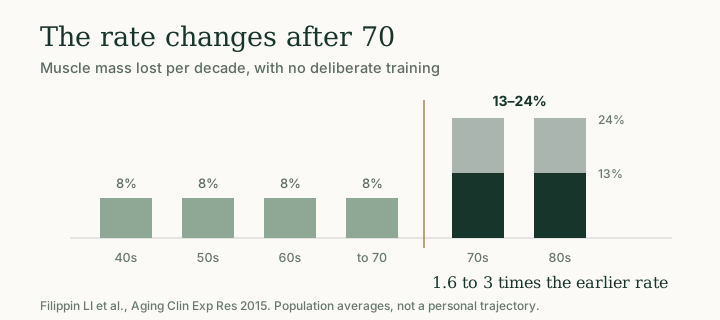
Two processes compound from midlife. Muscle mass declines roughly 8% per decade until about 70 and then faster, at 13 to 24% per decade (Filippin 2015); and muscle becomes less responsive to the protein that arrives, so the same meal does less work. Neither is a reason to avoid losing fat. Both are reasons the structure around the deficit stops being optional. Getting lean after 40 works through what changes metabolically and how to adjust the protein and training side.
The protein claim in this area is the one most often stated backwards. Expert groups recommend 1.0 to 1.2 g per kilogram of body weight per day for healthy older adults, rising with regular exercise (PROT-AGE 2013). Direct measurement by indicator amino acid oxidation puts the average requirement at 0.94 g/kg/day in six men over 65 (Rafii 2015, men) and 0.96 g/kg/day in twelve women over 65 (Rafii 2015, women) — roughly 30% above the official 0.66 and 0.80 g/kg figures. The authors of the men's study say plainly that their values are not different from the ones they had published in young men. So the finding is that the official recommendation is too low for everyone, not that ageing raises the requirement. Both numbers use a body-weight denominator; the higher 2.3 to 3.1 g/kg range belongs to lean, resistance-trained athletes in a deficit and uses fat-free mass (Helms 2014).
Past 65 the medication evidence thins to almost nothing. A systematic review searching for weight reduction reported separately in adults aged 65 and over found eight studies — five of them age-subgroup re-analyses of trials designed for other endpoints — rated its own evidence "limited", and located its strongest signal in older adults who also had cardiovascular disease (Chen 2025). None of those studies measured body composition or muscle. A 2026 review adds that short-to-medium-term trials found handgrip strength statistically preserved despite lean-mass loss, while longitudinal and retrospective work in older adults with type 2 diabetes reported falling grip strength with prolonged semaglutide use (Prokopidis 2026). Those are different populations from a healthy 66-year-old wanting to get lean, and the distinction has to be kept.
What is strongly evidenced after 60 is the training. Across 151 randomised trials in 6,306 adults aged 60 and over, even a low weekly volume of resistance training improved lean body mass, muscle size and physical function (Radaelli 2025), and in obese older adults specifically, adding resistance training to caloric restriction prevented an estimated 93.5% of the lean-mass loss otherwise seen, without blunting fat loss (Sardeli 2018). One trap to avoid while doing it: rising training loads are worth having, and they are not evidence that lean mass is being held. In a randomised trial, about 7% weight loss by dieting alone significantly reduced lean mass while measured muscle strength did not change at all (Weiss 2017). Getting lean after 60 sets out the muscle-first order of operations.
PCOS: a guideline sentence narrower than its reputation
The 2023 international PCOS guideline does mention GLP-1 medication, and almost every summary of it overstates what it says. The recommendation is a consensus recommendation, which the guideline's own legend defines as one made in the absence of adequate evidence. Its scope is the management of higher weight in adults with PCOS as per general population guidelines, it names liraglutide and semaglutide, and it attaches a requirement for effective contraception where pregnancy is possible (PCOS guideline 4.5). The medicine is treating weight in a person who has PCOS. No GLP-1 medication is registered for PCOS in any jurisdiction, and we treat weight, not PCOS.
The trial literature underneath it is also not the literature most readers assume. Across the 13 randomised trials pooled in the largest meta-analysis, 308 participants received exenatide and 87 received liraglutide, against 23 on semaglutide and none on tirzepatide (Lin 2025). The most recent systematic review found a BMI reduction of about 1.4 kg/m² versus control at low certainty, and rated the evidence insufficient to conclude anything about glucose, insulin, hirsutism or menstrual regularity (Forslund 2026). For a clinic that measures composition, the sharpest absence is that no study has reported what a GLP-1 medication does to fat versus lean tissue in women with PCOS. GLP-1 medication and PCOS goes through the guideline wording, the drug split and the contraception practice point in detail.
Menopause: the wrong thing gets blamed
Menopause does not accelerate weight gain. In 1,246 women followed by DXA around the final menstrual period, weight climbed linearly through premenopause without acceleration at the transition — what changed was composition, with fat gain roughly doubling and lean mass reversing from a small annual gain to a small annual loss (Greendale 2019). The scale keeps doing what it was already doing while the body underneath it changes. That is the single most useful correction in this cluster, because it moves attention from the number to the thing that is actually moving.
The metabolic claim needs the same correction. In a five-year cohort that measured it directly by indirect calorimetry, resting energy expenditure stayed stable across the transition; total energy expenditure fell, and the fall was driven by less physical activity and more sedentary time (Duval 2013). That points somewhere a person can act.
On the medication, no dedicated randomised trial in postmenopausal women exists. The best available evidence is a retrospective post hoc categorisation of women already enrolled in three tirzepatide trials, which found weight reduction of 26%, 23% and 23% at the three reproductive stages against 2%, 3% and 3% on placebo (Tchang 2025) — with no subgroup sample size, no interaction p-value, and no body-composition outcome reported. So the drug appears to work about as well after menopause, on the weakest study design that can address the question, and nobody has measured muscle in the group with the least lean tissue to spare. Menopause, hormones and weight covers the hormone-therapy evidence and what has actually been shown to protect muscle in this population.
After a birth: a timing question with no published answer
About a third of new mothers in Singapore are still carrying weight from the pregnancy a year later. In 379 first-time mothers, 35% were at least 5 kg above their pre-pregnancy weight at six months and 31% at twelve (Loy 2024). Singapore's Health Promotion Board tells new mothers that about 1 to 2 kg a month is a healthy rate and that the goal should be set over one to two years (HPB 2026) — consumer guidance that says nothing about medication.
No label, regulator or professional society anywhere sets a rule for how soon after delivery a GLP-1 medication may be started. Breastfeeding has four different answers depending on which document is open, and the two medicines split in opposite directions. On rat milk data, the EU product information for semaglutide states that it should not be used during breast-feeding (EU SmPC); the US National Library of Medicine's lactation database reaches the opposite conclusion, that only injectable forms should be used while breastfeeding, on the strength of eight women in whom the drug was undetectable in milk (LactMed 2026); and for tirzepatide the EU position is that it could be considered for use during breast-feeding (EU SmPC). Singapore's own answer is unavailable — the national formulary publishes sections 4.1 to 4.3 of the registered product information only (NDF Singapore). Postpartum weight and GLP-1 lays out all four positions side by side and how small the underlying human evidence is.
Men: two things commonly said, and both are wrong
Men do carry a higher share of their fat viscerally, and visceral fat is the depot that stays associated with cardiometabolic risk after adjustment. Two claims usually bolted onto that do not survive checking.
The first is that men respond better to the medication. They do not. In a 1,039-patient real-world cohort, women lost 15.1% of body weight against 10.7% in men at 15 months, and female sex was an independent predictor of greater loss in multivariable analysis (Castaneda 2026). The second is that the medicine targets belly fat. Pooling 89 studies across diet, exercise, weight-loss medication and surgery, the percentage reduction in visceral fat consistently exceeded the percentage reduction in subcutaneous fat while the absolute reduction was larger in subcutaneous fat — and the authors state flatly that no intervention preferentially targets visceral fat (Merlotti 2017). Across 61 studies, the preferential visceral loss was real at modest weight loss and weakened as total loss grew (Chaston 2008) — which is to say it is weakest at the losses these medicines produce. The proportional change is real; the targeting mechanism is not. Men, visceral fat and the uncle belly works through both corrections and the Singapore waist numbers.
Already lean: the group nobody enrolled
For a reader at BMI 22 chasing a stubborn few kilograms, the evidence position is unusually clean and unusually empty. No registered weight-management efficacy trial of either medicine has enrolled anyone below BMI 23 (registry query 2026). That is an absence, not a verdict: the medicine has not been shown to fail in lean people, and it has not been shown to be safe or effective in them either. The labels' silence on the point is not permission.
What is known runs the other way. Forbes described an inverse curvilinear relationship in humans — the leaner someone is when they start, the greater the proportion of any weight they lose that comes from lean tissue (Forbes 2000) — and a deeper deficit pushes that proportion higher again. The independent corroboration sits in the protein literature, where needs for lean, resistance-trained people in a deficit are likely 2.3 to 3.1 g per kilogram of fat-free mass, scaled upwards with severity of caloric restriction and with leanness (Helms 2014). The nearest thing to a professional-society caution is a 2025 joint advisory from four US societies recommending eating-disorder screening before starting and naming restrictive eating disorder a general contraindication (Mozaffarian 2025) — professional guidance, not a regulatory contraindication. GLP-1 and the last 5 kg sets out the thresholds and what the final few kilograms actually respond to.
A high BMI with clean bloods
Metabolically healthy obesity is better understood as a phase than as a type. In 6,809 US adults followed a median 12 years, almost half of those classified as metabolically healthy with obesity developed metabolic syndrome, and it was that transition — not the baseline label — that carried 60% higher odds of cardiovascular disease (Mongraw-Chaffin 2018). In 458,246 Chinese adults followed a median ten years, about 40% transitioned, and the transition carried a 53% higher risk of a major vascular event (Gao 2020). The two cohorts disagree on whether the baseline state itself carries risk, and both are worth reporting.
Any single risk number attached to the label depends on the comparison group and the length of follow-up. In the only Asian-population meta-analysis, metabolically healthy obesity carried 61% higher odds of cardiovascular disease against metabolically healthy normal weight and no significant difference at all against metabolically healthy non-obese — the authors' own conclusion being that control groups must be chosen carefully (Huang 2020). The finding people miss is the mirror image: in a pooled analysis of eight prospective studies, measured against metabolically healthy normal weight, metabolically unhealthy normal weight was the highest-risk group of all at a relative risk of 3.14 — above metabolically unhealthy obesity at 2.65 (Kramer 2013). High BMI but healthy goes through each comparison and what Singapore actually measures.
A date in the calendar
Nobody has run a trial of losing weight to a deadline. Every randomised trial in this space allocated a rate of loss; none allocated a date, so anything said about what a deadline does is inference. The one prospective measurement of a real one followed 343 brides: about half wanted to lose weight, average weight did not change before the wedding, participants had gained about 2 kg six months afterwards, and the women who had been told to lose weight gained significantly more (Prichard 2014).
What has been measured is the depth of the cut. Fat-free mass made up about 14% of weight lost on standard low-calorie diets and about 23% on very-low-calorie ones (Chaston 2007). A date does not change physiology, but it changes how deep a person is willing to cut — which is the mechanism worth naming. The practical move is to let the date set the depth of the deficit rather than the other way round. Deadline weight loss before a big day works backwards from a date and covers the pressure around it.
Younger men, NS and the IPPT
The SAF publishes exactly one weight-related figure, and it is narrower than the internet version. CMPB states that a pre-enlistee whose BMI exceeds 27.0 does a 19-week basic training course (CMPB). It is a training-length trigger at enlistment — not a pass mark, not a fitness standard, and not applicable to Operationally Ready NSmen, for whom no published weight or BMI standard was found in any MINDEF or CMPB document.
Most readers in this group also sit well below every treatment threshold, which puts them back in the same position as the last-5 kg reader: the question has never been put to a trial. The evidence that does apply to them is about training. Pooling 43 studies, adding aerobic training to a strength programme did not reduce muscle growth or maximal strength; the only significant penalty was to explosive strength, and it was worse when both were done in the same session (Schumann 2022). Running does not undo lifting. The relevant local number is the other side of it: Singapore's most recent national survey shows 84.7% of residents aged 18–74 meeting the physical activity guideline in 2024, while only 35.7% did sufficient muscle-strengthening activity (NPHS 2024). The aerobic half is being done. The strength half is being skipped, and it is the half that protects composition. NS, IPPT and weight covers the test, the thresholds and where medication does and does not fit.
What to do when the evidence runs out
Across nine questions, the pattern repeats. The principles are supported by large pooled evidence that spans ages, sexes and starting points. The group-specific questions are answered by post hoc slices, small retrospective cohorts, and documents that disagree with each other across borders. In four of these situations — postmenopausal women, adults over 65, women with PCOS, and people who are not overweight — the body-composition measurement that would settle the question has never been taken.
That has a practical consequence rather than a rhetorical one. Where the group-specific evidence is thin, the sensible response is to lean harder on the parts that are well evidenced everywhere: protein at a stated denominator, a resistance-training stimulus two or three times a week, a deficit no deeper than it needs to be, and measurements that are not the scale — the first two are set out in full in protecting muscle on GLP-1. It also means the medication question is settled one person at a time, by a doctor looking at the individual picture, rather than by a threshold read off a page.
Clinical-trial figures describe the populations that were studied; individual results vary and are not guaranteed. If you are considering treatment, check your eligibility and speak to a doctor about whether it is suitable for you.
Common questions
Does GLP-1 medication work differently depending on your age or sex?
Not in the direction most people assume. In a 1,039-patient real-world cohort, women lost more total body weight than men — 15.1% against 10.7% at 15 months — and female sex was an independent predictor of greater loss, while age was not an independent predictor at all (Castaneda 2026). What age and sex change is how much lean tissue a person has to spare and what a body is starting from, rather than how well the medicine works.
Is there a trial of GLP-1 medication in postmenopausal women?
No dedicated randomised trial exists. The closest evidence is a retrospective post hoc categorisation of women already enrolled in three tirzepatide trials by reproductive stage, which reported weight reduction of 26%, 23% and 23% in pre-, peri- and postmenopausal women against 2%, 3% and 3% on placebo (Tchang 2025). It gives no subgroup sample size and no interaction p-value, and it measured no body composition. Nobody has measured what happens to muscle in postmenopausal women on a GLP-1 medication.
Can you use GLP-1 medication if you are already at a healthy weight?
The medicine has never been studied in people who are not overweight. A query of 354 registered semaglutide and tirzepatide trials found no weight-management efficacy trial with an entry threshold below BMI 23, and the global programme floor is 27 (registry query 2026). Nothing has been shown either way — not that it fails, not that it is unsafe. Separately, a 2025 joint advisory from four US professional societies names restrictive eating disorder a general contraindication to GLP-1 use (Mozaffarian 2025).
Do older adults need more protein than younger adults?
The measurements do not show that. Indicator amino acid oxidation put the average requirement at 0.94 g per kg of body weight per day in six men over 65 (Rafii 2015, men) and 0.96 g/kg/day in twelve women over 65 (Rafii 2015, women) — roughly 30% above the official recommendation. The authors of the men's study state their values are not different from the ones they had published in young men. The finding is that the official figure is too low for everyone.
Is it safe to use GLP-1 medication while breastfeeding?
Singapore has no published answer: the national formulary carries sections 4.1 to 4.3 of the registered product information only, so section 4.6 on lactation is not available to quote (NDF Singapore). Elsewhere the documents disagree, and the two medicines split in opposite directions. On rat milk data, the EU product information for semaglutide says it should not be used during breast-feeding (EU SmPC), while the US National Library of Medicine's lactation database concludes that only injectable forms should be used while breastfeeding, on eight women in whom the drug was undetectable in milk (LactMed 2026). For tirzepatide the EU position is that it could be considered for use during breast-feeding (EU SmPC). This is a decision for a doctor who knows the individual case.
Does a deadline like a wedding change what weight loss does to your body?
Nobody has tested it. There is no interventional study of deadline-driven weight loss, and every trial in this area randomised the rate of loss rather than the presence of a date. The one prospective measurement of a real deadline followed 343 brides: average weight did not change before the wedding, and participants had gained about 2 kg six months afterwards (Prichard 2014). What has been measured is the depth of the deficit — about 14% of weight lost was fat-free mass on standard low-calorie diets and about 23% on very-low-calorie ones (Chaston 2007).