Gallstones are a recognised consequence of losing weight quickly, whatever is driving the weight loss. The US prescribing information for semaglutide states that treatment is associated with an increased occurrence of gallstones and gallbladder inflammation, and the tirzepatide label attributes acute gallbladder events to the weight reduction itself rather than to a drug-specific effect. This article covers what the labels report, the older evidence showing that dieting alone does the same thing, what raises the risk, and the symptoms that mean you should call a doctor.
Cholelithiasis and cholecystitis: gallstones, and inflammation of the gallbladder. Stones form when bile becomes concentrated enough for cholesterol to crystallise; inflammation follows when a stone obstructs the outflow.
What the product information reports
Both medicines' US labels report gallbladder events, and the two sets of figures are not the same.
For semaglutide, the label states that treatment is associated with an increased occurrence of cholelithiasis and cholecystitis. In the adult injection cohort it reports gallstones in 1.6% of treated patients against 0.7% on placebo, and gallbladder inflammation in 0.6% against 0.2% (prescribing information). One point of care with that source: the same label document now also covers an oral tablet, whose figures differ — 2.5% against 1% for gallstones — so a percentage taken from it only means something once you know which formulation it came from.
For tirzepatide, the pooled weight-reduction trials report gallstones in 1.1% of treated patients against 1% on placebo, which is close to parity, with gallbladder inflammation at 0.7% against 0.2% and gallbladder removal at 0.2% against none. The same label states that treatment is associated with an increased occurrence of acute gallbladder disease, and attributes those events to weight reduction rather than to a drug-specific mechanism (prescribing information).
Pooled randomised evidence points the same way. Across 113 randomised trials in adults with type 2 diabetes, GLP-1 receptor agonists carried a significant but modest increase in gallstone risk, odds ratio 1.30 (95% CI 1.01–1.68) (Monami 2017).
Those are US-label and pooled-trial figures. Singapore's registered product information is a separate document, and its warnings section is not published publicly.
Rapid weight loss causes gallstones on its own
This is the older and stronger part of the evidence, and it usually gets left out.
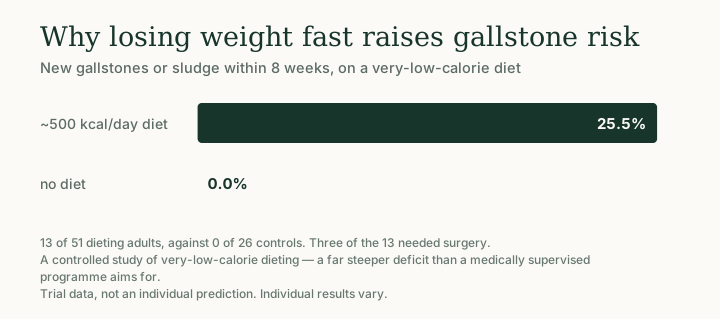
In 1989, 51 adults on an approximately 500 kcal per day diet were scanned by ultrasound alongside 26 non-dieting controls. After eight weeks, 13 of the 51 dieters had new gallstones or gallbladder sludge. None of the 26 controls did, and 3 of the 13 went on to need their gallbladder removed (Liddle 1989). No medication was involved.
That was a small study at an extreme deficit, and its one-in-four rate does not transfer to GLP-1-driven weight loss — an intake of around 500 kcal a day is far more severe than what these medicines typically produce. The pattern, though, shows up at ordinary commercial-programme intensities too. A Swedish matched cohort followed 6,640 adults through either a very-low-calorie diet or a more moderate low-calorie one. Over a year, gallstones requiring hospital care occurred at 152 per 10,000 person-years on the aggressive programme against 44 on the moderate one — a hazard ratio of 3.4 (95% CI 1.8–6.3). Gallbladder removals ran at 96 against 30 per 10,000 person-years (Johansson 2013).
Read the weight figures alongside that, because they are the interesting part. The two groups differed by about 3 kg over the year: 11.1 kg against 8.1 kg. Three kilograms of difference in outcome, three-fold difference in gallstone risk. Adjusting for three-month weight loss reduced the hazard ratios but did not remove them, which points at the severity of the restriction itself rather than at the kilograms alone.
What raises the risk
The clearest signal in this evidence is the depth and pace of the deficit rather than any individual characteristic.
Someone eating very little and losing weight fast is in the situation both of those studies describe. Someone losing weight steadily, eating enough, is further from it. That is the one lever here with comparative evidence behind it, and it is the same lever that protects muscle — covered in how fast should you lose weight.
At GetLean, our philosophy is that the medication is the catalyst and what you keep is the result. A working gallbladder is part of what you keep.
Two points from the label data are worth holding separately. The gallstone figures for the two medicines are not interchangeable — 1.6% against 0.7% for semaglutide's adult injection cohort, 1.1% against 1% for tirzepatide — so quoting one drug's number for the other misstates both. And the tirzepatide label's own reading, that these events follow weight reduction, sits comfortably with everything in the dieting literature above.
Beyond pace, this evidence does not support a list of individual risk factors specific to GLP-1 treatment, so this article does not give one. Any previous gallstone trouble, or a family history of it, belongs in the conversation with your doctor before you start.
The symptoms to act on
The US Medication Guides give patients four things to report: pain in the upper abdomen, yellowing of the skin or eyes, fever, and clay-coloured stools (Medication Guides). Contact a healthcare provider if any of them appear.
Two of those deserve expanding. Upper abdominal pain is easy to file under ordinary side effects, because nausea and abdominal discomfort are common in the early weeks. What distinguishes a gallbladder pattern is where it sits and how it behaves — upper abdomen, frequently after a meal, and painful rather than queasy. Jaundice and pale stools are not ambiguous at all: they mean bile is not draining, and they are a same-day matter.
Severe abdominal pain that will not go away, with or without vomiting and sometimes felt through to the back, is a separate and more urgent instruction in the same document — stop the medicine and call a healthcare provider right away (Medication Guides). That instruction relates to the pancreas, and the full list is in red flags on GLP-1.
Where this leaves you
Gallstones on GLP-1 medication are uncommon, quantified, and mostly a property of losing weight rather than of the drug. The comparative evidence says the risk tracks how hard the deficit is, which is something a treatment plan can influence. The symptoms are specific enough to recognise, which is why they are worth reading once before you need them.
Individual circumstances vary, and this article is not a substitute for the product information supplied with your medicine or for your doctor's instructions.
Common questions
Does GLP-1 medication cause gallstones?
The US prescribing information for semaglutide states that treatment is associated with an increased occurrence of gallstones and gallbladder inflammation (prescribing information). The tirzepatide label attributes acute gallbladder events to weight reduction itself rather than to a drug-specific effect (prescribing information).
How common are gallbladder problems on GLP-1 medication?
In the adult injection cohort of the semaglutide label, gallstones were reported in 1.6% of treated patients against 0.7% on placebo (prescribing information). For tirzepatide the figure was 1.1% against 1% on placebo (prescribing information). These are US-label figures.
Is it the medication or the weight loss?
Weight loss alone does this. In a 1989 controlled study, a quarter of adults on an approximately 500 kcal per day diet developed new gallstones or sludge within eight weeks, against none of the non-dieting controls (Liddle 1989). No medication was involved.
What are the warning signs of a gallbladder problem?
Pain in the upper abdomen, yellowing of the skin or eyes, fever, or clay-coloured stools. The US Medication Guides tell patients to contact a healthcare provider if these appear (Medication Guides).
Does losing weight more slowly lower the risk?
The comparative evidence points that way. A matched cohort of 6,640 adults found roughly three-fold higher rates of hospital-treated gallstones on a very-low-calorie diet than on a more moderate one, despite only about 3 kg difference in weight lost (Johansson 2013).