Two questions get bundled together here, and only one of them has a clear answer. How severe the deficit is clearly changes what you lose — that is well established. Whether the speed of loss matters independently of its severity is genuinely contested: two randomised trials say yes, one says no. This article separates them, because the practical advice differs depending on which you are asking about.
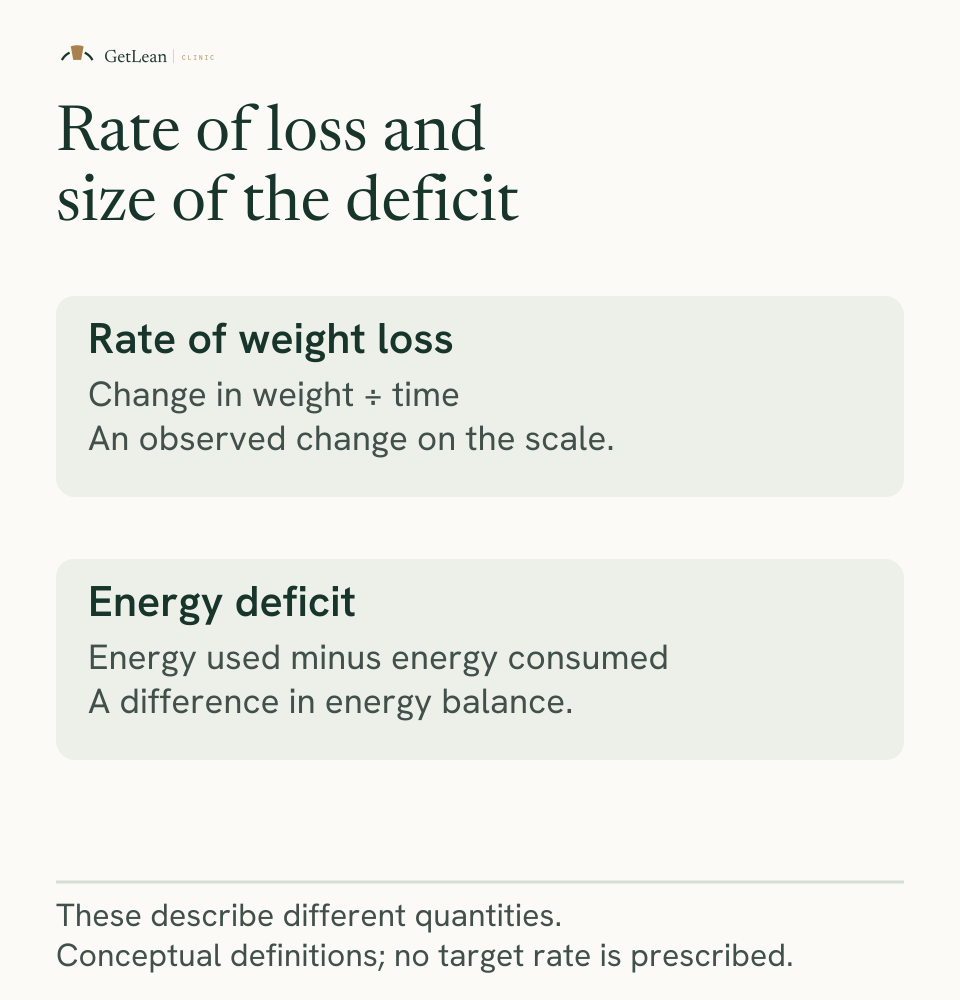
Rate of loss: how quickly weight comes off. Distinct from the severity of the calorie deficit, though in practice they usually move together.
What is clearly established
The more severe the restriction, the greater the share of weight lost as lean tissue.
A systematic review of dieting studies found median fat-free-mass loss of 14.0% of weight lost on standard low-calorie diets and 23.4% on very-low-calorie diets. Very-low-calorie diets plus exercise came out at 22.5%. By sex, men lost 27% and women 20%. And the degree of caloric restriction correlated with the percentage of fat-free mass lost, at r²=0.31, p=0.006 (Chaston 2007).
That correlation is the finding to hold on to. It is not about days on the calendar; it is about how deep the deficit goes.
What is contested
Whether speed matters on its own, once severity is accounted for. Here the trials disagree, so both sides are set out below.
For: In a randomised trial of 57 adults with a BMI of 28–35, percentage fat-free-mass loss was 8.8% on a very-low-calorie protocol against 1.3% on a slower low-calorie one (Vink 2016). A second trial matched total weight loss at about 5–6% and compared roughly five weeks against fifteen: the rapid group lost 1.51 ± 0.80 kg of lean mass against 0.52 ± 0.75 kg in the slow group, whose loss was not statistically significant; the between-group difference was 0.98 ± 0.25 kg, p<0.001 (Ashtary-Larky 2017).
Against: A randomised trial comparing a four-week rapid protocol with an eight-week gradual one, at matched weight loss of about 9%, concluded that "changes in body weight (≈9%) and composition were similar in both groups", and that weight-loss rate did not appear to significantly affect body composition once energy balance was re-established (Coutinho 2018).
Three small randomised trials, two in one direction and one in the other. What the evidence supports is that some studies indicate rate matters independently, and that it is not established. Anyone telling you there is a proven safe rate of weight loss per week is going beyond what exists.
Why this matters less than it sounds on medication
Because rate is largely not something you set.
On GLP-1 medication the rate of loss follows from the dose, the individual response and the appetite effect. It is a clinical variable managed by the prescribing doctor, not a dial the patient turns. Deciding to "lose more slowly" is not really available in the way it is on a self-directed diet.
There is also a finding that should defuse a common worry. In the SURMOUNT-1 body-composition sub-study, approximately 75% of the weight lost was fat mass and 25% lean mass — in the placebo arm as well as the treatment arm (Look 2025). The medication did not shift the ratio. Whatever is happening to lean mass is a property of losing weight, not of the drug.
So the rate question, on medication, mostly resolves into: this is a matter for your doctor, and the thing you can actually influence is something else.
The lever that is actually yours
What accompanies the loss.
Across 114 trials covering 4,184 people with overweight and obesity, lean mass was statistically unchanged where resistance training accompanied caloric restriction (Lopez 2022). That is a considerably larger and more consistent body of evidence than anything in the rate literature, and it points at an input you control completely.
Protein is the other half — the raw material that training directs. Neither alone does what both do.
Put the two bodies of evidence side by side and the practical conclusion is straightforward. The rate question is contested, partly out of your hands, and produces small effects. The training question is well evidenced, entirely in your hands, and produces a large one. Spend your attention accordingly.
At GetLean, our philosophy is that the medication is the catalyst and what you keep is the result. Rate is the catalyst's business. What you keep is decided by what you do alongside it.
Individual results vary, and clinical-trial figures describe the populations studied. Never adjust a prescribed dose to change your rate of loss — that is a conversation with the doctor who prescribed it.
Two consequences of a fast rate are worth reading alongside this. One shows in the mirror before it shows on a scan — what facial volume loss really is — and one shows in the composition of what came off, compared across molecules in what the head-to-head shows.
Common questions
Does losing weight faster cost you more muscle?
The evidence is mixed. Two randomised trials found faster protocols cost more lean mass — 8.8% versus 1.3% fat-free-mass loss in one (Vink 2016), and 1.51 kg versus 0.52 kg at matched weight loss in another (Ashtary-Larky 2017). A third found no significant difference (Coutinho 2018).
What is clearly established about the deficit?
That its severity matters. Median fat-free-mass loss was 14.0% of weight lost on low-calorie diets and 23.4% on very-low-calorie diets, and the degree of restriction correlated with fat-free-mass loss (Chaston 2007).
Is there a safe rate of weight loss?
No trial-derived figure applies universally, and on medication the rate follows from dose and individual response. It is a clinical question for your doctor rather than a target to set for yourself.
Does this mean I should slow down?
Not necessarily, and on medication it is largely not yours to choose. The clearly modifiable lever is what accompanies the loss — lean mass was statistically unchanged where resistance training accompanied a deficit across 114 trials (Lopez 2022).
Do trials show medication causes faster muscle loss?
No. In the SURMOUNT-1 sub-study the lean-mass share of weight lost was about 25% in both the tirzepatide and placebo arms (Look 2025).