What decides the outcome is progressive overload — a stimulus hard enough to demand adaptation, made harder over months. Equipment is how that stimulus gets delivered, and the evidence on which delivery method to use is narrower than the internet suggests. Elastic bands match machines and dumbbells for strength gains; no systematic review has tested them for muscle size at all. Bodyweight-only training has never been reviewed systematically for either. What the evidence does flag about training at home is not the equipment but the difficulty of loading it precisely and progressing it reliably. This article covers what each option is actually supported to do, and what has to happen wherever you train.
Progressive overload: making the training demand greater over time — more weight, more repetitions, or more sets — so the body keeps having a reason to adapt. Without it, a routine becomes maintenance of the status quo.
Do resistance bands work as well as weights?
For strength, the pooled answer is yes. For muscle size, nobody has run the analysis.
A systematic review and meta-analysis pooled eight trials covering 224 participants aged 15 to 88 — healthy and active people, high-performance athletes, and patients with moderate COPD or coronary heart disease. Elastic devices were tubes and Thera-Bands; conventional was machines and dumbbells. The result, verbatim: "no superiority between the methods analyzed for upper limb (standardized mean difference = −0.011; 95% confidence interval = −0.40, 0.19; p = 0.48) or lower limb muscular strength (standardized mean difference = 0.09; 95% confidence interval = −0.18, 0.35; p = 0.52)" (Lopes 2019).
Two things about that finding need saying, and the authors say both themselves. It is 224 people across eight heterogeneous studies of moderate methodological quality, so it is a direction rather than a settled fact. And the outcome pooled was strength only — one-rep max and maximum isometric contraction. No hypertrophy or muscle-mass outcome was included, and no systematic review of bands for muscle growth exists to fill the gap. A strength finding cannot be quietly promoted into a muscle-size claim.
A more recent randomised trial adds functional detail in an older population. Forty-eight community-dwelling adults with a mean age of 67 trained twice a week for 12 weeks on five whole-body exercises, randomised to free weights, elastic bands or a control group. Against control, both training groups significantly improved stair climbing, the 30-second chair stand, a box lift and a timed up-and-go carrying bags. Neither training group significantly improved one-rep max chest press or leg press against control (Schott 2026). The authors' reading is that adaptations in older adults are highly task-specific — you get better at what you practise. With 48 people across three arms and a mean age of 67, that trial does not transfer to a 40-year-old.
What about bodyweight training only?
This is the thinnest evidence in the whole area,.
The only direct head-to-head located is a four-week randomised training study in 23 healthy, moderately trained young men. Three days a week, one group did progressive push-up variations and the other did bench press. Both groups significantly increased bench-press one-rep max and push-up progression, and the push-up group improved more on the push-up progression. But: "No significant differences were found within groups for MT [muscle thickness]" — in either group (Kotarsky 2018). Four weeks in 23 men is what that null result mostly reflects.
No systematic review of bodyweight-only training for strength or hypertrophy in adults exists. So bodyweight training is under-studied rather than shown to be inferior, and anyone claiming a hierarchy between push-ups and a bench press is filling in a gap the literature has left empty.
One adjacent data point is worth having, with its limits attached. Ten years of US emergency-department surveillance recorded national estimates of 546,655 weightlifting-related and 108,001 bodyweight-related injury presentations. After adjusting for age and sex, exercise modality did not predict inpatient hospitalisation (adjusted OR 0.91; 95% CI 0.60–1.38; p = 0.666) (Liu 2026). That surveillance counts presentations with no denominator of hours trained or people training, so the five-to-one ratio reflects how many people lift versus do bodyweight work as much as anything about risk, and it says nothing about any individual's chances.
Why light equipment can still build muscle
Because the variable that matters is how hard the set is, not what supplies the resistance.
Pooling 21 studies in which every set was taken to muscular failure, hypertrophy was similar whether the load was at or below 60% of one-rep max or above it; strength gains were significantly greater with heavier loads (Schoenfeld, load, 2017). A 12-week randomised trial in 49 trained young men found 30–50% of one-rep max taken to failure produced the same Type I and Type II fibre growth as 75–90%, with the heavier group gaining more bench-press strength (Morton 2016).
This is the route through which bands, bodyweight and light dumbbells become defensible for muscle — not a bands-specific study, because there isn't one, but a load-specific one. And it comes with the same two conditions each time. The equivalence was produced with sets taken to failure, so it does not license easy sets. And the evidence sits largely in trained young men, so it has not been demonstrated unchanged in beginners, in women or in older adults.
The consequence for equipment choice is unglamorous: a band that leaves you three repetitions short of failure is doing less than a dumbbell that does not, and a dumbbell that has been the same weight for four months is doing less than a band you have progressively shortened.
Does training at home work as well as training at a gym?
No trial has compared the two settings head to head for muscle or strength. The nearest evidence is indirect, and it points at progression rather than at postcodes.
A meta-analysis of 20 controlled trials covering 1,397 participants split resistance-training programmes by setting. Gym-based programmes significantly improved the trial outcome (mean difference −0.39; 95% CI −0.57 to −0.22); home-based programmes did not (+0.12; 95% CI −0.16 to +0.39) (Bärg 2025). Three limits change how much weight that carries here. Every participant had type 2 diabetes, which is a condition we do not treat and a population whose response may not be ours. The outcome measured was glycaemic control, not muscle mass and not strength. And each setting was compared against its own control rather than against the other, so this is an indirect comparison, not a race.
What the authors propose as the explanation is the transferable part: "increased motivation by coaches or training buddies in the gym, resulting in increased adherence to the training program, as well as the limited availability of equipment or imprecise load dosing during home workouts." Equipment range and load precision, not the room.
The supervision literature supports that reading and softens it. In older adults, a meta-analysis of 11 studies found supervised programmes produced moderately greater strength gains than unsupervised ones (mean SMD 0.51, p = 0.04) — but the effects favouring supervision were largest where the comparison arm had no supervised sessions at all, and much smaller where an otherwise-home programme still included a few supervised sessions (Lacroix 2017). In untrained young men, close coaching at one instructor per five trainees beat one per twenty-five for strength gains, with identical attendance and identical training volume — the difference was how many people trained at maximum intensity (Gentil 2010). In moderately trained men, direct supervision produced a faster rate of load increase and significantly greater one-rep max at week 12 (Mazzetti 2000).
Read together, those three say the same thing in three populations: supervision changes how hard and how progressively people train, not whether they show up. A home programme that borrows those two properties — hard sets, and a written progression — is borrowing the mechanism rather than the venue.
One disclosure belongs here rather than in a footnote. The home-versus-gym meta-analysis and the exercise-mode meta-analysis cited in the next section share a senior author, who declares lecture, consultation or honorarium payments from Abbott, Lilly and Novo Nordisk and a seat on an Abbott advisory board. The work is pre-registered and the disclosures are published, but two papers from one group are not two independent confirmations of each other, and we prescribe a product made by one of those companies.
What has to happen, wherever you train
The evidence separates training modes. It has not separated venues.
Pooling 34 randomised trials covering 1,455 people with overweight or obesity, adding exercise to a calorie-restricted diet protected fat-free mass by a mean difference of +0.87 kg (95% CI +0.59 to +1.16, p ≤ 0.001) — on average, "EX prevented nearly half of FFM loss (45.7%)". Split by mode, mixed training reached +1.20 kg (p < 0.001) and strength training +0.83 kg (p = 0.013) (Deller 2026). Combined and strength training are the modes with demonstrated fat-free-mass protection. Nothing in that analysis distinguishes a squat rack from a stairwell.
So the specification is about the stimulus, and it is short:
- Two or three sessions a week, full body. More weekly sets per muscle group is associated with graded improvement, with diminishing returns (Schoenfeld, volume, 2017), and the floor is genuinely low: one hard set per exercise, two to three times a week, produced significant strength gains in resistance-trained men over 8–12 weeks, a dose those authors call suboptimal rather than ideal (Androulakis-Korakakis 2020).
- Sets taken close to the point where another good repetition is not possible. This is the condition every light-load finding depends on.
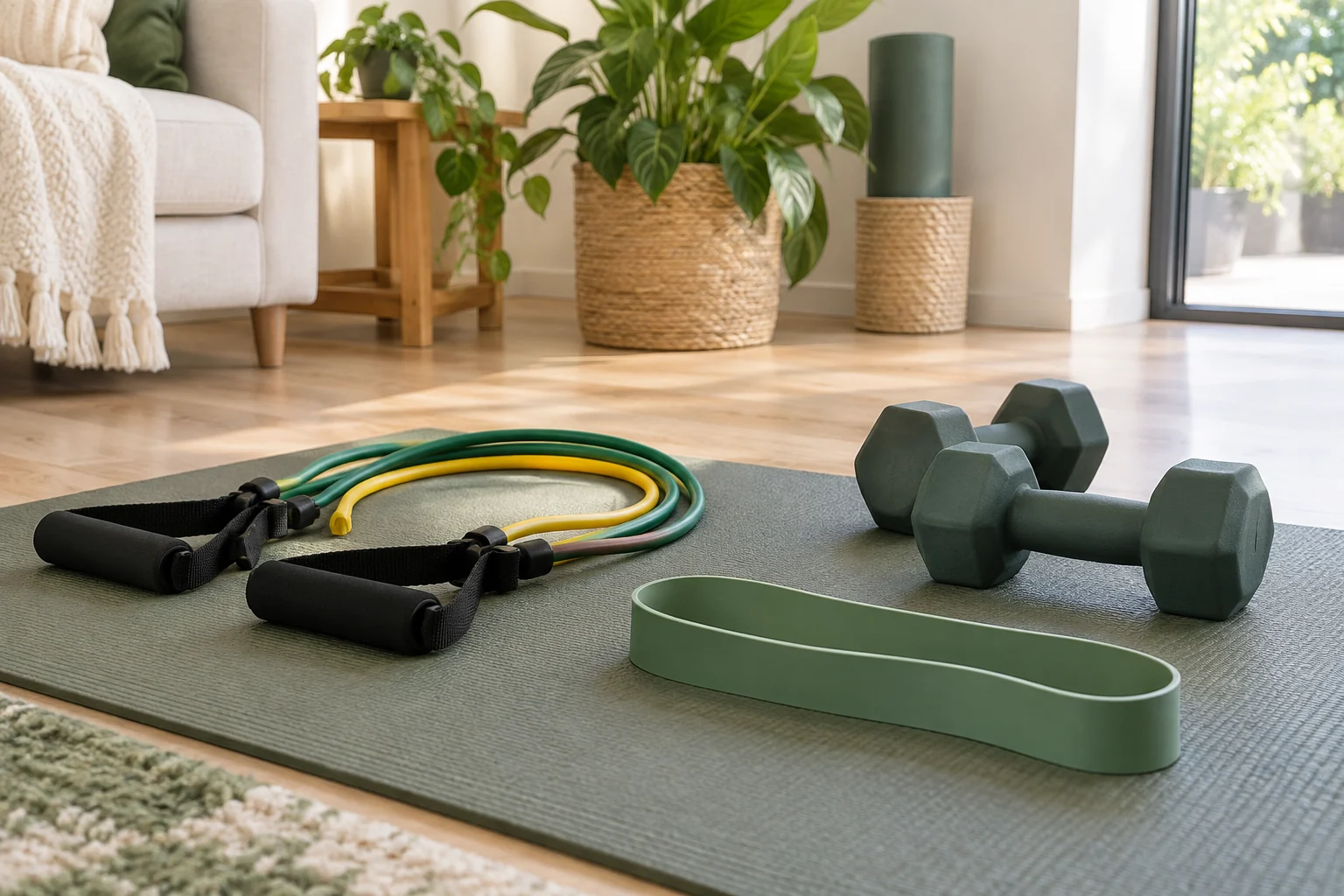
- A way to make it harder next month. Bands in ascending strengths or shortened, dumbbells that go up in small steps, or a movement progression. Precise loading is the specific thing the home-training literature flags as missing.
- A written record. Not for motivation — for progression. A log is what makes overload progressive rather than aspirational.
Equipment that satisfies those four points is sufficient equipment. That can be a gym, a condo gym, or a corner of a bedroom with a band and a pair of dumbbells. The minimum resistance training that works sets out the sessions themselves, and why "toned" is a body-composition outcome covers why no equipment category has a special effect on the shape of the result.
At GetLean, our philosophy is that the medication is the catalyst and the training is what decides what you keep. Individual results vary, and clinical-trial figures describe the populations that were studied. Before starting resistance training — particularly with any existing joint, cardiac or metabolic condition — ask a doctor whether it is suitable for you.
Common questions
Can you build muscle with resistance bands?
The bands evidence covers strength, not muscle size. A meta-analysis of eight trials found elastic resistance produced strength gains statistically indistinguishable from machines and dumbbells (Lopes 2019), and no systematic review of bands for muscle growth exists. The route that does support muscle growth with light equipment is effort: when sets are taken to failure, light and heavy loads produce similar hypertrophy (Schoenfeld, load, 2017).
Is bodyweight training enough?
The evidence here is genuinely thin. The only direct head-to-head located is a four-week trial in 23 moderately trained young men, where progressive push-up training raised bench-press strength as much as bench-press training did — and muscle thickness did not change significantly in either group (Kotarsky 2018). There is no systematic review of bodyweight-only training to lean on, so it is fairer to call bodyweight work under-studied than to call it equivalent.
Is training at home as effective as training at a gym?
No trial has compared them head to head for muscle or strength. The nearest evidence compared each setting against its own control in people with type 2 diabetes, on a blood-sugar outcome rather than a muscle one, and found a benefit for gym-based programmes but not home-based ones (Bärg 2025). The authors attribute the gap to load progression and adherence rather than to the venue itself, which is the part worth acting on.
Do I need a gym membership to protect muscle during weight loss?
The evidence separates training modes, not venues. Pooling 34 randomised trials, adding exercise to a calorie-restricted diet prevented roughly 46% of the fat-free mass otherwise lost, with combined and strength training reaching statistical significance (Deller 2026). What has to be supplied is a progressive resistance stimulus. Where it is supplied has not been shown to be the deciding variable.
What equipment do I actually need at home?
Enough resistance to make a set genuinely hard, and enough range to keep making it harder over months. Bands match conventional equipment for strength gains (Lopes 2019) but are difficult to load precisely, which is the specific weakness the home-training literature points at. A means of adding small increments matters more than the equipment category.