Two inputs protect muscle while body fat comes off: a resistance-training stimulus, and enough protein. Neither substitutes for the other — training without adequate protein gives the signal with no material, and protein without training gives the material with no signal. Everything else here, supplements and timing schemes and step targets included, is either a small refinement on those two or is not supported at all. This guide covers how much protein and against which denominator, how to reach it when appetite is suppressed, what the minimum effective training dose is, how to tell whether it is working, and which popular additions do less than their reputation suggests.
Resistance training: any training where a muscle works against a load heavy enough that the final repetitions are genuinely hard. Free weights, machines, bands and body weight all qualify. The load and the effort are what signal the tissue is needed; the equipment is a detail.
Why two inputs, and why neither substitutes for the other
Take them separately first, because the evidence for each is strong on its own.
Resistance training is the better-evidenced of the two. A meta-analysis of 114 trials covering 4,184 people with overweight and obesity found lean mass statistically unchanged when resistance training accompanied caloric restriction (Lopez 2022). In obese older adults specifically, six randomised trials pooled together found adding resistance training to caloric restriction prevented an estimated 93.5% of the lean-mass loss otherwise seen, without blunting fat loss (Sardeli 2018) — an older-adult figure that should not be assumed to hold at every age. Across 34 randomised trials of exercise during calorie restriction, adding exercise of any kind prevented roughly 46% of the fat-free mass that would otherwise have been lost (Deller 2026). Viewed from the other direction: in a network meta-analysis of 62 trials and 4,429 people, dieting without exercise was the only arm whose lean-body-mass loss reached statistical significance (Xie 2025).
Protein carries its own evidence, and the clearest demonstration of the two working together comes from a four-week trial in 40 untrained overweight young men on a large supervised deficit with six days a week of resistance and interval training. The group eating 2.4 g of protein per kg of body weight per day gained 1.2 kg of lean mass and lost 4.8 kg of fat. The group eating 1.2 g/kg gained 0.1 kg of lean mass — a change not different from zero — and lost 3.5 kg of fat (Longland 2016). Both groups trained. The protein decided how much the training was worth. Those conditions were unusually aggressive and unusually supervised, so the trial illustrates the mechanism rather than describing a typical outcome; individual results vary.
One caveat applies to every training claim on this page. No trial of resistance training, home training or step targets has been run in people taking a GLP-1 medication. Everything here is carried across from general weight-loss populations — a reasonable extrapolation, since the deficit is what drives lean-mass loss whatever created it, but an extrapolation.
How much protein, and which denominator
Two ranges circulate, they use different denominators, and conflating them is the single most consequential error in this subject.
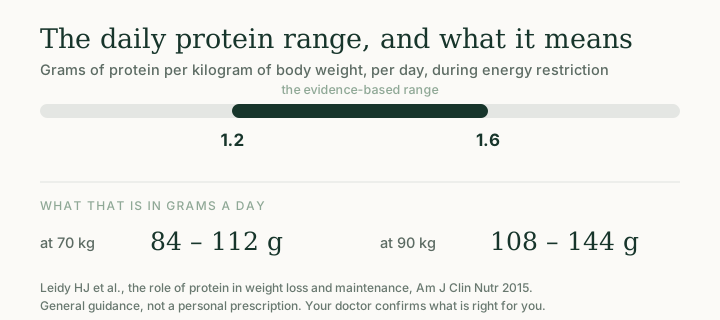
1.2 to 1.6 grams per kilogram of body weight per day. This is the range from the most widely cited review of protein in weight loss, alongside meal-specific quantities of at least around 25 to 30 g per meal (Leidy 2015). The paper's own worked examples come out at roughly 89 to 119 g a day for women and 104 to 138 g a day for men, which back-calculates to body weights of about 74 kg and 86.5 kg. The denominator is total body weight.
2.3 to 3.1 grams per kilogram of fat-free mass per day. This is a different figure for a different population: lean, resistance-trained athletes in caloric restriction, scaling upward with the severity of the deficit and with leanness (Helms 2014). The denominator is fat-free mass — body weight minus fat.
Applying the fat-free-mass range to body weight overstates the target by about 43% at 30% body fat, and by more as body fat rises. Worked through: a person of 100 kg at 30% body fat has 70 kg of fat-free mass, so the athlete range comes to roughly 161 to 217 g a day — not the 230 to 310 g the same numbers give if they are multiplied by total body weight. The population differs too. The higher range was derived in people who are already lean and already training hard, which most people starting a GLP-1 medication are not.
There is also a ceiling. Pooling 49 trials and 1,863 people, protein intakes beyond about 1.6 g per kg of body mass per day produced no further gain in fat-free mass on top of resistance training (Morton 2018). Above that, the extra protein has not been shown to add anything. Protein on a GLP-1 medication in Singapore works the arithmetic through with local food, and any personal target is a conversation with your doctor rather than a number to read off a page.
Hitting the target when appetite is suppressed
This is the practical problem the medication creates. Reduced appetite is the mechanism, and it does not discriminate between the food that matters for muscle and the food that does not. In a crossover trial of 30 adults, semaglutide reduced total intake across a single laboratory test day by about 24% versus placebo (Blundell 2017) — a single test-day measurement rather than tracked daily eating, but it gives the scale of the effect. When total intake falls that far, protein has to be chosen rather than accumulated.
Protein is also the most satiating macronutrient, which cuts both ways. Raising protein from 15% to 30% of calories increased satiety and cut spontaneous energy intake by about 440 kcal a day in one 19-person study (Weigle 2005). On a suppressed appetite that satiety is working against a smaller total to begin with, so the practical move is to eat the protein first rather than last.
Singapore food makes this concrete, because protein per calorie varies enormously across dishes that look comparable. Measured per portion in a food-court analysis: steamed chicken rice, 777 kcal and 38.3 g of protein; char siew wanton noodle, 402 kcal and 26.5 g; char kway teow, 659 kcal and 14.5 g; roti prata, 511 kcal and 6.2 g (Yeo 2021). Two of those are ordinary lunches that make a target reachable, and two of them are not — eating and training lean in Singapore works that local picture through on HPB's own database rather than this study's figures. How to hit a protein target when you have no appetite covers the practical order of operations, and choosing a protein powder in Singapore covers when a supplement earns its place.
Does timing matter?
Much less than the total does, and the evidence for that is unusually clean.
A meta-regression covering more than 20 trials found that once total daily protein intake is controlled for, the timing of protein around a training session has no significant effect on strength, hypertrophy or fat-free mass — and that total daily protein was the strongest predictor of the outcome (Schoenfeld 2013). In the unmatched trials, the apparent timing benefit turned out to be a difference in total intake wearing a disguise.
The distribution question — spreading protein evenly across the day versus loading it at dinner — produced two opposite answers in the same twenty men. Measured acutely over a 13-hour infusion during a moderate deficit at 1.3 g/kg/day, even distribution across four meals beat the skewed pattern (Murphy 2015). Measured over two weeks in the same participants, distribution made no difference at all, while adding resistance training raised muscle protein synthesis by about 26% (Murphy 2018). Same investigators, same men, different measurement window, different answer. That disagreement is the finding, and it is why the pooled conclusion favours total intake over schedule.
A further scope limit is worth knowing, because the popular per-meal targets are almost all drawn from a population that is not dieting. The widely quoted 0.4 g per kg of body weight per meal across four meals is anchored to a daily total its own authors fence, in their own words, to non-dieting conditions (Schoenfeld & Aragon 2018). Carrying it across to someone eating less because their appetite is suppressed is a transplant, not a recommendation. Does protein timing matter on a reduced appetite works through what does and does not transfer.
The minimum effective training dose
Less than most people assume, and considerably less than the internet's version.
In resistance-trained men, a single hard set per exercise, at roughly 70 to 85% of one-repetition maximum, two to three times a week, taken to failure, produced significant strength gains over 8 to 12 weeks — an overall increase of about 12 kg on the one-rep max (Androulakis-Korakakis 2020). The authors describe that dose as suboptimal, and it was tested in trained men only; whether it generalises to women or to untrained people is unclear from that paper. It is a floor rather than a target — which is exactly the useful number for someone deciding whether a shortened week is worth doing at all.
Three further findings shape what a sensible week looks like. Volume matters in a graded way — each additional weekly set per muscle group was associated with about 0.37% more growth, with diminishing returns; the widely repeated "10 sets a week" threshold comes from a categorical comparison in that same paper that was not statistically significant, so it should not be quoted as a proven number (Schoenfeld 2017). Frequency matters less than volume: when weekly volume is held constant, one, two or three sessions a week produce similar growth (Schoenfeld 2019). And load matters less than effort for muscle growth: when sets are taken to muscular failure, light and heavy loads produce similar hypertrophy, though heavy loads produce more maximal strength (Schoenfeld 2017, load).
That last finding is what makes equipment a second-order question. Across eight trials, elastic resistance produced strength gains statistically indistinguishable from machines and dumbbells (Lopes 2019) — a strength outcome, not a muscle-size one, across 224 people of moderate study quality. Supervision does appear to matter: in older adults, supervised programmes produced moderately greater strength gains than unsupervised ones, though the gap largely closes once an otherwise-home programme includes some supervised sessions (Lacroix 2017). Training at home versus at a gym weighs those trade-offs, and the minimum effective resistance-training dose sets out the full prescription.
For someone who has never lifted, two things are worth knowing at the start. Measurable muscle growth appears at around three to four weeks in previously sedentary men, the only population this was measured in, with strength improving in parallel (DeFreitas 2011) — so the first month feels like nothing is happening while something is. And adults aged 50 and over gain reliably: across 47 studies and 1,079 participants, strength rose roughly a quarter to a third across the major lifts (Peterson 2010). Strength training for people who have never done it is the starting point.
Singapore's own guidelines already ask for this. SPAG 2022 asks adults for muscle-strengthening work on at least two days a week, at 8 to 12 repetitions per set, alongside the aerobic target rather than instead of it. The most recent national survey shows 84.7% of residents aged 18 to 74 meeting the physical activity guideline in 2024, while only 35.7% did sufficient muscle-strengthening activity (NPHS 2024). That gap is HPB's data; the reading of it — that Singaporean adults under-train the half that protects muscle — is ours.
Where cardio and walking fit
Both belong in the week. Neither is a substitute for a resistance stimulus, and neither deserves the blame it sometimes gets.
On aerobic training, precision matters. In the pooled analysis of 34 randomised trials, combined training added 1.20 kg of fat-free mass versus diet alone and strength training added 0.83 kg, both statistically significant, while endurance training added 0.51 kg and fell just short of significance. Crucially, the same paper reports that subgroup testing found no significant differences between the training modes (Deller 2026). The defensible reading is that resistance and combined training are the modes with demonstrated fat-free-mass protection, and aerobic training alone is unproven for it — which is an absence of evidence, not evidence of harm. One trial does show a direct gap: in dieting obese adults of around 70, aerobic-only exercise was associated with roughly double the relative lean-mass loss of resistance-only or combined training, and combined training produced the largest gain in physical function (Villareal 2017) — a single six-month trial in a sedentary, mean-age-70 population, and it should be read as such. There is also no established point at which cardio "becomes catabolic" — no peer-reviewed minutes-per-week threshold exists. Cardio-only training and muscle loss works through what the mode comparison does and does not show.
On walking, the evidence base is superb for one thing and absent for another. The largest synthesis of device-measured step counts — 57 studies across 35 cohorts — associates about 7,000 steps a day with substantially lower risk of death, cardiovascular disease, dementia and depressive symptoms compared with 2,000 steps. Body composition was not among the outcomes studied (Ding 2025). Walking is exceptionally well evidenced for how long people live and essentially unevidenced for what they are made of. It earns its place in the week on its own merits, and it does not earn a claim about muscle. Why walking is not enough, and what "active" needs to mean makes that distinction properly.
How to tell whether it is working
Two measurements, and the first is routinely misused.
Strength in training — tracked for its own sake. This is the misused one. In a randomised trial, about 7% weight loss by dieting alone reduced whole-body lean mass by around 2% and lower-body lean mass by around 4%, while measured muscle strength did not change at all (Weiss 2017). The observational data point the same way: across nearly 1,900 older adults followed for three years, strength fell roughly three times faster than muscle mass, and participants who gained lean mass showed no strength benefit for it (Goodpaster 2006). Strength and mass are correlated across people and dissociable within one person. Record your loads, because losing strength matters in its own right and because it is the thing you can feel — and do not read a rising bench press as proof that lean mass is being held. Strength as a vital sign covers how to track it and what it does mean.
A body-composition scan, repeated on the same device. Across fifteen bioimpedance devices tested against a four-compartment model, only a third met a strict accuracy standard for a single measurement, while most tracked change over 12 to 16 weeks considerably better (Siedler 2022). Consistency beats precision: the same machine, the same conditions, the same time of day. That precision figure also sets the interval, because scanning more often than the machine can resolve produces noise that reads as a result — which is why the interval matters as much as the device. At the time of writing, published Singapore prices ran roughly $40–45 for an InBody scan and around $300–310 for a DEXA scan (ATA Medical price list, July 2026); prices change, so check the provider's own page. Body-composition testing in Singapore compares what each method actually measures, and works through how often a scan is worth repeating.
GetLean does not ask patients for a body-composition scan at any point. The programme is telehealth only; what is tracked is weight, through the daily WhatsApp check-ins, and the habits behind it. The device evidence above is for readers who choose to measure on their own account.
What helps less than advertised
Creatine. The strong evidence for creatine is real, and it is not about dieting. Across 22 randomised trials in adults with a mean age of 57 to 70, creatine alongside resistance training produced 1.37 kg more lean tissue mass than resistance training alone (Chilibeck 2017). Every one of those trials estimated lean tissue by a method that assumes a fixed hydration of fat-free mass — and creatine increases total body water. In one trial, 42 days of creatine with no resistance training raised both total body water and the DXA lean-mass estimate in the same participants, which is why the authors called their outcome an estimate (Brooks 2023). A jump on the next scan after starting creatine has therefore not been shown to be muscle, and starting creatine between two scans you intend to compare makes the comparison unreadable. On creatine during weight loss specifically, one trial exists: four days at 18 kcal/kg/day, concluding that creatine raised muscle creatine stores but did not affect body-fat or protein loss (Rockwell 2001). No trial has tested it in anyone taking a GLP-1 medication. Much of this literature is also written by a small author network with declared industry ties — which does not make the findings wrong, but does mean an industry-adjacent position paper is not an independent guideline. Whether to take it is a conversation with your doctor.
Protein powder. Useful as a convenience, not as an addition. Once daily protein is already at target, supplementation adds nothing further to fat-free mass (Morton 2018). A Singapore-specific point widely got wrong: a tub of protein powder is very probably not an HSA-regulated health supplement at all. Under the joint HSA/SFA classification tree, a protein or creatine isolate sold as a loose powder with no defined dose falls on the conventional-food branch and is directed to the Singapore Food Agency under the Sale of Food Act, while the same substance in a capsule with a stated dose goes to HSA (HSA/SFA classification tree). Presentation decides the agency, not the ingredient.
Sleep. Real, probably worth attending to, and resting on a much thinner base than its confident treatment online suggests. The entire case that sleep protects composition during a deficit is two controlled trials. In the better known of the two, ten adults with overweight dieted for two weeks on 5.5 versus 8.5 hours of sleep opportunity: total weight lost was identical between the arms, but a much smaller share of it came from fat on short sleep (Nedeltcheva 2010). Ten people, fourteen days, and underlying proportions carrying standard deviations larger than the gap between the arms. The second, in 36 adults over eight weeks who lost under three hours of sleep a week in total, found the same pattern in the proportion of weight lost as fat — while the absolute lean-mass losses were not significantly different between the groups (Wang 2018). No meta-analysis has ever pooled sleep restriction against fat-free-mass outcomes, and no trial has tested whether short sleep blunts the gains from a training programme. What does survive pooling is behavioural: across 41 randomised trials, sleep restriction reliably raised hunger and food intake by about 250 kcal a day, while showing no reliable effect on average leptin or ghrelin (Zhu 2019) — which means the familiar hunger-hormone story is weaker than the behaviour it was invented to explain. On duration, the AASM and Sleep Research Society consensus is a floor rather than a range: adults should sleep seven or more hours a night on a regular basis (Watson 2015). Singapore's Health Promotion Board says the same thing — at least seven hours a day (HPB HealthHub). Sleep and muscle retention during a calorie deficit covers what the two trials do and do not establish.
Speed and age both change the arithmetic
Speed. Whether losing weight faster costs more lean tissue is genuinely unsettled. One randomised trial found a very-low-calorie protocol produced 8.8% fat-free-mass loss against 1.3% on a slower one (Vink 2016); another, comparing a four-week rapid protocol against an eight-week gradual one at matched total loss, found body-composition changes similar in both (Coutinho 2018). Some evidence indicates faster loss costs more lean tissue; it is not established. The pace of a titration is a clinical decision for your doctor. How fast should you lose weight sets out both sides.
Age. The same deficit lands on a steeper background trend. Muscle mass declines roughly 8% per decade until about 70 and 13 to 24% per decade afterwards (Filippin 2015), so a 55-year-old losing lean tissue is adding to a decline already running. The training response does not disappear with age — the strength gains across 47 studies in adults over 50 are among the more reliable findings here (Peterson 2010). The Asian consensus on sarcopenia sets low grip strength at under 28 kg for men and under 18 kg for women; those are clinical diagnostic thresholds applied by a clinician, not benchmarks to test yourself against (Chen 2019). Getting lean after 40 covers what changes from midlife onward.
At GetLean, our philosophy is that GLP-1 medication should act as a catalyst — not something to depend on indefinitely. Protein and training are the two things that decide what the catalyst leaves behind. Clinical-trial figures describe the populations that were studied; individual results vary and are not guaranteed. If you are considering treatment, check your eligibility and speak to a doctor about whether it is suitable for you.
Common questions
How much protein do you need on a GLP-1 medication?
The most commonly cited range for weight loss is 1.2 to 1.6 grams per kilogram of body weight per day (Leidy 2015). A separate, higher range of 2.3 to 3.1 grams per kilogram is measured per kilogram of fat-free mass, not body weight, and was derived in lean resistance-trained athletes (Helms 2014). The two numbers use different denominators and are not interchangeable. Ask your doctor what target is appropriate for you.
Does protein timing matter?
Much less than the total. Once daily protein intake is accounted for, timing around training had no significant effect on strength, muscle growth or fat-free mass, and total daily protein was the strongest predictor of the result (Schoenfeld 2013). In energy-restricted older men, spreading protein evenly beat skewing it when synthesis was measured acutely (Murphy 2015) and made no difference at all when the same men were measured over two weeks (Murphy 2018).
What is the minimum amount of training that protects muscle?
Less than most people assume, but not zero. In resistance-trained men, a single hard set per exercise, two to three times a week, taken to failure, produced significant strength gains over 8 to 12 weeks — and the authors call that a floor rather than a target (Androulakis-Korakakis 2020). Singapore's national guidelines ask all adults for muscle-strengthening work on at least two days a week at 8 to 12 repetitions per set (SPAG 2022).
Is cardio bad for muscle?
That is more than the evidence supports. Pooling 34 randomised trials, exercise of any kind added to a calorie deficit prevented roughly 46% of the fat-free mass otherwise lost; combined and strength training reached statistical significance and endurance training alone fell just short, but the direct comparison between training modes was not significant (Deller 2026). Resistance and combined training are the modes with demonstrated protection; aerobic training alone is unproven for it rather than shown to be worse.
Does getting stronger mean you are keeping muscle?
No, and this is the most common measurement error in the area. In a randomised trial, about 7% weight loss by dieting alone reduced whole-body lean mass by around 2% and lower-body lean mass by around 4%, while measured muscle strength did not change at all (Weiss 2017). Track strength because losing it matters in its own right, not as a stand-in for a body-composition measurement.
Should you take creatine while losing weight?
That is a question for your doctor, and the evidence is thinner than the internet suggests. The meta-analyses showing creatine adds lean tissue studied people who were training rather than dieting (Chilibeck 2017), and creatine raises total body water, which inflates the lean-mass estimate every routine scan produces (Brooks 2023). The only trial that tested creatine during energy restriction ran four days and found no effect on fat or protein loss (Rockwell 2001).