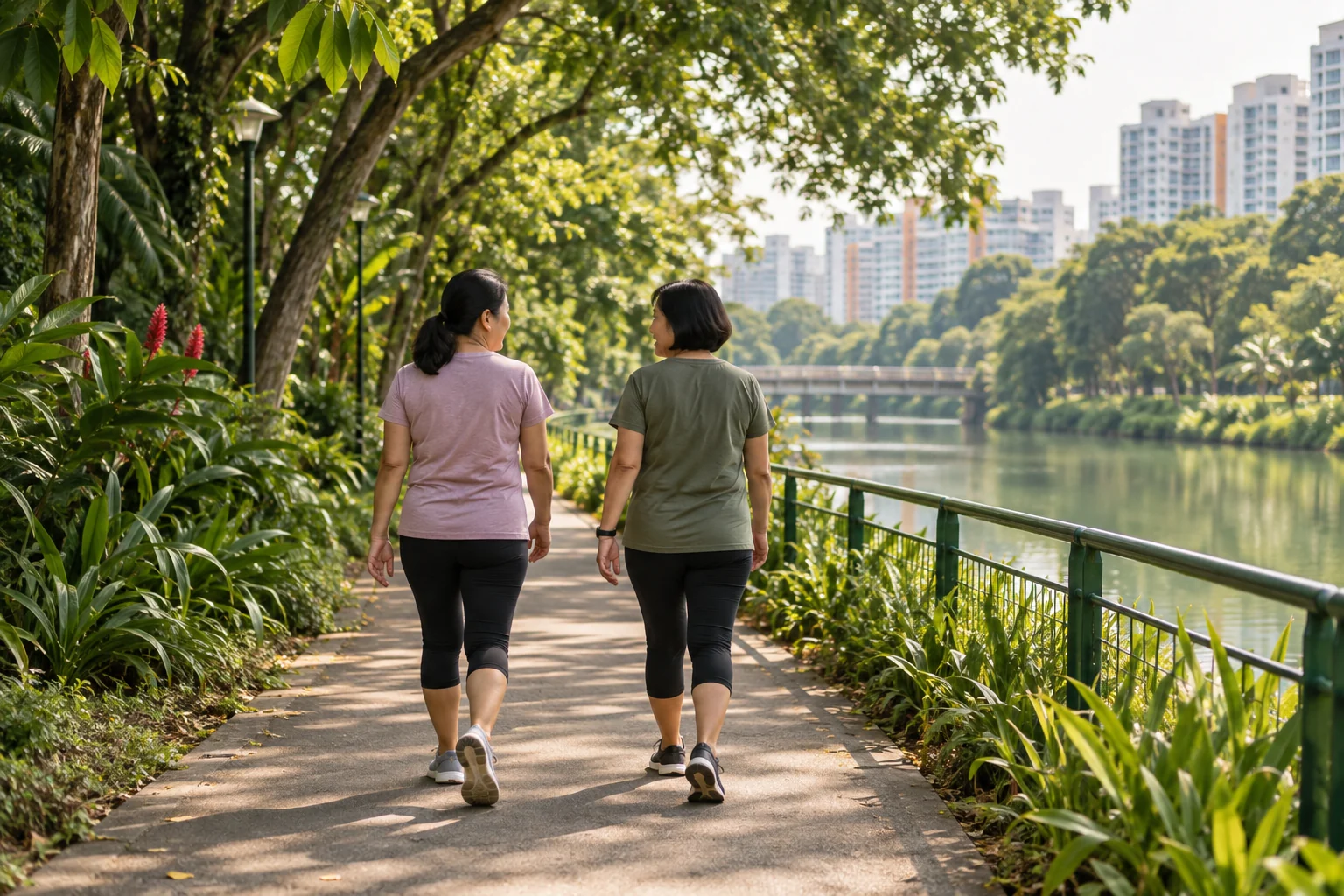
Walking is superbly evidenced for how long you live and poorly evidenced for what you are made of. Both halves of that sentence carry weight. The largest synthesis of device-measured step counts examined death, cardiovascular disease, cancer, dementia, depressive symptoms, physical function and falls — and body composition was not among its outcomes at all. So a step target is a strong health intervention and a silent one on the question this article set out to answer. This article covers what walking is proven to do, what no one has measured, why "aerobic is bad for muscle" is the wrong correction, and what Singapore's own survey data says about where the gap actually is.
Muscle-strengthening activity: work that loads the major muscle groups against resistance. Singapore's national guidelines ask for it on at least two days a week, at 8 to 12 repetitions per set — as a separate requirement from the weekly aerobic target, not as part of it.
What walking is actually proven to do
Almost everything except the thing this article is about.
The largest synthesis to date reviewed device-measured step counts across 57 studies from 35 cohorts and meta-analysed 31 of them from 24 cohorts. Compared with 2,000 steps a day, 7,000 steps a day was associated with an all-cause mortality hazard ratio of 0.53 (95% CI 0.46–0.60), cardiovascular disease incidence of 0.75, cardiovascular mortality of 0.53, cancer mortality of 0.63, dementia of 0.62, depressive symptoms of 0.78 and falls of 0.72, with inflection points around 5,000 to 7,000 steps a day for several of them (Ding 2025). Certainty was graded moderate for most outcomes, low for cardiovascular mortality, cancer incidence and physical function, and very low for falls; cancer incidence did not reach significance.
The mortality finding replicates. An individual participant-data meta-analysis of 47,471 adults across 15 international cohorts found progressively lower mortality across step quartiles — adjusted hazard ratios of 0.60, 0.55 and 0.47 against the lowest — with the curve flattening at roughly 6,000 to 8,000 steps a day in adults aged 60 and over and 8,000 to 10,000 in adults under 60 (Paluch 2022). In 16,741 US women with a mean age of 72, about 4,400 steps a day was associated with a hazard ratio of 0.59 against about 2,700, levelling off around 7,500 (Lee 2019).
All three are observational, so none establishes cause, and the authors of the largest name residual confounding as a limitation. Within those limits it is one of the better dose-response evidence bases in preventive medicine, and nothing below is an argument against walking.
Where the 10,000 came from
Not from research, and the version most people repeat is more specific than the record supports.
The peer-reviewed account of its provenance puts it plainly: "A value of 10000 steps/day is gaining popularity with the media and in practice and can be traced to Japanese walking clubs and a business slogan 30+ years ago" (Tudor-Locke 2004). The tidier story that circulates — a named product, a specific year, an Olympics, a character that looks like a walking man — appears in press and blog write-ups rather than in that source, and appears in press and blog write-ups rather than in that source.
The consequence is practical rather than trivia: a number of commercial origin became the threshold people judge themselves against, and the research-derived figures sit lower. The synthesis above concluded that while 10,000 remains viable for the more active, around 7,000 steps a day is associated with clinically meaningful improvements and may be more realistic for some (Ding 2025).
What the steps evidence does not cover
Body composition. Not partially, not weakly — the outcome is absent.
The nearest things to it are three studies, each stopping short in a different way.
A meta-analysis of nine pedometer-based walking programmes covering 307 participants, none including any dietary intervention, found a pooled weight change of −1.27 kg (95% CI −1.85 to −0.70). The outcome measured was body weight only, the authors call the effect modest, and they caution in the paper itself that people who walk more being thinner does not establish cause (Richardson 2008).
A recent eight-week controlled trial put 30 women with obesity on individualised nutrition therapy and compared two step strategies. Fat mass, weight, BMI and waist fell significantly in both groups, "whereas lean body mass and muscle mass did not change significantly" (Kal 2026). With 15 women per arm and no non-walking control, that null result reflects a study too small to detect the differences that matter rather than evidence that walking preserved anything.
The most informative of the three is a 12-week randomised trial in 82 adults on a 500–800 kcal daily deficit, one arm adding 2.5 hours a week of moderate walking. Total fat mass fell significantly more with walking, −6.4 ± 3.1 kg against −4.8 ± 3.0 kg (P = 0.020), while the difference in total weight lost did not reach significance (−8.8 kg against −7.0 kg, P = 0.064) (Kleist 2017). Walking added to a diet demonstrably improved fat loss. What that trial's abstract does not report is a fat-free-mass figure, and the full text was not accessible, so no lean-mass conclusion follows from it.
Put together: a step count is a well-evidenced instruction about health and an unevidenced one about muscle.
Does that mean aerobic exercise costs you muscle?
No, and this is where the correction usually overshoots.
The largest pooled analysis of exercise mode during calorie restriction — whose senior author declares lecture and consultancy payments from Abbott, Lilly and Novo Nordisk — covered 34 randomised trials and 1,455 people with overweight or obesity. Adding exercise to the diet protected fat-free mass by a mean difference of +0.87 kg (95% CI +0.59 to +1.16, p ≤ 0.001) — on average, "EX prevented nearly half of FFM loss (45.7%)". By mode: mixed training +1.20 kg (p < 0.001), strength training +0.83 kg (p = 0.013), endurance training +0.51 kg (95% CI −0.04 to +1.05, p = 0.067). And the sentence that decides how all of this should be written: "subgroup testing found no significant differences between training modes" (Deller 2026).
Endurance training missed the significance threshold. The comparison between modes did not find a difference. Those are two distinct results, and collapsing them produces a claim the data does not carry. The defensible line is that resistance and combined training are the modes with demonstrated fat-free-mass protection, and that aerobic training alone has not been shown to protect it. The indefensible line — aerobic exercise is worse for your muscle — is not supported by any pooled comparison.
A second network meta-analysis, 62 randomised trials and 4,429 participants, lands in the same place from a different angle. Of nine intervention arms compared against control, the only one whose confidence interval excluded zero for lean body mass was calorie restriction without exercise, at −1.66 (95% CI −3.12 to −0.19). Every diet-plus-exercise arm crossed zero, and they overlapped heavily with each other (Xie 2025).
Aerobic work has also been shown to do real protective work. In a systematic review of 52 studies in adults over 50, 81% of those on energy restriction alone lost at least 15% of their weight as fat-free mass, against 39% of those on energy restriction plus exercise — and the exercise arms in that review were mainly aerobic (Weinheimer 2010). Walking itself carries a mechanistic signal too: in 15 overweight men put through four days at an extreme deficit while walking eight hours a day, whole-body fat-free mass still fell significantly (P < 0.001), yet the exercised limbs lost proportionally far less than the non-exercised arm (Calbet 2017) — a within-person limb contrast at a deficit no patient of ours would be at, rather than a clinical outcome.
Against all of that sits one trial showing a direct gap. In 160 previously sedentary obese older adults with a mean age of about 70, six months of dieting plus aerobic exercise was associated with a 5% fall in lean mass, against 2% for resistance-only and 3% for combined training (Villareal 2017). Its direction is informative and its percentages should not be carried across to a 35-year-old; we cover it in full in cardio-only exercise during weight loss.
Singapore's own numbers are the interesting part
Singapore's national physical activity guidelines were issued jointly by Sport Singapore and the Health Promotion Board on 12 June 2022. The adult recommendation, verbatim: "Adults should accumulate a total equivalent of 150 to 300 minutes of moderate-intensity activity (mostly aerobic) throughout the week for health benefits." And, separately: "Additionally, adults should engage in moderate-intensity muscle strengthening activities targeting the major muscle groups at least twice per week to build their strength… a general good practice is to complete 8 to 12 repetitions per set" (SPAG 2022).
That document states it adopts the WHO guidelines, and it is not a copy of them: Singapore's adult headline is framed entirely in moderate-intensity equivalents, omits WHO's alternative of 75–150 minutes of vigorous activity, and adds the 8-to-12-repetitions detail. What both share is the strengthening requirement — WHO's 2020 guidelines ask adults for "muscle-strengthening activities at moderate or greater intensity that involve all major muscle groups on 2 or more days a week", graded a strong recommendation on moderate-certainty evidence (Bull 2020).
Now the survey figures, which the SPAG guidebook reproduces from the National Population Health Survey 2020. Among Singaporean adults aged 18 to 74, 76.4% met the WHO physical activity guidelines. Only 33.8% did sufficient muscle-strengthening activity — 44.1% at ages 18 to 29, 25.5% at 60 to 74, 40.1% of men and 27.8% of women (SPAG 2022).
Those are HPB's numbers. The reading of them is ours: a country that has largely absorbed the aerobic half of its own guideline has not absorbed the strengthening half, and the gap widens with exactly the age at which muscle becomes hardest to replace. Neither HPB nor MOH publishes that conclusion, and no Singapore agency has stated that aerobic activity alone is insufficient. We are drawing the inference; the figures are theirs.
So what does "active" have to mean?
Two things, held separately, because the guidelines hold them separately.
Keep the walking. It has the strongest dose-response evidence in this article for mortality and major disease, the returns arrive well below 10,000 steps, and adding 2.5 hours a week of it to a calorie deficit produced significantly more fat loss than the diet alone (Kleist 2017). After weight loss, more than 250 minutes a week of activity is associated with better maintenance — on cross-sectional and prospective evidence, with the position stand itself noting no randomised trials support it (Donnelly 2009).
Add the strengthening, because nothing else supplies it. Two sessions a week is what both the Singapore and the WHO guidelines ask for. The minimum resistance training that works sets out how small that dose can be, and what a good week actually looks like puts both halves into one week.
At GetLean, our philosophy is that the medication is the catalyst and what you keep is the result — and "active" has to mean the second thing as well as the first, because only one of them has been shown to change what a deficit is made of. Individual results vary, and clinical-trial figures describe the populations that were studied. Before starting resistance training — particularly with any existing joint, cardiac or metabolic condition — ask a doctor whether it is suitable for you.
Common questions
Is walking enough exercise to protect muscle?
Nothing in the walking literature answers that question. The largest synthesis of device-measured step counts studied death, cardiovascular disease, cancer, dementia, depressive symptoms, physical function and falls — body composition was not among its outcomes (Ding 2025). Walking is very well evidenced for how long you live and poorly evidenced for what you are made of, so it belongs alongside resistance training rather than in place of it.
How many steps a day should I walk?
The dose-response evidence flattens well below the number most people quote. Compared with 2,000 steps a day, 7,000 was associated with an all-cause mortality hazard ratio of 0.53 (Ding 2025), and across 15 international cohorts the association levelled off at roughly 6,000 to 8,000 steps a day over 60 and 8,000 to 10,000 under 60 (Paluch 2022). All of it is observational.
Is 10,000 steps a real target?
Not one that came from research. The peer-reviewed account of its provenance says the figure can be traced to Japanese walking clubs and a business slogan of about thirty years earlier (Tudor-Locke 2004); the tidier versions circulating online add brand and date details that source does not contain. A more recent synthesis suggests around 7,000 steps a day may be a more realistic target for many people while remaining clinically meaningful (Ding 2025).
Is aerobic exercise bad for muscle while losing weight?
No pooled comparison shows that. In the largest analysis of exercise mode during a calorie deficit, mixed training protected fat-free mass by 1.20 kg and strength training by 0.83 kg, while endurance training reached 0.51 kg and missed statistical significance at p=0.067 — and subgroup testing found no significant differences between the training modes (Deller 2026). Resistance and combined training are the modes with demonstrated fat-free-mass protection; aerobic alone has not been shown to protect it, which is a different statement from being worse.
How much strength training do Singapore's guidelines ask for?
Singapore's national guidelines ask adults for muscle-strengthening activity targeting the major muscle groups at least twice per week, suggesting 8 to 12 repetitions per set, in addition to 150 to 300 minutes a week of mostly aerobic moderate-intensity activity (SPAG 2022). WHO's 2020 guidelines make the twice-weekly strengthening requirement a strong recommendation on moderate-certainty evidence (Bull 2020).