Cardio does not destroy muscle. What it does — and this is the finding that matters — is fail to protect it during weight loss in the way resistance training does. In the one trial that tested aerobic, resistance and combined exercise head to head in dieting adults, the aerobic-only group lost roughly double the relative lean mass of the other two. This article covers that evidence, the wider picture, and a widely repeated claim about cardio that has no research behind it at all.
Lean mass: everything that is not fat. During a calorie deficit it comes off alongside fat unless something signals the body to keep it.
The trial that tested all three
One hundred and sixty previously sedentary obese older adults, mean age around 70, were randomised to a control group, diet plus aerobic exercise, diet plus resistance training, or diet plus both (Villareal 2017).
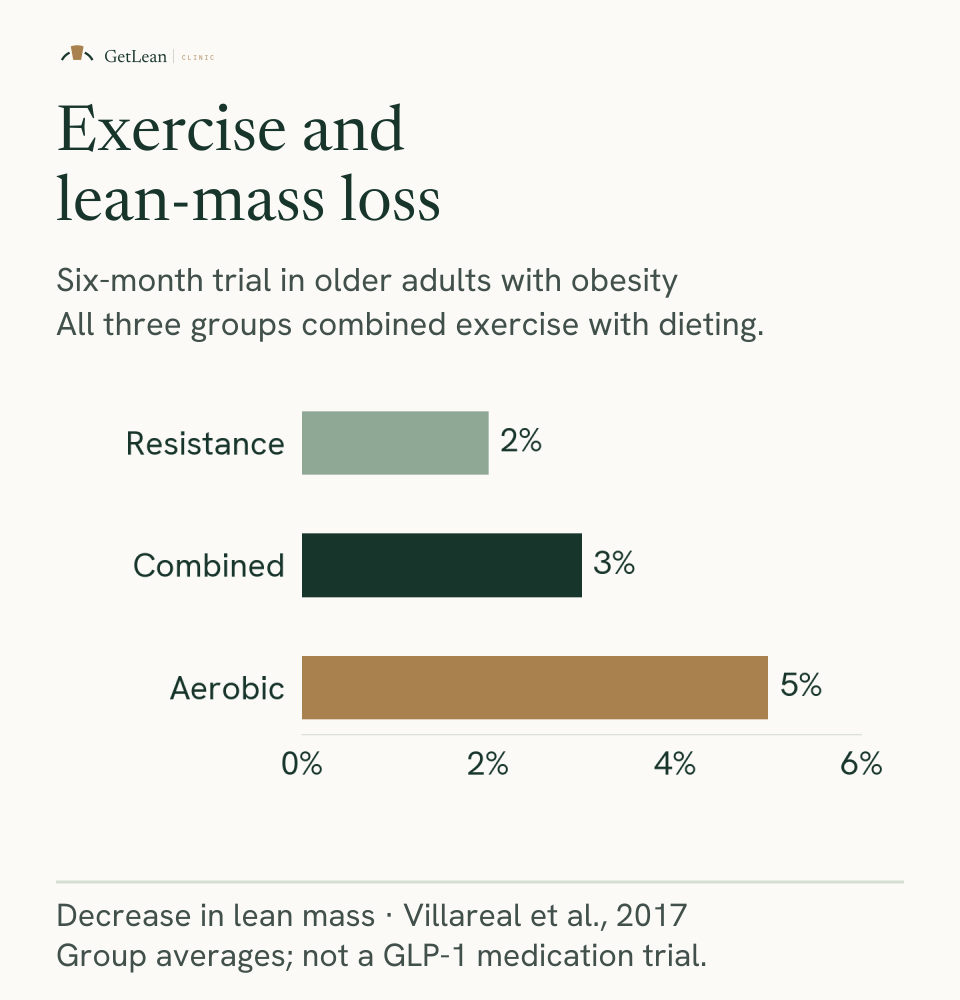
All three exercise groups lost about 9% of body weight. What differed was what the weight was made of.
| Group | Lean mass change |
|---|---|
| Resistance only | 58.1 → 57.1 kg (−2%) |
| Combined | 56.5 → 54.8 kg (−3%) |
| Aerobic only | 55.0 → 52.3 kg (−5%) |
The aerobic-only arm lost roughly double the relative lean mass of the resistance-only arm, at the same weight loss. Bone went the same way — total hip bone mineral density fell 3% in the aerobic-only group against 0.5% with resistance and 1% with combined training.
And on the outcome that arguably matters most, physical performance, combined training won clearly: a 21% improvement, significantly better than either single modality.
That is one trial, in a specific population — previously sedentary, obese, around 70 years old. The percentages should not be carried across to a 35-year-old. The direction is what generalises.
The wider evidence
It points the same way from two other angles.
Any exercise beats none. A systematic review of 52 studies in men and postmenopausal women aged 50 and over with a BMI above 25 found that 81% of those on energy restriction alone lost at least 15% of their body weight as fat-free mass, against 39% of those doing energy restriction plus exercise (Weinheimer 2010). The exercise arms there were mainly aerobic — so cardio was doing real work.
Resistance training is what holds lean mass specifically. Across 114 trials covering 4,184 people, lean mass was statistically unchanged where resistance training accompanied caloric restriction (Lopez 2022). In obese older adults across six randomised trials, adding resistance training prevented an estimated 93.5% of the lean-mass loss otherwise seen — without reducing fat or total weight loss (Sardeli 2018).
So the summary is not "cardio bad". Exercise of any kind helps, and resistance training is the kind that specifically addresses lean mass.
The claim with nothing behind it
You will read that cardio "becomes catabolic" past some duration — an hour, ninety minutes, a certain weekly mileage.
There is no established threshold. No peer-reviewed figure identifies a minutes-per-week point at which aerobic exercise itself starts costing muscle, and the specific numbers that circulate trace to fitness writing rather than to research.
What is real is a different and better-defined idea: sustained low energy availability. Muscle loss during heavy training is driven by taking in too little energy and protein relative to what you are expending — a property of the balance between eating and training, not of aerobic exercise as an activity. A long run does not consume muscle. Months of under-eating around long runs can.
That distinction matters practically. The fix is not less cardio. It is enough food, enough protein, and a resistance stimulus.
What this means on GLP-1 medication
It sharpens an existing problem.
A median 14% of weight lost is fat-free mass on standard low-calorie diets, rising to about 23% on very-low-calorie diets (Chaston 2007). Someone in a substantial deficit who exercises only by walking or running has the deficit driving lean-mass loss and nothing signalling the body to hold on to it.
Cardio is not the problem in that picture. The absence of resistance training is.
The practical version is unglamorous: keep the cardio you enjoy, because it is good for you and it helps, and add two short resistance sessions a week. The minimum that works is genuinely small.
At GetLean, our philosophy is that the medication is the catalyst and what you keep is the result. Exercise choice is one of the few levers that changes what you keep rather than how much you lose.
Individual results vary, and clinical-trial figures describe the populations studied. Before starting resistance training — particularly with any existing joint, cardiac or metabolic condition — ask a doctor whether it is suitable for you.
Common questions
Does cardio make you lose muscle?
Not by itself. But in dieting obese older adults, the aerobic-only group lost 5% of lean mass against 2% for resistance-only and 3% for combined training (Villareal 2017). Cardio did not protect lean mass the way resistance training did.
Is there a point where cardio becomes catabolic?
No established threshold exists. No peer-reviewed minutes-per-week figure has been identified, and the numbers that circulate come from fitness writing rather than research. Muscle loss during heavy training is driven by inadequate energy and protein relative to output.
Is cardio still worth doing during weight loss?
Yes. Adding exercise to energy restriction roughly halved the proportion of adults over 50 losing at least 15% of their weight as fat-free mass, in a review whose exercise arms were mainly aerobic (Weinheimer 2010). It should not be the only thing you do.
What is the best combination?
In the trial testing all three, combined training produced the largest improvement in physical performance, at 21% (Villareal 2017), while resistance training was the component that protected lean mass (Lopez 2022).
Does walking count?
It counts as activity and it is worth doing. It does not supply the resistance stimulus the lean-mass evidence depends on.