Three questions sit underneath this entire cluster: can I have this, what actually happens, and what does it cost me. In Singapore more of the answer is written down than most readers expect — in the outpatient medical service regulations, in a joint circular from three regulators, in the registered product information, and on public registers anyone can search in a minute. This guide takes those documents in the order a patient meets them: who a service can assess, what a consultation must involve, what is and is not tested, how the medicine is lawfully supplied, what none of it can be claimed against, and how to check any provider is inside the rules. Several of those rules stop short of what a reader wants to know, and this guide marks where they stop.
Eligibility and suitability: eligibility is a criterion published on a page, deciding who a service is set up to assess. Suitability is a clinical judgement about one person, made by a doctor who has assessed them. A website can do the first job; only a consultation can do the second.
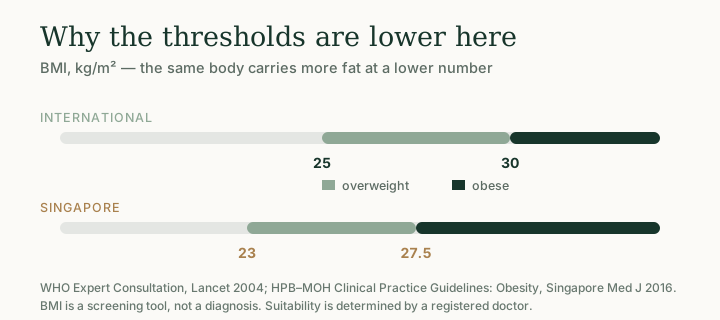
Four BMI scales, and why they disagree
Singapore runs several BMI scales at once. All are correct, they answer different questions, and confusing them is the commonest error in this area.
Singapore's national obesity classification applies to the whole local adult population: overweight from a BMI of 23.0, obesity from 27.5, with waist-circumference action points above 90 cm in men and 80 cm in women (HPB-MOH 2016). It classifies a population; it is not a treatment threshold.
The registered product information governs the medicine. For the registered semaglutide product, the weight-management indication begins at a BMI of 30 and above, or 27 to under 30 with at least one weight-related comorbidity — dysglycaemia, meaning prediabetes or type 2 diabetes, along with hypertension, dyslipidaemia, obstructive sleep apnoea or cardiovascular disease (NDF). Those are the international cut-offs, not adjusted for Asian bodies, and they sit above Singapore's own national classification — so a Singaporean can be classified obese nationally while sitting below the label's threshold for an uncomplicated prescription. On the same portal, tirzepatide's current registrations carry a weight-management indication with the same BMI thresholds, while the 2023 injection registration SIN16718P carries type 2 diabetes only.
MOH's Healthier SG primary-care protocol is a third document, written for doctors in primary care, and it sets a third medication indication: BMI of 30 and above, or 27.5 to 29.9 among Asians with co-morbidities or complications of obesity (MOH protocol).
Our own criteria answer a fourth question — who this service is set up for. They are a BMI of 25 and above alongside a related health condition. If you are already taking a GLP-1 medication, that range may not apply to you, and suitability is decided by the doctor at the consultation rather than by the number.
One boundary belongs here rather than in a footnote. Type 2 diabetes appearing on the label's list of qualifying comorbidities is a reason someone may be eligible for weight management; it does not make weight management a treatment for diabetes, and the same holds for blood pressure, lipids and sleep apnoea. GetLean is a weight-management service, and anyone with those conditions should have them managed by their own doctor. Am I eligible? BMI thresholds and Asian cut-offs works through all four scales.
What BMI cannot see, and why the number is still the gate
BMI is weight divided by height squared. It cannot tell muscle from fat, and it is a population screening tool applied to one person — two people at a BMI of 28 can carry materially different amounts of lean tissue and materially different risk, and the ratio reports them identically. That limitation is the reason this clinic exists, so it is worth saying plainly.
The Singapore evidence is direct on the point. In 291 Singaporean Chinese, Malay and Indian adults measured against a four-compartment model, a prediction equation derived from Caucasian populations under-predicted body-fat percentage by 2.7 to 5.6 percentage points, with the gap varying by ethnicity (Deurenberg-Yap 2000); a later DXA study of 537 Singaporean adults found the same direction of error, and reported the absence of a consensus body-fat threshold or an Asian-specific one (Chen 2021). A WHO expert consultation concluded that risk rises below the standard international overweight threshold — it retained the international classification and added action points including 23.0 and 27.5 kg/m² (WHO 2004), and Singapore adopted the relevant ones. Waist adds information cheaply: action points above 90 cm in men and 80 cm in women (HPB-MOH 2016), and across 78 studies a waist-to-height boundary of about 0.5 discriminated risk better than BMI or waist alone (Browning 2010). The full picture is in why Asian BMI thresholds are lower: the science.
None of that undoes the criteria. The number decides who gets a conversation; the conversation decides everything after it.
What has to happen before anyone prescribes
Telemedicine in Singapore is licensed as the remote provision of an Outpatient Medical Service under the Healthcare Services Act and the Healthcare Services (OMS) Regulations 2023 (MOH 2024), and the framework is specific about what a licensee must do.
Before any service is provided remotely, a licensee must ascertain the patient's identity, contact information and location, say that essential life-saving measures should not be sought remotely, and say who is providing the service and in what role. It must not provide a service remotely to a first-time patient at all unless it is through real-time two-way interactive audiovisual communications, held somewhere closed and private, with the patient having a full view of the practitioner's face. And where a practitioner is of the opinion that a patient needs care or a physical examination that cannot be carried out remotely, the licensee must make alternative arrangements and tell the patient (OMS Regulations).
The joint MOH, HSA and SMC circular puts the same requirements in working language and adds two things worth knowing. "Teleconsultations must not be provided solely by way of self-service, text-only questions", and medicines should not be prescribed "just by getting a patient to fill-up a questionnaire". And among the medicines a licensee's own written guidelines must address — because a patient has to be taught to use them — it names inhalers, insulin and GLP-1 injections (Circular 87/2024). That is a duty to hold a considered protocol about when such prescribing is appropriate. Sitting above the licensing rules, Singapore's Medical Council states that telemedicine "is not equal to conventional in-person care" and must meet the same standard of care (SMC 2016).
On which route produces better results, there is less to report than the argument suggests. No randomised or controlled comparison of telemedicine against in-person care for weight management has been published; the nearest evidence is a retrospective single-centre US review, not designed or powered as a comparison, in which six-month weight change did not differ significantly between patients seen in person, by video, or by both (Tchang 2022). What happens at a GLP-1 video consultation in Singapore describes the encounter, and telehealth, your GP or a specialist: which route fits compares the routes.
What the doctor asks, and what people leave out
Singapore's Medical Council writes the obligation to gather enough information as a duty on the doctor: sufficient information, from good history-taking and adequate clinical evaluation, before offering any opinion, making management plans or offering treatment (SMC 2016). A history covers the same ground as any first consultation — weight and how it has moved, what you have already tried, other conditions, other medicines and supplements, personal and family history, and whether pregnancy is a possibility now or planned.
Most people leave something out, and the reasons are well described. In two US surveys totalling 4,510 adults, 81.1% of one sample and 61.4% of the other reported avoiding disclosing at least one type of medically relevant information to a clinician, most often because they did not want to be judged or lectured, did not want to hear how harmful the behaviour is, or were embarrassed (Levy 2018). Those samples were American and not drawn at random, and the study measured stated reasons rather than what withholding does to outcomes — so the percentages do not transfer here, but the reasons are ordinary ones, which is worth knowing before the call.
If the doctor wants more information before prescribing, or wants a physical examination first, it is a normal step rather than a verdict on you — usually it means further checks at a physical clinic are worth doing so treatment can begin safely, and it does not mean GLP-1 medication is off the table. What your doctor will ask you, and why it matters goes through the question set.
Blood tests: what is required, and what is not
No product label in the United States, the European Union or Singapore requires a blood test before starting GLP-1 medication for weight management.
The US semaglutide label's entire pre-treatment laboratory instruction is to monitor blood glucose in patients who already have diabetes mellitus. Separately it asks for renal function to be monitored in patients reporting reactions that could lead to volume depletion — triggered by nausea, vomiting or diarrhoea rather than at baseline — and for heart rate to be monitored at regular intervals. A full-text search of that label returns no match for creatinine, liver function, HbA1c, thyroid function or TSH (label). The US tirzepatide label carries two instructions and no more — the same renal trigger, and blood glucose in people who already have diabetes — and no heart-rate warning at all (label).
The test people most often assume is mandatory is the one the labels argue against. Both state that routine monitoring of serum calcitonin, or thyroid ultrasound, "is of uncertain value for early detection of MTC" and "may increase the risk of unnecessary procedures" (labels). The European product information for tirzepatide does list a rise in blood calcitonin — as a side effect, common in people treated for weight management and uncommon in those treated for type 2 diabetes, and nowhere as something to measure (EU product information). An observed adverse reaction and a monitoring instruction point in opposite directions, and reading one as the other is how a citation becomes an invented protocol — GLP-1 safety: how the Singapore label reads takes the thyroid warning and the rest of the adverse-reaction picture apart in full.
Singapore's public formulary publishes product information, indication, dosing and contraindications, and a search of it for monitoring and laboratory terms returns none of them (Singapore formulary). The position is genuinely not public — and that silence does not mean there is no requirement, nor that the American or European position applies by default.
There is still a good reason for a doctor to take blood, and it is about the person rather than the medicine. A US endocrinology guideline — a 2016 American document — recommends that anyone with overweight or obesity be screened for the conditions that travel with it: fasting glucose and HbA1c, a full lipid panel, blood pressure, and liver function tests for fatty liver (Garvey 2016). Blood tests and GLP-1: what is checked, and what is not sets out each document in full.
GetLean does not do blood tests, and does not order them. The consultation is by video, so there is no phlebotomy in it: the doctor takes your history, goes through your medications, and assesses whether treatment is appropriate for you. If you already have a recent health-screening report, it is worth having in front of you — it is your document, and what is in it can change what the doctor asks about.
How the medicine reaches you
A prescription-only medicine may be supplied by retail in Singapore only from a licensed retail pharmacy, by a healthcare service licensee to its own patient on the written instructions of a qualified practitioner who is that licensee's personnel, or by a qualified practitioner to a patient under their care — "qualified practitioner" meaning a doctor registered under the Medical Registration Act 1997 (Therapeutic Products Regulations). MOH has stated the same for these medicines specifically (MOH 2024). At GetLean, a doctor assesses you and we dispense the medication ourselves rather than routing you to a third party.
The pharmacy route is different, with different rules attached. HSA's e-pharmacy guidance governs a licensed retail pharmacy operating through a secured online platform, and requires Good Distribution Practice, compliance with Singapore Standard SS 644 where a delivery service is offered, and packing that protects products from heat and moisture (HSA). Applying one route's requirements to the other misdescribes both.
Which brings us to the question everyone actually asks, and the point at which the public record stops. SS 644 exists, and its contents page confirms clauses on storage and delivery conditions and on delivery via a logistics service provider — but the substantive text is sold rather than published, so it has not been read (SS 644). MOH has confirmed in Parliament that retail pharmacies must comply with SS 644:2025, and that "Patients must be counselled concerning the proper use of dispensed medications regardless of care setting" (MOH 2026). There is therefore no publicly readable Singapore rule stating a temperature, a container type or a transit-time limit for delivering a refrigerated medicine to a home, and building one out of the product labels would be inventing a regulatory standard.
The labels answer a different question — how a patient keeps a pen. The single-dose semaglutide pen or syringe is refrigerated at 2°C to 8°C and may then be kept at 8°C to 30°C for up to 28 days (label); the single-dose tirzepatide pen or vial may be kept unrefrigerated at temperatures not exceeding 30°C for up to 21 days in total (label). Two further presentations carry two further figures, so anyone who says "a GLP-1 pen keeps for a month out of the fridge" has flattened four rules into one. How medication delivery works with a licensed clinic sets out all four.
What it costs, and what cannot be claimed
Plan to pay for this yourself.
Medisave can be used for outpatient treatment only through specific named schemes, and the main one for ongoing medication is the Chronic Disease Management Programme, which covers 23 conditions. Obesity and weight management are not among them (MOH). The precise statement matters: no official source names obesity as an excluded condition, it is simply not on the list. If you are told "Medisave excludes obesity treatment", that sentence is not written anywhere.
Claimable: Medisave's outpatient uses and MediShield Life's surgical coverage are enumerated lists. Something is claimable because it appears on the list, and not appearing is different from being excluded.
MediShield Life is a hospitalisation and day-surgery scheme, so an ongoing outpatient medicine sits outside its scope; obesity is not named in its published exclusion list either way (CPF). Integrated Shield Plans and employer cover are private terms that vary by insurer and plan, and no government page can answer for them — ask your insurer and get it in writing.
And here is the asymmetry, which cuts against this category and belongs in the open. Bariatric surgery is claimable and weight-management medication is not. MOH's Table of Surgical Procedures is an exhaustive list of procedures for which MediSave and MediShield Life can be claimed, and six bariatric procedures are on it — sleeve gastrectomy at table 5B, gastric banding, bypass and biliopancreatic diversion at 5C (MOH TOSP). Being listed does not make an operation free or automatic: MediSave is a capped withdrawal from a patient's own account, and MOH's protocol sets bariatric indications for Asian patients at BMI ≥37.5, or ≥32.5 with a named obesity-related condition (MOH protocol). A cost page that left that asymmetry out would mislead by omission.
If you are not a citizen or permanent resident
Two facts point in opposite directions, and keeping them apart is the whole answer.
Residency does not decide who may be prescribed for. The particulars a valid prescription must carry include the patient's name and "identity card or other identification document number", so a passport or FIN satisfies the rule, and nothing in the medicines legislation conditions being prescribed for on citizenship or residency (Therapeutic Products Regulations).
Where residency bites is money. CPF contributions "are only payable for Singapore Citizens and SPRs", so a foreigner has no CPF account and therefore no Medisave (CPF), and MediShield Life "protects all Singapore Citizens and Permanent Residents" without extending to foreigners (MOH). Neither is the operative constraint here — weight-management medication is not among Medisave's listed claimable uses for anyone. GLP-1 for foreigners, expats and PRs in Singapore works through the residency questions.
Buying it cheaper somewhere else
Two rules govern this, they run in opposite directions, and they are constantly conflated.
The first: a prescription written by a doctor who is not registered in Singapore is not a valid Singapore prescription, because the regulations define a valid prescription as one written and signed by a "qualified practitioner", meaning a doctor registered under the Medical Registration Act 1997 (Therapeutic Products Regulations). An overseas consultation does not authorise supply here.
The second: HSA permits personal import of up to three months' supply of a person's own prescribed medicine without prior approval, with a valid prescription or doctor's letter, in original labelled packaging, and not for supply to anyone but the immediate family member it was prescribed for (HSA). That allowance is about carrying your own medicine, not about sourcing a cheaper supply.
There is also a part of a lower price that cannot be inspected. WHO issued a global alert in June 2024 after falsified semaglutide pens were found in the regulated supply chains of Brazil, the United Kingdom and the United States, warning that falsified product may be ineffective, contaminated or contain substituted ingredients (WHO 2024). No Singapore detection was found or verified. The cold chain is the other uninspectable part, since a pen's history between a foreign counter and a home fridge is not something a buyer can check. Is cheaper GLP-1 from Malaysia or overseas worth it? works through the arithmetic.
Checking that a provider is inside the rules
Four things can be verified from public records before paying anything, and each is provider-neutral — the same register, the same test, whoever you are checking.
MOH publishes the registers and tells the public to use them: the HealthHub directory of licensed services, and the Singapore Medical Council register of doctors. Its watchlist of enforcement actions records actions taken, so absence from it proves nothing either way (MOH). The outpatient regulations require a licensee's website or app to conspicuously display its business name, a contact email or telephone number, the fact that it is approved to provide the service by remote provision, and a statement about life-saving measures (OMS Regulations). Whether a live video consultation happens on a first visit you can simply ask; the rules require yes (Circular 87/2024). And every registered semaglutide and tirzepatide product on HSA's register carries the classification Prescription Only (HSA register).
Advertising by licensed healthcare services is separately regulated, and the rules are published, so any provider's pages can be read against them.
What no register can tell you is whether the programme around the medicine does anything about muscle — the part that most changes what a person is left holding, and the subject of protein and resistance training on GLP-1. How to check a weight-loss provider is properly licensed covers the four checks, and how to choose a GLP-1 clinic: nine questions to ask covers what the registers cannot answer.
At GetLean, our philosophy is that GLP-1 medication should act as a catalyst rather than something to depend on indefinitely — so the questions worth asking a provider are about the plan, the exit and the muscle, not only about the prescription.
This guide describes the position as verified against primary sources in August 2026; regulations, registers and scheme rules change. Individual circumstances vary, and whether treatment is appropriate for you is a decision for a doctor who has assessed you. If you are considering treatment, check your eligibility and speak to a doctor about whether it is suitable for you.
Common questions
Am I eligible for GLP-1 treatment in Singapore?
Our criteria are a BMI of 25 and above alongside a related health condition. If you are already taking a GLP-1 medication, that range may not apply to you. Meeting the criteria starts a consultation; whether the medicine is suitable is a clinical decision the doctor makes there.
Why are there several different BMI numbers?
Because four documents answer four questions. Singapore's national obesity classification sets overweight at 23 and obesity at 27.5 (HPB-MOH 2016); the registered product information sets the weight-management indication at BMI ≥30, or ≥27 with a weight-related comorbidity (NDF); MOH's primary-care protocol sets medication indications at ≥30, or 27.5–29.9 with comorbidity (MOH protocol). Our own criteria are a fourth thing again, deciding who this service is set up to assess.
Do I need a blood test before starting GLP-1 medication?
No product label in the United States, the European Union or Singapore requires one for weight management (semaglutide label, tirzepatide label), and Singapore's public formulary publishes no monitoring section at all (Singapore formulary). What a doctor orders is a clinical judgement about the person in front of them, and there are good reasons to screen someone with overweight or obesity for related conditions (Garvey 2016).
Can a first consultation be done by video?
Yes, and for a first-time patient it has to be live. The outpatient regulations prohibit remote provision to a first-time patient unless it is through real-time two-way interactive audiovisual communications (OMS Regulations), and the joint circular states that medicines should not be prescribed just by getting a patient to fill up a questionnaire (Circular 87/2024). Where a physical examination is needed, the licensee must make alternative arrangements.
Can I use Medisave or insurance for weight-loss medication?
Weight-management medication is not among Medisave's listed claimable outpatient uses, and obesity is not one of the 23 conditions in the Chronic Disease Management Programme (MOH). MediShield Life is a hospitalisation and day-surgery scheme, so an ongoing outpatient medicine sits outside it (CPF). Integrated Shield Plans and employer cover vary by insurer, so ask and get the answer in writing.
Can foreigners and expats be prescribed GLP-1 medication in Singapore?
Residency does not decide who may be prescribed for. The prescription particulars accept a patient's identity card or other identification document number, so a passport or FIN satisfies the rule (Therapeutic Products Regulations). Where residency matters is money: CPF contributions are payable only for Citizens and Permanent Residents, so a foreigner has no Medisave account (CPF) — though weight-management medication is not among the claimable uses for anyone.
Is it cheaper to buy GLP-1 medication in Malaysia or overseas?
A prescription written by a doctor who is not registered in Singapore is not a valid Singapore prescription, because the regulations define a qualified practitioner by registration under the Medical Registration Act 1997 (Therapeutic Products Regulations). Separately, HSA permits personal import of up to three months' supply of your own prescribed medicine with a prescription or doctor's letter, in original labelled packaging (HSA). Two different rules, constantly conflated.