Losing weight lowers blood pressure by roughly one millimetre of mercury per kilogram in the trials that measured it. That is a real effect and a modest one, and it fades as the weight comes back — which is why the durable benefit in the long trials belongs to the people who kept the weight off rather than to everyone who lost it. Two of the most-quoted numbers in this area are not weight-loss results at all, and they are worth knowing about before you meet them.
Systolic and diastolic: the two numbers in a blood-pressure reading. Systolic is the pressure as the heart beats, diastolic the pressure between beats. Both are measured in millimetres of mercury, written mm Hg.
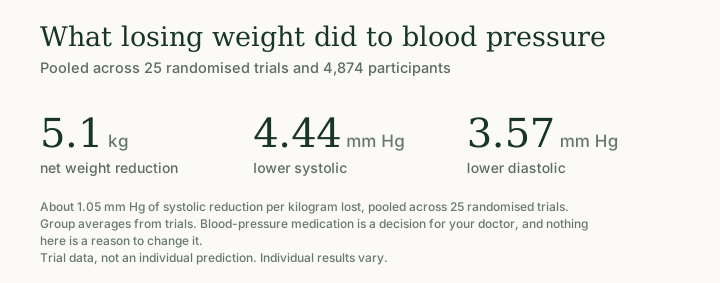
How much does losing weight lower blood pressure?
About 1 mm Hg of systolic pressure per kilogram lost, from the meta-analysis that anchors this whole subject.
Pooling 25 randomised trials across 4,874 participants, a net weight reduction of 5.1 kg lowered systolic pressure by 4.44 mm Hg and diastolic by 3.57 — working out at 1.05 mm Hg systolic per kilogram. Within the same analysis there was a dose-response: losing more than 5 kg gave 6.63/5.12, losing 5 kg or less gave 2.70/2.01. Reductions were larger in populations taking antihypertensive drugs (Neter 2003).
One caution belongs with that figure and is easy to lose. It is a straight line fitted across trials whose average loss was about 5 kg, so it does not extrapolate: the bariatric trials below lost far more weight than that for a pooled blood-pressure change of the same modest size.
The confidence behind that number is lower than the number looks. A Cochrane review of weight-reducing diets specifically in people with hypertension found weight falling 4.0 kg at high certainty — but rated the blood-pressure effect, 4.5 mm Hg systolic, as low certainty, resting on three trials and 731 participants. No included study measured mortality as a predefined outcome (Semlitsch 2021).
The effect sizes agree closely. The confidence does not. Both belong in any honest account.
What happens over three years
The blood-pressure difference mostly goes, because the weight mostly goes — and something more useful survives it.
In the Trials of Hypertension Prevention, 1,191 adults with high-normal blood pressure and not on medication lost 4.4 kg at six months, 2.0 kg at 18 months and 0.2 kg at 36 months. By three years the average participant was back to their starting weight (Stevens 2001). Blood pressure followed the same shape: 3.7/2.7 mm Hg at six months down to 1.3/0.9 at 36 months (TOHP II 1997).
Now the part worth reading twice. Even as the average effect faded, the number of people developing hypertension stayed lower — relative risks of 0.78 to 0.82 through 48 months, the investigators concluding that reductions in hypertension incidence were achieved despite the declining average effect (TOHP II 1997). And among participants who lost at least 4.5 kg and held it for 30 months, the relative risk of developing hypertension was 0.35 (Stevens 2001).
The benefit belongs to the maintainers. That is an argument for designing the exit into a weight-loss programme from the start, rather than treating maintenance as whatever happens afterwards.
Two famous numbers that are not about weight loss
Both come up constantly in weight-loss content, and neither measures what losing weight does.
The DASH diet's blood-pressure figures. Both DASH trials deliberately fed participants to hold body weight constant — the first states that sodium intake and body weight were maintained at constant levels, the second adjusted caloric intake throughout to keep weight constant (Appel 1997, Sacks 2001). They quantify what dietary composition and sodium do at a stable weight. They contain no weight-loss signal at all. The widely-quoted 11 mm Hg is doubly misplaced in this context: it is a diet-composition effect, and it is the hypertensive subgroup only — 133 of 459 participants. The trial's overall combination-diet result was 5.5/3.0 (Appel 1997).
Singapore's own hypertension trial. SingHypertension enrolled 916 adults in local primary care and lowered systolic pressure by 3.33 mm Hg. It worked through medication titration and coaching, and it explicitly reported that BMI and waist circumference did not differ between the intervention and control arms (Jafar 2022). It is a good trial and it is not evidence that weight loss lowers blood pressure in Singapore. No local trial has demonstrated that.
What surgery shows, and where the evidence disagrees with itself
Large sustained weight loss changes how much medication people need — and two long studies disagree about whether it prevents hypertension in the first place.
GATEWAY randomised 100 adults with hypertension on at least two drugs at maximum dose. At 12 months, 83.7% of the surgical group had cut their antihypertensive medication by at least 30% while holding blood pressure under 140/90, against 12.8% of controls, and 51% were off all antihypertensive medication against none (Schiavon 2018). At five years, 80.7% against 13.7%, with 46.9% against 2.4% still off medication entirely (Schiavon 2024).
The Swedish Obese Subjects study points the other way, and it is serious. At eight years, with weight loss maintained at 16.3%, the odds ratio for developing diabetes was 0.16 — a large protective effect — while the odds ratio for developing hypertension was 1.01, meaning no effect at all. The authors state that maintained weight reduction strongly counteracted the development of diabetes over eight years but showed no long-term effect on the incidence of hypertension (Sjöström 2000).
These do not reconcile by hand-waving. GATEWAY is randomised, 100 people, five years, in people who already had hypertension. Swedish Obese Subjects is observational, 2,188 people, eight years, looking at whether hypertension develops. They are answering different questions in different populations, and both results stand.
One number keeps the surgical figures in proportion: pooling 29 randomised trials of bariatric surgery, systolic pressure fell 4.51 mm Hg (Dastjerdi 2025). Most of the benefit is banked as medication withdrawal, not as a dramatically lower reading.
Lower blood pressure is not the same as fewer heart attacks
Look AHEAD tested that step directly, and did not find it.
The trial randomised overweight and obese adults with type 2 diabetes to an intensive lifestyle intervention and followed them for a median 9.6 years. It was stopped early for futility. The primary cardiovascular composite gave a hazard ratio of 0.95, and the conclusion is unambiguous: an intensive lifestyle intervention focusing on weight loss did not reduce the rate of cardiovascular events in overweight or obese adults with type 2 diabetes (Look AHEAD 2013).
Improving a risk factor and improving an outcome are separate claims, and only the first is well supported here.
The Singapore picture
Blood pressure is the condition in this cluster where the local data is strongest, and the striking figure is not the prevalence.
In the National Population Health Survey 2024, measured rather than self-reported, crude hypertension prevalence among adults aged 18 to 74 was 33.8%. Of those, 51.2% had never been diagnosed. Among people who did know they had it, 60.4% were poorly controlled (NPHS 2024). Roughly half of Singaporean adults with high blood pressure do not know.
Singapore's current hypertension guidance lists weight reduction if overweight or obese among the lifestyle interventions for elevated blood pressure, and separately names obstructive sleep apnoea as a cause of secondary hypertension. It gives no figure for blood-pressure reduction per kilogram (ACE 2023).
Where this sits beside our criteria
Our eligibility criteria are a BMI of 25 and above alongside a related health condition. High blood pressure is one of the conditions that can qualify. Being eligible on account of a condition and being treated for that condition are different things: GetLean is a weight-management service, and blood pressure is managed by the doctor already looking after it.
If you have diagnosed hypertension, the route that is actually yours is the Chronic Disease Management Programme — hypertension is the second of its 23 covered conditions, which makes its management MediSave-claimable at polyclinics and more than 1,250 GP and private specialist clinics (MOH). No medicine in this class is registered in Singapore for treating hypertension; it appears in the Singapore-registered product information only as an example of a weight-related comorbidity that can qualify an overweight patient for weight management (Singapore NDF).
Nothing on this page is a reason to change how you take a blood-pressure tablet. That decision belongs to the doctor who prescribed it, and it is made on readings rather than on the scale.
How the BMI thresholds work is in am I eligible. The neighbouring conditions are covered in sleep apnoea and body weight and prediabetes and body weight, and the whole cluster sits under conditions and body weight.
Common questions
Does losing weight lower blood pressure?
Yes. Pooling 25 randomised trials, an average 5.1 kg loss lowered systolic pressure by 4.44 mm Hg and diastolic by 3.57, working out at roughly 1 mm Hg per kilogram (Neter 2003).
Can I stop my blood pressure tablets if I lose weight?
That is a decision for the doctor who prescribed them, and stopping without one is not safe. What the trials show is that medication reduction becomes possible for some people after large, sustained weight loss — in a surgical trial, 83.7% cut their medication by at least 30% while holding blood pressure under 140/90 (Schiavon 2018).
How long does the blood pressure benefit last?
It tracks the weight. In a three-year trial the average participant was back to starting weight by 36 months and the blood-pressure difference had largely faded (Stevens 2001), though the reduction in new hypertension persisted (TOHP II 1997).
Is the DASH diet's 11 mm Hg a weight-loss result?
No. Both DASH trials deliberately fed participants to keep body weight constant (Appel 1997, Sacks 2001), so their results measure dietary composition and sodium. The 11 mm Hg figure is also from the hypertensive subgroup only.
How common is high blood pressure in Singapore?
In the National Population Health Survey 2024, 33.8% of adults aged 18 to 74 had measured hypertension, 51.2% of them previously undiagnosed, and 60.4% of those already diagnosed were poorly controlled (NPHS 2024).