Weight loss improves obstructive sleep apnoea. It rarely resolves it. Across the randomised trials, breathing interruptions fall in proportion to the weight lost, remission is uncommon, and the more severe the apnoea was to begin with the less likely it is to go away — which makes this a smaller promise than most content on the subject offers, and a more useful one to plan around.
AHI, the apnoea–hypopnoea index: the number of times an hour that breathing stops or becomes shallow during sleep. Five to 14 is mild, 15 to 29 moderate, 30 and above severe. Remission is conventionally an AHI under 5.
Does losing weight cure sleep apnoea?
No, and the clearest evidence for that comes from the studies where the most weight came off.
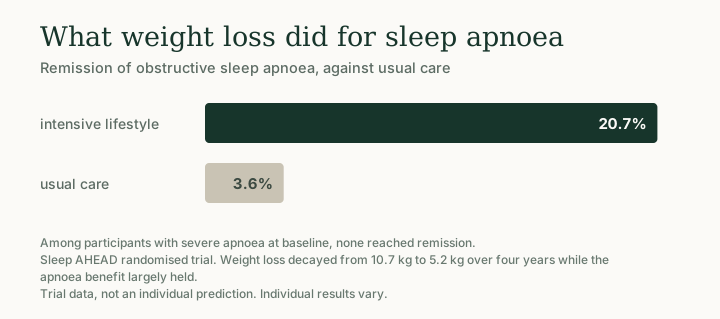
In Sleep AHEAD, the largest lifestyle trial, 264 adults with type 2 diabetes and sleep apnoea lost 10.8 kg over a year against 0.6 kg in the control group. The apnoea-hypopnoea index fell 9.7 events per hour further than control, and 13.6% reached remission against 3.5% (Foster 2009). Four years on, remission was 20.7% against 3.6% (Kuna 2013). Real, and a minority.
The surgical evidence is the strongest single citation on the question, because it removes the objection that not enough weight was lost. Pooling 12 studies with sleep studies before and after bariatric surgery, mean BMI fell from 55.3 to 37.7 — a drop far beyond anything a lifestyle programme achieves — and the mean AHI still landed at 15.8, squarely in the moderate range. The authors' conclusion is that patients should not expect a cure of sleep apnoea after surgical weight loss (Greenburg 2009).
Severity is the other half of the answer. Among the Sleep AHEAD participants who had severe apnoea, none had remission over four years, and few even moved down to mild (Kuna 2013).
How much does each kilogram change?
About 0.4 to 0.5 fewer breathing interruptions per hour, per kilogram — a figure two randomised trials in different populations converge on.
Sleep AHEAD's four-year analysis put it at 0.43 events per hour per kilogram (Kuna 2013). A Swedish trial using a very low energy diet put it at 0.50, with a confidence interval running from 0.11 to 0.88 (Johansson 2011). One is a diabetic American cohort and the other is a Swedish very-low-energy-diet cohort, so that agreement across different populations and different methods is the most robust quantitative finding in this literature.
It also does not extrapolate, and two findings say so directly. In the only randomised comparison of surgery against conventional weight loss in sleep apnoea, the surgical group lost 5.5 times more weight — 27.8 kg against 5.1 kg — and the difference in AHI between groups was 11.5 events per hour, which did not reach statistical significance in 60 participants (Dixon 2012). That is an underpowered result rather than proof that surgery does not help, but it sits awkwardly beside any simple linear story. Separately, near-identical weight losses of 19.2 and 18.2 kg produced very different AHI changes — 38 events per hour against 12 — depending on how severe the apnoea was at the start (Johansson 2009).
So the per-kilogram number describes an average across modest losses. It is not a conversion rate you can multiply out to a target.
What the benefit does and does not depend on
Not only the weight, which is the most interesting finding in this literature and the one with the most practical consequence.
Following the Sleep AHEAD participants for four years, weight loss decayed from 10.7 kg to 7.4 kg to 5.2 kg — roughly half of it regained. The AHI benefit did not decay with it, holding at 9.7, then 8.0, then 7.7 events per hour. The effect was related to weight loss, and also to the intervention independently of weight loss (Kuna 2013). The benefit outlasted the weight loss that produced it, which argues the mechanism is not purely mass.
Pushing the other way, sleep apnoea worsens on its own. In 2,968 adults followed for five years in the Sleep Heart Health Study, sleep-disordered breathing progressed over time even in those whose weight was stable (Newman 2005). Losing weight slows a moving target rather than resetting it.
How certain is any of this?
Less certain than the number of studies suggests, and the most recent assessment says so plainly.
The 2026 meta-analysis pooling 18 randomised trials and 2,242 participants found the AHI fell by 11.10 events per hour — but heterogeneity ran above 90%, and the overall certainty of evidence was rated very low by GRADE (Chen 2026). An earlier pooled analysis found the AHI falling from 52.5 to 28.3 events per hour, which sounds decisive until you notice the endpoint is still moderate sleep apnoea; its authors describe dietary weight-loss programmes as adjunct rather than curative therapy (Anandam 2013).
That is also how the American Thoracic Society frames it. Its guideline makes a strong recommendation for comprehensive lifestyle intervention in overweight adults with sleep apnoea — as part of treatment, explicitly not as a replacement for it (ATS 2018).
None of these trials measured whether a lower AHI leads to fewer heart attacks, strokes or deaths. Improving the index is not the same as improving an outcome, and nobody here tested the second thing.
What the Singapore picture looks like
There is no national statistic, which is worth knowing before you trust any figure you are shown.
The National Population Health Survey measures hypertension, obesity and diabetes. It does not measure sleep apnoea anywhere in the report (NPHS 2024). The number in circulation as a national figure comes from a community study: in a multiethnic Singaporean sample, weighted prevalence of moderate-to-severe sleep-disordered breathing was 30.5%, and 91.0% of those people did not know they had it. That estimate rests on 242 home sleep tests using portable monitors rather than full overnight polysomnography, so it is a community study rather than national surveillance (Tan 2016).
The same study contains the most useful local illustration in this whole subject. Broken down by ethnicity, moderate-to-severe rates were 32.1% among Chinese participants, 33.8% among Malays and 16.5% among Indians — while mean BMI ran the other way, 23.3, 26.0 and 25.4 respectively (Tan 2016). The leanest group had roughly double the rate of a heavier one. Body weight matters here. It is not the whole story, and this is Singapore data rather than borrowed data making that point.
Singapore's 2025 consensus statements recommend screening for sleep apnoea in patients with hypertension, cardiovascular disease, diabetes or obesity, and recommend weight management in patients with sleep apnoea who are overweight or obese (Academy of Medicine Singapore 2025). Both are strong recommendations. Weight management appears there as part of the care of the condition, alongside its other treatment rather than instead of it.
Where this sits beside our criteria
Our eligibility criteria are a BMI of 25 and above alongside a related health condition. Obstructive sleep apnoea is one of the conditions that can qualify. Being eligible on account of a condition and being treated for that condition are different things: GetLean is a weight-management service, and sleep apnoea is managed by the doctor or sleep service already looking after it.
That distinction is not a technicality. No medicine in this class is registered in Singapore for treating sleep apnoea; the condition appears in the registered product information only as an example of a weight-related comorbidity that can qualify an overweight patient for weight management (Singapore NDF). What the trial evidence on GLP-1 medication and sleep apnoea actually measured, and in whom, is set out in the long-term effects of GLP-1 medication. How the BMI figures work, and why Singapore uses lower ones, is in am I eligible. The rest of this cluster is in conditions and body weight, and the closest neighbour to this article is blood pressure and body weight.
If you already have a sleep apnoea diagnosis, keep the doctor who made it in the loop. Any change to CPAP belongs to them, and it belongs on a repeat sleep study rather than on a number from the bathroom scale.
This page assumes you already know you have sleep apnoea. If that is not settled — or if you are wondering whether the snoring, the broken nights or a partner's account add up to anything — sleep apnoea: the signs, and why most cases are missed covers which signs actually predict it, and why 91% of people with it in a Singapore study did not know.
Common questions
Does losing weight cure sleep apnoea?
Rarely. In the largest lifestyle trial 13.6% reached remission at one year against 3.5% in the control group (Foster 2009), and among participants with severe apnoea followed for four years, none did (Kuna 2013).
How much weight do I need to lose to improve sleep apnoea?
Across two randomised trials each kilogram lost was associated with roughly 0.4 to 0.5 fewer breathing interruptions per hour (Kuna 2013, Johansson 2011). That figure is an average across small losses and does not scale up to large ones.
Can I stop CPAP if I lose weight?
That is a decision for the doctor managing your apnoea, made on a repeat sleep study rather than on the scale. Even after bariatric surgery took mean BMI from 55.3 to 37.7, the pooled average apnoea-hypopnoea index remained 15.8 — still in the moderate range (Greenburg 2009).
How common is sleep apnoea in Singapore?
There is no national figure. The National Population Health Survey does not measure it (NPHS 2024). One community study of a multiethnic Singaporean sample found 30.5% with moderate-to-severe sleep-disordered breathing and 91.0% of those previously undiagnosed (Tan 2016).
Is sleep apnoea only about body weight?
No. In that same Singapore study the group with the lowest average BMI had about double the moderate-to-severe rate of the group with a higher average BMI (Tan 2016), so body weight is one contributor among several.