People arrive at a weight-management service in two different ways. Some want to lose weight. Others have been told by a doctor to lose weight, because something turned up — a blood-pressure reading, a glucose result, a sleep study, an incidental finding on a scan. This guide is for the second group, and it covers what the evidence actually shows weight loss does to four conditions, what it does not do, and where the Singapore data runs out.
One thing is worth saying at the top, because it shapes everything below. Having a weight-related condition can make someone eligible for a weight-management programme. It does not make that programme a treatment for the condition.
Eligibility and indication: eligibility is whether your situation fits what a service is set up to help with. An indication is what a medicine is registered by the regulator to treat. A condition can appear in the first sense — as a reason someone qualifies for weight management — without appearing in the second sense at all. Every condition on this page is in that position in Singapore.
What all four conditions have in common
Three things, and they are more useful than any individual figure.
The effect is graded. In each condition the benefit rises with the amount of weight lost rather than switching on at a threshold. Blood pressure falls by about 1.05 mm Hg of systolic pressure per kilogram in the meta-analysis of 25 randomised trials (Neter 2003). Sleep apnoea improves by roughly 0.43 breathing interruptions an hour per kilogram (Kuna 2013). Liver histology improves steadily with the percentage of body weight lost (Vilar-Gomez 2015). None of these is a conversion rate you can multiply out — they are averages fitted across trials of modest weight loss, and the sections below explain why they break at the top end.
Improvement is common and resolution is not. This is the honest headline across the whole cluster. After bariatric surgery took mean BMI from 55.3 to 37.7, mean sleep apnoea severity was still 15.8 events an hour, in the moderate range, and the authors conclude patients should not expect a cure (Greenburg 2009). Among Sleep AHEAD participants with severe apnoea, none remitted over four years (Kuna 2013). Prediabetes is the exception that proves the rule, and even there reverting to normal glucose is not the same as being back to normal on every measure.
The benefit belongs to the people who keep the weight off. In the Trials of Hypertension Prevention the average participant was back to their starting weight by 36 months, and the average blood-pressure difference faded with it — but participants who lost at least 4.5 kg and held it for 30 months had a relative risk of hypertension of 0.35 (Stevens 2001). Maintenance is where the benefit is, which is why the exit belongs in the plan from the start rather than being whatever happens when the programme ends.
Where the Singapore data is strong, and where it stops
It varies more than you would expect between conditions that are usually discussed together.
Blood pressure has the best local data in the cluster. The National Population Health Survey measures it directly rather than by self-report: crude prevalence of 33.8% among adults aged 18 to 74, of whom 51.2% had never been diagnosed, and 60.4% of those who had been diagnosed were poorly controlled (NPHS 2024). Roughly half of Singaporean adults with high blood pressure do not know.
Prediabetes has the best local outcome data. The Singapore impaired glucose tolerance follow-up re-examined 297 people after eight years: 35.1% developed diabetes, 23.0% stayed impaired, and 41.4% reverted to normal glucose tolerance (Wong 2003). Both directions, from one local cohort.
Sleep apnoea has no national statistic at all. The National Population Health Survey does not measure it (NPHS 2024). The figure that circulates as a national number comes from a community study which found 30.5% with moderate-to-severe sleep-disordered breathing and 91.0% of them undiagnosed (Tan 2016) — a good study, and not national surveillance.
Fatty liver has neither. Singapore's complete published set of 29 ACE Clinical Guidances includes hypertension and pre-diabetes and contains nothing on fatty liver, obesity, weight management or BMI (ACE repository). There is no national screening programme for it. Any Singapore prevalence percentage you meet for fatty liver should be traced to its source before it is believed.
Knowing which of those four situations you are in changes how much weight to put on a number someone quotes at you.
The four conditions, one article each
Each of these goes into a single condition properly — what the trials measured, in whom, and what must not be concluded from them.
Sleep apnoea and body weight. Weight loss improves obstructive sleep apnoea and rarely resolves it. Covers the remission rates from the largest lifestyle trial and from surgery, why the per-kilogram figure does not extrapolate, and the Singapore study whose leanest ethnic group had roughly double the rate of a heavier one.
Blood pressure and body weight. About 1 mm Hg per kilogram, with the certainty rating attached. Covers what happens over three years, why the DASH diet's famous figures are not weight-loss results, and where the surgical and observational evidence disagree with each other.
Prediabetes and body weight. The condition where the news is best and the local data is strongest. Covers why Singapore does not diagnose prediabetes by HbA1c, the eight-year Singapore reversion figure, and why the two long-term prevention trials disagree about complications.
Fatty liver and body weight. The dose-response is real and steep, and almost nobody in the study reached the dose. Covers the denominator behind the famous resolution figures, and why Singapore has no prevalence number worth quoting.
Long-term effects of GLP-1: what the big trials show. Separate from the four above, and deliberately so. Where the drug-trial evidence lives — what the cardiovascular, kidney and sleep-apnoea trials found, how narrow the enrolled populations were, and how far the follow-up extends.
What is registered here, and what is not
None of these conditions is something this class of medicine is registered to treat in Singapore.
The registered weight-management indication names dysglycaemia, hypertension, dyslipidaemia, obstructive sleep apnoea and cardiovascular disease — but it names them as examples of weight-related comorbidities that qualify an overweight patient for weight management (Singapore NDF). They appear as entry criteria, not as targets. A medicine registered for weight management in a patient who has sleep apnoea is not a medicine registered for sleep apnoea, and the distinction is the regulator's, not ours.
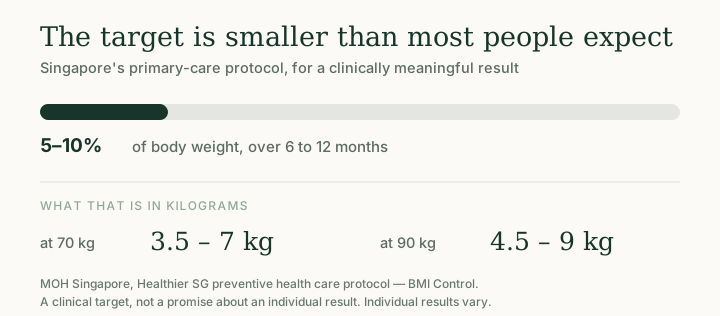
Singapore's primary-care protocol works from a similar but longer list — type 2 diabetes, hypertension, lipid disorder, fatty liver, polycystic ovarian syndrome, obstructive sleep apnoea and metabolic syndrome — and uses it the same way, as conditions that change the BMI threshold at which intervention is considered (MOH protocol). Its weight-loss target is 5 to 10% of body weight over 6 to 12 months.
Improving a condition is not the same as improving an outcome
This is the step most content skips, and it has been tested directly.
Look AHEAD randomised overweight and obese adults with type 2 diabetes to an intensive lifestyle intervention and followed them for a median 9.6 years. Weight came off and blood pressure improved. The trial was stopped early for futility: the hazard ratio for the primary cardiovascular composite was 0.95, and the conclusion states that an intensive lifestyle intervention focusing on weight loss did not reduce the rate of cardiovascular events in this population (Look AHEAD 2013).
That does not make the risk-factor improvements worthless. It means the chain from "a number improved" to "something bad was prevented" is a separate claim requiring separate evidence, and in the trial designed to test it in this population, it did not hold.
Earlier in the same disease course it did hold. Following people with impaired glucose tolerance for 30 years, the Da Qing study found fewer microvascular complications, fewer cardiovascular deaths, fewer deaths from any cause and average life expectancy 1.44 years longer (Gong 2019). So the honest general statement is not that the chain never holds — it is that it has to be demonstrated for the population and the stage in question, and cannot be assumed from an improved number.
Where this sits beside our criteria
Our eligibility criteria are a BMI of 25 and above alongside a related health condition. Being eligible on account of a condition and being treated for that condition are different things: GetLean is a weight-management service, and each of these conditions stays with the doctor already managing it.
For two of the four, there is a specific route that is already yours. Diabetes and pre-diabetes are named together as the first of the 23 conditions on MOH's Chronic Disease Management Programme, and hypertension is the second — which makes their management MediSave-claimable at polyclinics, specialist outpatient clinics and more than 1,250 GP and private specialist clinics (MOH). If you have one of those diagnoses, that is where the condition is managed, whatever else you decide to do about your weight.
What our criteria are, how they sit beside the three published BMI scales Singapore runs at once, and what "a related health condition" means in practice are set out in am I eligible for GLP-1 treatment. The screening that rules people out is in who should not take GLP-1 medication.
Common questions
Which conditions count as weight-related?
Singapore's primary-care protocol names type 2 diabetes, hypertension, lipid disorder, fatty liver, polycystic ovarian syndrome, obstructive sleep apnoea and metabolic syndrome (MOH protocol). The registered product information gives a shorter list built around dysglycaemia, hypertension, dyslipidaemia, sleep apnoea and cardiovascular disease (Singapore NDF).
Does losing weight treat these conditions?
It improves them by measurable amounts and rarely resolves them. Roughly 1 mm Hg of systolic blood pressure per kilogram (Neter 2003) and about 0.4 fewer breathing interruptions an hour per kilogram (Kuna 2013) are the best-evidenced figures, and both are averages across modest losses rather than conversion rates.
If I have one of these conditions, can GetLean treat it?
No. Being eligible on account of a condition and being treated for that condition are different things. We are a weight-management service, and each of these conditions stays with the doctor already managing it. None of them is a registered indication for this class of medicine in Singapore (Singapore NDF).
Does improving a condition mean living longer?
It does not follow automatically, and the two long trials point different ways. Look AHEAD improved weight and blood pressure in adults who already had type 2 diabetes, yet was stopped early for futility with a hazard ratio of 0.95 for cardiovascular events (Look AHEAD 2013). At the earlier prediabetes stage, the Da Qing study found the opposite over 30 years: fewer deaths from any cause and average life expectancy 1.44 years longer (Gong 2019). Improving a risk factor and improving an outcome are separate claims, and each needs its own evidence.
How good is Singapore's data on these conditions?
It varies enormously. Blood pressure and prediabetes have strong national or local data (NPHS 2024, Wong 2003). Sleep apnoea is not measured in the national survey at all, and fatty liver has neither a national guideline nor a screening programme (ACE repository).