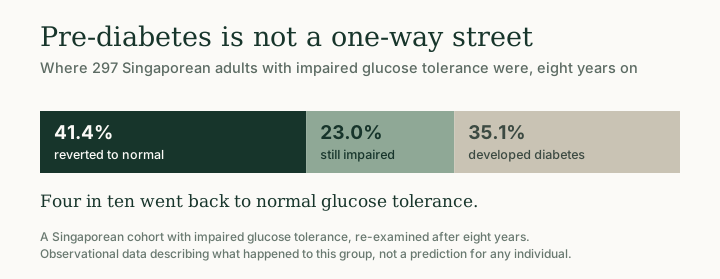
Prediabetes is not a one-way street, and Singapore has its own data showing it. When 297 Singaporeans with impaired glucose tolerance were re-examined eight years later, more of them had gone back to normal than had developed diabetes. Body weight is the factor most consistently associated with which direction someone travels — which makes this the condition in this cluster where the local evidence is strongest and the news is best.
Prediabetes: blood glucose above the normal range but below the threshold for diabetes. In Singapore it is diagnosed as impaired fasting glucose or impaired glucose tolerance, on glucose measurements rather than on HbA1c.
How is prediabetes diagnosed in Singapore?
Not by HbA1c, which is the single most common error made about this condition locally.
Singapore's clinical guidance states it plainly: glycated haemoglobin is not currently indicated as a diagnostic test for pre-diabetes here. The thresholds are set on glucose instead — impaired fasting glucose means a fasting plasma glucose of 6.1 to 6.9 mmol/L with a 2-hour post-load glucose under 7.8, and impaired glucose tolerance means a fasting glucose under 7.0 with a 2-hour post-load glucose of 7.8 to 11.0 mmol/L (ACE 2021).
So the HbA1c band of 5.7 to 6.4% that appears throughout international content is the American criterion. It is not what a Singapore doctor is working to, and someone who reads their own HbA1c against it is reading a different country's standard.
Around 14% of Singaporeans have impaired glucose tolerance (ACE 2021). Separately, among Singaporeans who have diabetes, 16.5% do not know it (NPHS 2024) — about one in six, not the one in three that older material still repeats.
Does prediabetes always become diabetes?
No, and the Singapore follow-up study is the clearest answer available anywhere.
Researchers identified people with impaired glucose tolerance from a 1992 survey and re-examined them in 2000, using an oral glucose tolerance test at both ends. Of 297 people with impaired glucose tolerance at baseline, after eight years: 35.1% had developed diabetes, 23.0% were still impaired, and 41.4% had reverted to normal glucose tolerance (Wong 2003).
More went back than went forward. A page that reports only the progression figure has given you half of a Singapore finding, and the less encouraging half.
Reverting is not the same as being back to normal
The same study makes that distinction, and it is the most useful thing in it.
People who reverted to normal glucose tolerance remained more obese and had higher blood pressure than those who had been normal throughout — at both the 1992 and the 2000 examination. Their triglycerides, HDL cholesterol and insulin resistance, on the other hand, became indistinguishable from the always-normal group. The authors' conclusion is that some but not all cardiovascular risk factors normalise when glucose does, and that continued surveillance and treatment may be important even after someone reverts (Wong 2003).
A normal glucose result is a good result. It is not a discharge.
What lifestyle change achieves
A large reduction in how many people go on to develop diabetes, from the trial that established the field.
In the Diabetes Prevention Program, a lifestyle intervention built around weight loss and physical activity reduced the incidence of type 2 diabetes by 58% against placebo over an average of 2.8 years — more effective than metformin, which reduced it by 31%. About 7 people would need to take part in the lifestyle programme to prevent one case of diabetes over three years (Knowler 2002).
Singapore's own guidance gives a figure for the same idea in a local context: lifestyle intervention reduces the risk of developing type 2 diabetes by 31 to 37% over 2 to 6 years (ACE 2021).
Does preventing diabetes prevent its complications?
The two long-term trials disagree, and anyone who tells you otherwise has read one of them.
The Diabetes Prevention Program Outcomes Study followed its participants for 15 years. Diabetes incidence stayed lower — down 27% in the lifestyle group. But the aggregate microvascular outcome was not significantly different between the treatment groups: 11.3% in the lifestyle group against 12.4% on placebo. Within the same paper, a different comparison — people who did not develop diabetes against people who did, regardless of which group they were randomised to — found 28% fewer microvascular complications (DPPOS 2015).
The Da Qing study, following people with impaired glucose tolerance for 30 years, found the opposite. Diabetes onset delayed by a median 3.96 years, microvascular complications down at a hazard ratio of 0.65, fewer cardiovascular deaths, fewer deaths from any cause, and average life expectancy 1.44 years longer (Gong 2019).
Both results are real, and the design difference is the reason they can coexist. A randomised comparison asks what the intervention did to the group it was assigned to. An observational comparison asks what happened to people who ended up in a particular state. The second is more flattering and less reliable, because whatever caused someone to avoid diabetes may also be causing the better outcome. Fifteen years of randomised follow-up did not show a microvascular benefit between groups; thirty years in a different population did. That is where the evidence stands.
What happens once diabetes is established
Remission becomes much harder, which is the argument for paying attention at the prediabetes stage.
Look AHEAD tested an intensive lifestyle intervention in adults who already had type 2 diabetes. Any remission — partial or complete — reached 11.5% in the first year and 7.3% at year four, against 2.0% in the control group. Sustained remission for a full four years was 3.5%. The authors describe these as exploratory analyses, and their own word for the absolute rates is "modest" (Gregg 2012).
Set that beside the 41.4% who reverted from impaired glucose tolerance in Singapore (Wong 2003) and the difference between the two stages is stark. Different populations and different studies, so it is not a like-for-like comparison — but the direction of it is not in doubt.
Where this sits beside our criteria
Our eligibility criteria are a BMI of 25 and above alongside a related health condition. Prediabetes is one of the conditions that can qualify. Being eligible on account of a condition and being treated for that condition are different things: GetLean is a weight-management service. We do not treat prediabetes or diabetes, and glucose is managed by the doctor already looking after it.
That line matters more here than anywhere else in this cluster. Prediabetes appears in the Singapore-registered product information only as an example of a weight-related comorbidity that can qualify an overweight patient for weight management (Singapore NDF) — not as something the medicine is registered to treat.
If you have been told you have prediabetes, the route that is yours is the Chronic Disease Management Programme. Diabetes and pre-diabetes are named together as the first of its 23 covered conditions, which makes their management MediSave-claimable at polyclinics, specialist outpatient clinics and more than 1,250 GP and private specialist clinics (MOH). Start there, and keep that doctor in the loop about anything else you do.
How the BMI thresholds work is in am I eligible. The conditions that most often travel with this one are covered in fatty liver and body weight and blood pressure and body weight, and the cluster sits under conditions and body weight.
Before any of this is measured, there is sometimes something to see. The signs of insulin resistance you can see covers the skin changes that can appear years earlier — most recognisably a darkened patch at the back of the neck that will not wash off — and why none of them is a substitute for the blood test.
Common questions
Does prediabetes always turn into diabetes?
No. In a Singapore study that re-examined 297 people with impaired glucose tolerance after eight years, 35.1% had developed diabetes, 23.0% were still impaired and 41.4% had reverted to normal glucose tolerance (Wong 2003).
How is prediabetes diagnosed in Singapore?
On glucose measurements, not HbA1c. Singapore's clinical guidance states that glycated haemoglobin is not currently indicated as a diagnostic test for pre-diabetes here, and sets thresholds of a fasting glucose of 6.1 to 6.9 mmol/L, or a 2-hour post-load glucose of 7.8 to 11.0 mmol/L (ACE 2021).
Is the HbA1c range of 5.7 to 6.4% used in Singapore?
That band comes from American criteria. Singapore diagnoses pre-diabetes on fasting or post-load glucose instead, and its guidance says explicitly that HbA1c is not currently indicated as a diagnostic test for it here (ACE 2021).
Does losing weight prevent diabetes?
In the Diabetes Prevention Program, a lifestyle intervention built around weight loss and activity reduced the incidence of diabetes by 58% over an average of 2.8 years (Knowler 2002). Singapore's own guidance puts the reduction at 31 to 37% over 2 to 6 years (ACE 2021).
If I prevent diabetes, do I avoid its complications?
The two long-term trials disagree. At 15 years the Diabetes Prevention Program Outcomes Study found no significant difference in microvascular complications between randomised groups (DPPOS 2015), while the Da Qing study at 30 years found fewer microvascular complications, fewer deaths and longer life expectancy (Gong 2019).