In body-composition sub-studies of GLP-1 trials, lean mass accounted for roughly a quarter of the weight lost in one peer-reviewed analysis, while a review of a second sub-study puts the figure closer to 40%. The number that gets far less attention is what happened in the placebo groups: they lost a similar share of lean mass. That is the finding this article is built around, because it changes what the problem actually is. Muscle loss is not something the medication does to you. It is what substantial weight loss does, whatever produces it.
Lean mass: everything in the body that is not fat — mostly muscle, but also bone, organ tissue and water. Trials measure lean mass; muscle is the part of it people care about.
How much of the weight lost is lean mass?
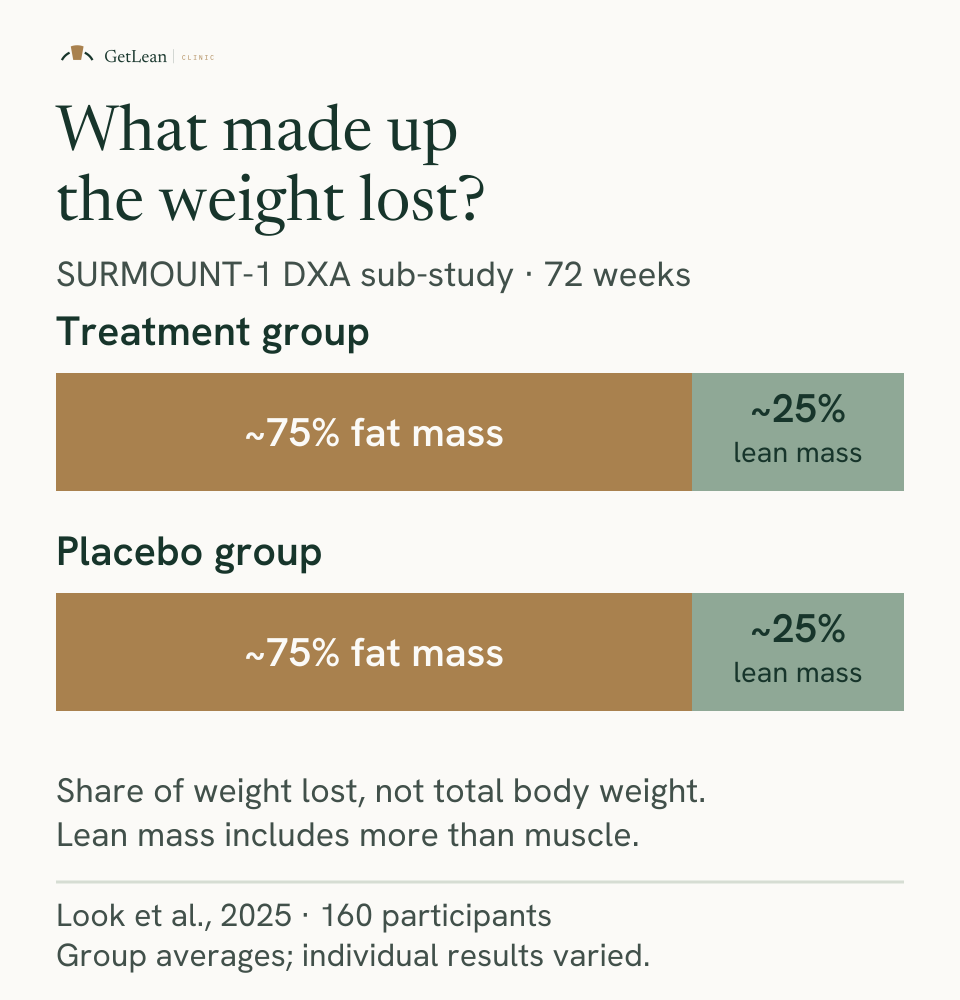
The clearest figure comes from the SURMOUNT-1 body-composition sub-study, which used DXA scans in 160 participants. The paper states it directly: of the body weight lost, approximately 75% was fat mass and 25% was lean mass — for both tirzepatide and placebo (Look 2025). In the tirzepatide arm, fat mass fell 33.9% and lean mass fell 10.9%; in the placebo arm, fat mass fell 8.2% and lean mass 2.6%.
The higher figure people quote comes from semaglutide. A 2025 review, citing the supplementary data of the STEP 1 body-composition sub-study, reports a mean weight reduction of 17.32 kg that included a 6.92 kg mean reduction in total lean mass — and states that 40% of the weight lost was lean mass (Mechanick 2025).
That 40% figure deserves a caveat that it is rarely given. It rests on a 140-person sub-study that was presented as a conference analysis rather than published as a standalone peer-reviewed trial paper (Wilding 2021), and its internal figures have not been fully reconciled. The 25% figure for tirzepatide, by contrast, is a verbatim sentence in a peer-reviewed paper that reports both arms. Both are worth knowing. They are not equally well established.
Does the medication cause the muscle loss?
On the sub-study evidence, no — and this is the part that reframes the whole question.
If GLP-1 medication were doing something specific to muscle tissue, the drug arm and the placebo arm would separate. In SURMOUNT-1 they did not: the lean-mass share of weight lost was about the same in both, and the authors note the proportion was "relatively consistent" across clinically relevant subgroups (Look 2025).
Compare that with ordinary dieting. A systematic review of weight-loss studies found the median proportion of weight lost as fat-free mass was about 14% on standard low-calorie diets and about 23% on very-low-calorie diets, with more severe restriction associated with more fat-free-mass loss (Chaston 2007). Diet-driven weight loss has always cost lean mass. Nobody built a public conversation around it, because diet-driven weight loss on that scale was uncommon.
So the mechanism is not mysterious. Lose a substantial amount of weight and a meaningful share of it comes from lean tissue. What has changed is the scale of the weight loss now being achieved, not the biology of what weight loss is made of. The muscle question became urgent because the results became large.
One more correction worth making, because it runs the other way. Some summaries describe these sub-studies as showing that lean body mass increased. It did not. Absolute lean mass fell. What rose was the proportion of remaining body mass that is lean tissue, because fat fell faster (Look 2025). Those are opposite claims.
Is there a reliable number to plan around?
No, and treating one as reliable is its own mistake.
The frequently quoted rule that about a quarter of weight lost is lean tissue has been examined directly, and the conclusion was that it is an oversimplification which shifts with age, inactivity and whether someone exercises (Heymsfield 2014). It is a rough group-level average, not a constant that applies to an individual.
The pooled dieting data show the same spread from a different angle: 14% on moderate restriction, 23% on severe restriction, 27% in men against 20% in women (Chaston 2007). The number moves with how the weight is lost and who is losing it.
Whether the speed of loss matters independently of its size is genuinely unsettled. Two randomised trials suggest it does: one reported 8.8% fat-free-mass loss on a very-low-calorie protocol against 1.3% on a slower one (Vink 2016), and another found 1.51 kg of lean-mass loss on a rapid protocol against 0.52 kg on a slow one at matched total weight loss (Ashtary-Larky 2017). A third randomised trial, comparing a four-week with an eight-week protocol at matched weight loss, found body-composition changes were similar in both groups (Coutinho 2018). Some evidence indicates rate matters on its own; it is not established.
There is also some evidence that lean-mass loss does not continue indefinitely. In a 106-person single-arm cohort followed for a year on semaglutide, lean mass fell by about 3.0 kg by month seven and then stabilised while fat loss continued, and mean handgrip strength improved by 4.5 kg at twelve months (Alissou 2026). That study had no comparison group, so it cannot show what is attributable to the medication, and grip strength is a measure of strength rather than of muscle mass. It is a useful signal, not a settled answer.
What actually protects muscle?
Resistance training, with enough protein to support it — the two inputs that protecting muscle on GLP-1 works through in full. This is where the evidence is strongest and least contested.
A meta-analysis covering 114 trials and 4,184 people with overweight and obesity found that where resistance training was combined with caloric restriction, lean mass was maintained — an effect size of roughly −0.3 kg that did not reach statistical significance (Lopez 2022). In other words, the trials that included resistance training did not show the lean-mass loss that trials without it do.
In older adults the effect has been quantified more directly. Pooling six randomised trials in obese older adults, adding resistance training to caloric restriction prevented an estimated 93.5% of the lean-body-mass loss otherwise seen — and did so without reducing fat loss or total weight loss (Sardeli 2018). That figure comes from a small evidence base in a specific age group and should not be read as a universal constant, but the direction is unambiguous.
Protein is the other half. The protein target and how to reach it on Singapore food is covered separately, because hitting it on a suppressed appetite is a practical problem rather than a knowledge problem.
At GetLean, our philosophy is that the medication is the catalyst and the plan around it decides what you keep. The sub-study data is the reason: the weight is going to come off either way, and what it is made of is the part that is still under your control. Individual results vary, and clinical-trial figures describe the populations studied.
A 2026 network meta-analysis of 262 trials put numbers on how the two most effective molecules differ on exactly this measure — one of them removed the most fat mass and the most lean mass. We set the figures out in what the head-to-head shows.
Common questions
How much of the weight lost on GLP-1 is muscle?
In a tirzepatide sub-study of 160 people, approximately 75% of the weight lost was fat mass and 25% was lean mass (Look 2025). A review citing semaglutide sub-study data reports around 40% (Mechanick 2025). There is no single fixed figure, and the proportion varies with how severe the deficit is, sex and age.
Is 40% of weight lost on GLP-1 really muscle?
That figure comes from a review's reading of a body-composition sub-study presented as a conference analysis, not from a standalone peer-reviewed trial paper (Mechanick 2025). It is worth knowing and worth attributing. The better-evidenced tirzepatide figure is lower, at about 25% (Look 2025).
Does GLP-1 medication cause more muscle loss than dieting?
The sub-study evidence says no. In SURMOUNT-1 the lean-mass share of weight lost was about 25% in both the tirzepatide arm and the placebo arm (Look 2025), and pooled dieting studies report 14–23% depending on how severe the restriction is (Chaston 2007). Weight loss costs lean mass regardless of what drives it.
Does GLP-1 medication build muscle?
No. In the sub-studies, absolute lean mass fell. What increased was the proportion of remaining body mass that is lean tissue, because fat mass fell faster (Look 2025). Those are different claims and are frequently confused.
How do you avoid losing muscle on GLP-1 medication?
Resistance training and adequate protein are the levers with evidence behind them. A meta-analysis of 114 trials found lean mass was statistically unchanged when resistance training accompanied a calorie deficit (Lopez 2022), and in obese older adults it prevented an estimated 93.5% of the lean-mass loss otherwise seen (Sardeli 2018). Ask a doctor whether resistance training is suitable for you before starting.