No published source sets a rule for how long after giving birth a GLP-1 medication may be started — not a drug label in any jurisdiction, not a regulator, and not a professional society. Breastfeeding does not have one answer either: the instruction differs between the two medicines in this class, between the US and EU documents, and between a drug label and the NIH's lactation database. Singapore's own lactation text is not published at all. This article sets out what each document actually says, how small the human evidence behind it is, and what is known about postpartum weight in Singapore, so that the conversation with your own doctor starts from the real position.
Postpartum weight retention: the weight still being carried above pre-pregnancy weight at a given point after delivery. Research usually measures it at six or twelve months.
How much weight do women keep after a pregnancy?
The most relevant figure for a Singapore reader comes from a local cohort. Among 379 first-time mothers followed in Singapore, 35% (132 of 379) were still carrying at least 5 kg above their pre-pregnancy weight at six months, and 31% (109 of 347) at twelve months (Loy 2024). The 5 kg mark is that study's own definition of "substantial" retention rather than a clinical threshold.
The same cohort compared feeding practices. Set against exclusive breastfeeding, mixed feeding carried a risk ratio of 1.85 (95% CI 1.15–2.99) and exclusive formula feeding 2.11 (1.32–3.28) for substantial retention at six months, attenuating by twelve months and appearing stronger in women who had entered pregnancy with overweight or obesity. Feeding mode was not randomised and weights were self-reported, so the finding is an association; the authors' own verb is that breastfeeding "may help mitigate" retention.
What happens during pregnancy carries forward. Pooling 34 observational studies, women who gained more than the recommended amount in pregnancy retained about 2.98 kg more at six months (95% CI 0.59–5.37), about 1.89 kg more between six and twelve months, and roughly 0.62 kg more for every extra kilogram gained in pregnancy at the 6–9 month mark (Meyer 2024). The six-month interval is wide and the studies were very heterogeneous, so the direction is firmer than the number. An earlier meta-analysis of nine cohorts found the difference persisting far longer — about 3 kg at three years and about 4.7 kg at fifteen years or more (Nehring 2011).
What Singapore's health authority says about the pace
The Health Promotion Board tells new mothers that "a weight loss of about 1 to 2kg a month is considered as a healthy amount to lose" and to "set realistic goals for weight loss over a period of one to two years", noting that it takes about nine months to grow a baby (HPB 2026). On intake while breastfeeding, the same page asks women to continue a balanced diet with sufficient calories and a variety of nutrients, because those matter for milk production.
That page is consumer health-promotion guidance rather than a clinical guideline, and it says nothing about weight-loss medication. It contains no BMI threshold and no timing rule.
Is there a rule about how soon after birth a GLP-1 can be started?
No. Labels, HSA, MOH, HPB and the published literature were searched, and no jurisdiction sets a postpartum interval. No professional-society statement on the question was located either. No trial, cohort or case series of GLP-1 medication started in the postpartum period for weight was found.
The washout rules that do exist run in the other direction — before conception, not after delivery. Semaglutide should be discontinued at least two months before a planned pregnancy according to both the US and EU documents; the EU document gives one month for tirzepatide, and the US document gives no pre-conception window at all (product information). The EU semaglutide information also states as a general instruction that semaglutide should not be used during pregnancy (EU SmPC). Those are pre-conception rules and they do not convert into a postpartum one.
So the timing question has no published answer to look up. It belongs to the doctor who knows the pregnancy, the delivery, the feeding plan and the rest of the medical history.
Breastfeeding: four documents, four positions
The instructions below are stated by document and jurisdiction on purpose, because they do not agree, and because the two molecules in this class split in opposite directions.
Semaglutide. The EU product information is the most restrictive: "Semaglutide should not be used during breast-feeding." Its basis is animal data — in lactating rats semaglutide was excreted in milk, so a risk to a breastfed child cannot be excluded (EU SmPC). The US prescribing information splits by formulation: for the oral tablet, breastfeeding is "not recommended", driven by the absorption-enhancer excipient rather than by semaglutide itself, which was below the limit of quantification; for the injection there are no data and no recommendation either way (US PI). The NIH's lactation database reaches the opposite conclusion from the EU: "Only injectable forms of semaglutide should be used during breastfeeding" (LactMed 2026).
Tirzepatide. Here the EU is the more permissive document: "Overall, tirzepatide could be considered for use during breast-feeding" (EU SmPC). The US label reports the pharmacokinetic data and stops there, drawing no conclusion (US PI). The NIH database sits between them — needing the medicine "is not a reason to discontinue breastfeeding", but it should be used "with caution... especially while nursing a newborn or preterm infant" (LactMed 2026).
Singapore. The national formulary publishes only sections 4.1 to 4.3 of the registered product information for both products — indications, dosing and contraindications — and directs readers to HSA's product insert for everything else (NDF Singapore). Section 4.6, which covers fertility, pregnancy and lactation, is not among them. There is therefore no Singapore breastfeeding instruction available to quote, and none of the four positions above may stand in for one.
A boundary worth stating alongside the tirzepatide material: tirzepatide's current registrations in Singapore carry a weight-management indication alongside the type 2 diabetes one, while the 2023 injection registration SIN16718P carries type 2 diabetes only (NDF Singapore). Its lactation record appears here as safety information about a medicine a reader may already have been prescribed.
How small the human evidence actually is
For semaglutide, the entire human milk-transfer evidence base is one study of eight women. Milk samples held in a human-milk biorepository were assayed at 0, 12 and 24 hours after a dose; semaglutide was not detected in any of them, and the modelled worst-case relative infant dose was 1.26%, well below the conventional 10% threshold (Diab 2024). That 1.26% is a modelled worst case computed from the assay's detection floor, not a measurement, and the study assayed milk rather than infants.
The largest systematic review of this literature — 36 studies, searched to September 2025 — describes the lactation data as "sparse" and rests its lactation conclusion on a single pharmacokinetic study (Ozbek 2026). That study is the eight-woman one above, so the review and the study are one body of evidence rather than two.
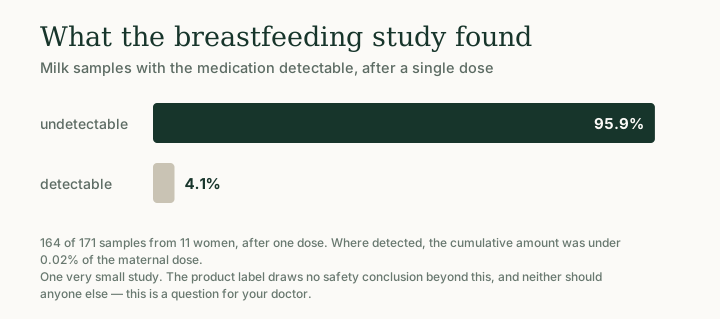
For tirzepatide, the whole record is 11 lactating women given a single 5 mg dose, in whom the drug was undetectable in 164 of 171 milk samples with a cumulative amount under 0.02% of the maternal dose (US PI). Weight-management maintenance doses run higher than 5 mg, and no milk data exist at those doses.
No infant blood levels have been measured in either drug. And the authors of the semaglutide milk study list plainly what their work did not touch: long-term infant outcomes, the safety of maternal nutrient intake, and the nutrient content of breast milk (Diab 2024). A medicine whose principal action is to reduce appetite raises an energy-intake question in a lactating woman that no study has yet answered.
What has been tested after birth
Diet and activity have been. Across 27 randomised trials with outcome data for about 3,485 women, a combined dietary and physical-activity programme after birth produced 2.49 kg more weight loss than no intervention (95% CI −3.34 to −1.63), and the difference was still 2.41 kg at twelve months (Dodd 2018). That figure is the difference from a no-intervention arm rather than a total, no included trial involved weight-loss medication, and the review notes that no included study reported maternal or infant outcomes in a subsequent pregnancy.
Where this decision belongs
With your own doctor, and earlier rather than later. The questions that decide it are ones only a clinician with your record can weigh: how the pregnancy and delivery went, whether you are breastfeeding and how old the baby is, what else you are taking, and what your weight has done since. Nothing in the published record answers those from a distance, and the documents that come closest disagree with each other by jurisdiction.
At GetLean, our philosophy is that the medication is a catalyst and the plan around it is what holds — protein, resistance training and a planned exit. That plan is worth building whatever the answer on medication turns out to be, and in the postpartum period it sits alongside HPB's advice to keep calories and nutrients sufficient while breastfeeding (HPB 2026). If you want to know where you stand, you can check your eligibility and raise the timing and feeding questions directly with the doctor at consultation.
Common questions
Can you take GLP-1 medication while breastfeeding?
There is no single answer, because the documents disagree. The EU product information for semaglutide states it should not be used during breast-feeding (EU SmPC), while the NIH lactation database concludes that only injectable forms should be used while breastfeeding (LactMed 2026). Singapore's own lactation section is not published, so no Singapore instruction exists to quote. This is a decision for your own doctor, with your feeding plan in front of them.
How soon after giving birth can you start a GLP-1 medication?
No published source sets a postpartum interval — not a drug label in any jurisdiction, not a regulator, and not a professional society. The washout rules that do exist run in the other direction, before conception (product information). Timing after delivery is a clinical judgement for the doctor who knows your pregnancy, delivery and feeding plan.
How much weight do women in Singapore keep after pregnancy?
In 379 first-time mothers followed in Singapore, 35% were still carrying at least 5 kg above their pre-pregnancy weight at six months and 31% at twelve months (Loy 2024). The 5 kg figure is that study's definition of substantial retention, not a clinical threshold.
Does breastfeeding help with postpartum weight?
The Singapore cohort found that mixed feeding and exclusive formula feeding were associated with roughly twice the risk of substantial weight retention at six months compared with exclusive breastfeeding (Loy 2024). Feeding mode was not randomised and weights were self-reported, so this shows an association rather than a cause, and the authors' own wording is that breastfeeding may help mitigate retention.
How much human evidence is there on GLP-1 medication in breast milk?
Very little. For semaglutide it is one study of eight women, in which the drug was undetectable in every milk sample (Diab 2024); for tirzepatide it is 11 women given a single 5 mg dose (US PI). No infant blood levels exist in either, and the largest systematic review describes the lactation evidence as sparse and rests on that same semaglutide study (Ozbek 2026).