Most guidance supports 1.2–1.6 grams of protein per kilogram of body weight per day during active weight loss to preserve muscle (Leidy 2015). On a GLP-1 medication, where appetite is deliberately suppressed, hitting that number takes planning — because the medication reduces hunger but does not reduce your body's need for protein. This article explains the evidence behind the target, why it matters more on a GLP-1 than on a standard diet, and how to reach it using food that is actually available in Singapore.
Lean mass: everything that is not fat — mostly muscle, but also bone, organ tissue, and water. Protecting lean mass during weight loss is the difference between getting lighter and getting leaner.
How much protein do you actually need on a GLP-1 medication?
The evidence-based range during active weight loss is approximately 1.2–1.6 g of protein per kg of body weight per day (Leidy 2015). For a person weighing 70–90 kg — a common range for people starting a GLP-1 programme in Singapore — that translates to roughly 85–145 g of protein per day, spread across meals.
The range exists because individual needs differ: age, activity level, how much muscle you are carrying, and how fast you are losing weight all shift the ideal number. The 1.2 g/kg end is a reasonable minimum; people who train with weights or who are losing weight rapidly benefit from pushing towards the upper end.
A practical way to work with this: calculate your target at both ends of the range using your current body weight, and aim to land somewhere in the middle on most days. Perfection is not the goal — consistency is.
Why does protein matter more when you are losing weight fast?
GLP-1 medication is effective. The question no one asks is what you are actually losing.
In a DXA body-composition sub-study of a major tirzepatide trial (SURMOUNT-1), approximately 25% of the weight lost was lean mass — not fat (Look 2025). This is not unique to that medication; it is what happens whenever someone loses weight quickly without adequate protein and resistance training. The medication accelerates weight loss; the same risk scales with it.
This is where protein earns its place. A meta-analysis of energy-restricted diets found that higher-protein approaches preserved approximately 0.43 kg more fat-free mass than standard-protein diets, across the same calorie restriction (Wycherley 2012). That figure sounds modest, but over the course of a programme lasting months, the cumulative difference in muscle retention is meaningful — especially because muscle loss is slow to reverse.
Individual results vary. What the evidence shows consistently is the direction: more protein during a deficit leads to better lean-mass retention.
How do you hit protein when your appetite is gone?
The appetite suppression from GLP-1 medication is the point — but it works against protein intake if you eat whatever feels easiest rather than what protects your muscle. Three habits close the gap.
Protein first. At every meal, eat your protein source before anything else. When capacity is limited, protein gets priority over rice, noodles, or vegetables. This is a single rule that changes the composition of almost every meal without requiring a different plate.
Target 25–30 g per eating occasion. Evidence from higher-protein diet research supports distributing protein across meals rather than concentrating it in one sitting (Leidy 2015). Three meals at 25–30 g each gets most people to their daily target without requiring large portions at any one sitting. Two meals and a protein drink is an equally valid approach.
Use liquids when solids are hard. On days when nausea or reduced appetite makes eating difficult, a protein drink — whether a commercially prepared shake or a blended option with milk and Greek yoghurt — delivers 20–30 g in a format that most people tolerate even when solid food does not appeal. Whole-food sources are preferable when appetite allows; liquids are a bridge, not a default.
Do people who train with weights need more?
Possibly, and the higher figure that circulates online is measured against a different yardstick than most people assume. A systematic review of energy-restricted resistance-trained athletes put their likely protein needs at 2.3–3.1 g per kg of fat-free mass per day, scaling upwards with the severity of the deficit and with leanness (Helms 2014). Fat-free mass is not body weight. For someone weighing 100 kg at 30% body fat, that range works out to roughly 161–217 g per day, not the 230–310 g the same numbers would give if you multiplied by total body weight.
Two further limits matter. That range was derived in lean, resistance-trained athletes — the inclusion criteria were men at or below 23% body fat and women at or below 35%, with more than six months of training behind them. Most people starting a GLP-1 programme are not in that population. And it is intended for people actively training with weights, not for general activity.
For most people on a GLP-1 programme who are not yet training consistently, the 1.2–1.6 g/kg range is the right starting point. If you are already lifting weights or plan to start — which matters enormously for protecting muscle — it is worth discussing protein targets with a doctor or sports dietitian, because the two inputs interact. More protein without training does less than protein paired with a stimulus to build and preserve muscle.
Singapore food translation
Singapore's food landscape is well suited to high-protein eating, but portion sizes and cooking methods vary enough that it is worth building a rough map. All figures below are approximate — actual protein content varies with portion size, preparation, and sourcing. For more detailed per-dish figures and hawker ordering strategies, see hawker dishes ranked by protein per calorie.
Animal proteins are the most protein-dense options commonly available:
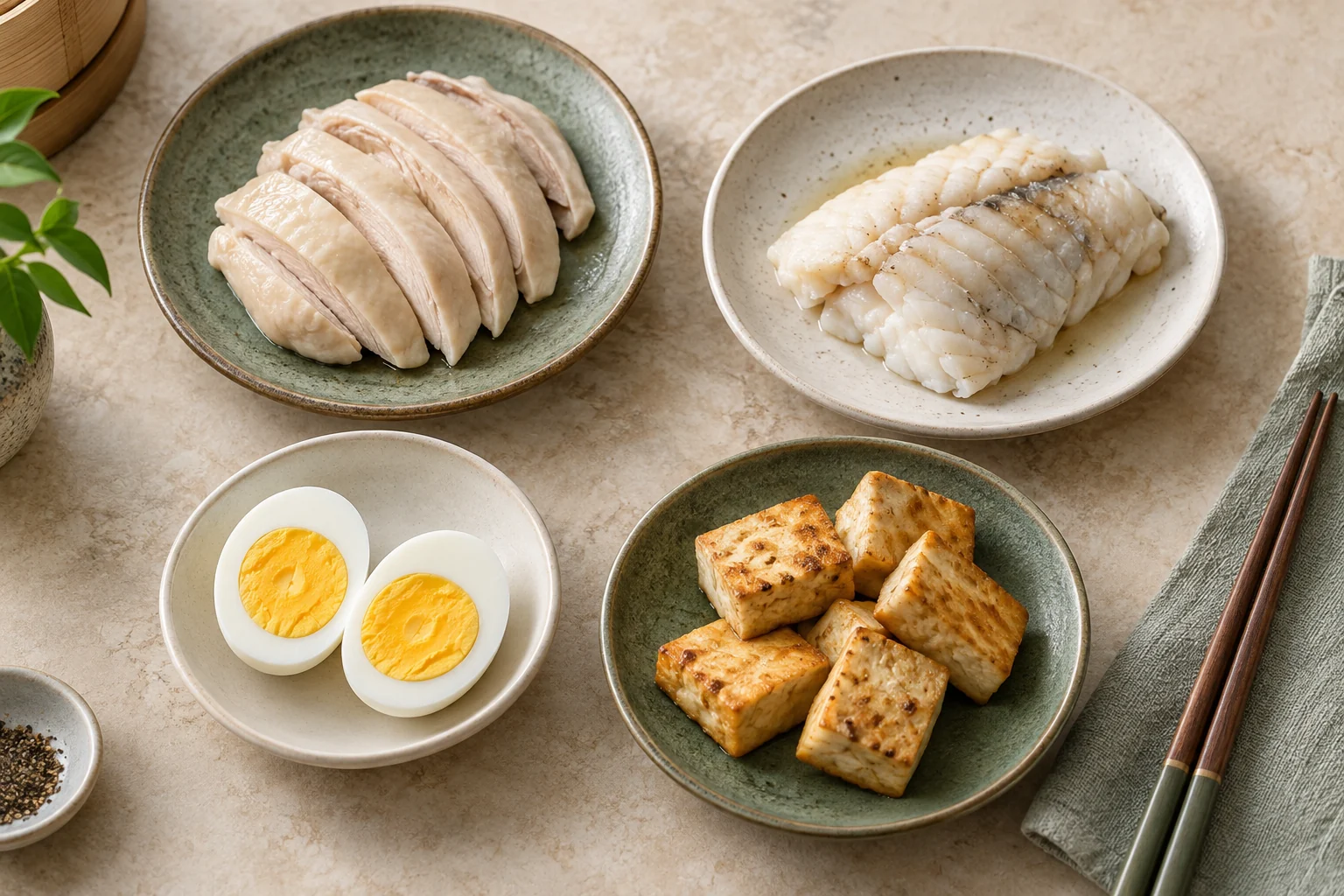
- A serving of chicken breast (as in chicken rice, without skin) delivers roughly 25–35 g of protein, depending on the portion.
- White fish — including the toman, seabass, and batang common in zi char and fish soup stalls — runs approximately 20–30 g per serving.
- Eggs are a reliable and affordable option; three large eggs provide around 18–21 g.
- Prawns and other seafood are moderate-to-high in protein and relatively low in fat.
Plant proteins tend to be lower in concentration but are widely available:
- Firm tofu (tau kwa) provides roughly 10–15 g per block, depending on size; soft tofu (tau huay/silken tofu) is considerably lower.
- Edamame, tempeh, and certain legumes used in local cuisine contribute meaningfully to daily totals.
- Soya milk, which is everywhere in Singapore hawker centres and kopitiams, provides roughly 6–8 g per 250 ml serving — modest but worth counting on a tight appetite day.
Dairy is less central to a traditional Singapore diet but is widely available at supermarkets:
- Greek yoghurt is the highest-protein dairy option per serve; plain full-fat or low-fat versions carry roughly 15–20 g per 170–200 g tub, with far less sugar than flavoured yoghurt.
- Regular milk contributes around 8 g per 250 ml glass.
The practical pattern for hitting a daily target: anchor each meal around one solid animal-protein serving, use tofu or eggs as an additional source when available, and fill remaining gaps with dairy or a protein drink if needed. This approach is achievable at hawker centres, kopitiams, and food courts without special ordering — it mostly requires selecting the protein item first and eating it while still hungry.
Common questions
How much protein per day on GLP-1?
Most guidance supports around 1.2–1.6 g of protein per kg of body weight per day during active weight loss (Leidy 2015). For a 70–90 kg person, that works out to roughly 85–145 g per day. Individual needs vary, and a doctor or dietitian can help determine where in that range makes sense for you.
How do I eat enough protein with no appetite?
Put protein on your plate first and eat it before anything else. Aim for roughly 25–30 g of protein at each eating occasion. On days when solid food feels difficult, a protein drink can fill the gap without requiring a large volume of food (Leidy 2015).
Is protein powder necessary on GLP-1 medication?
It is useful, not required. If a suppressed appetite is making it hard to reach your target through whole foods alone, a shake is a practical bridge. Whole-food sources are generally preferable when appetite allows. No supplement is a substitute for an overall eating pattern that prioritises protein.
Do I need more protein if I lift weights?
Possibly, but check the denominator before acting on the number. A review of lean, resistance-trained athletes in a calorie deficit put their likely needs at 2.3–3.1 g per kg of fat-free mass per day (Helms 2014) — a considerably smaller base than body weight, and a population most people starting treatment are not in. Discuss the target with a doctor or sports dietitian, because training load and protein need interact.
What if I miss my protein target?
Some lean-mass loss becomes more likely. Protein and resistance training work together to protect muscle during a deficit — neither alone is as effective as both combined. Aiming for your target on most days, even imperfectly, is better than not tracking it at all.