Insulin resistance is usually silent. It does have signs that show on skin, and the most recognisable one is a darkened, velvety patch at the back of the neck that will not wash off no matter how hard it is scrubbed. None of these signs is a diagnosis. All of them are a reasonable reason to ask a doctor for a blood test, and the blood test is the only thing that answers the question.
Acanthosis nigricans: the medical name for that darkened, thickened, velvety change in the skin. It appears most often at the back of the neck, in the armpits and in the groin — skin folds, where the change is easiest to miss and easiest to mistake for grime.
What insulin resistance actually is
The body producing more insulin to get the same job done.
Insulin moves glucose out of the blood and into cells. When cells respond less readily to it, the pancreas compensates by making more. For a while that works, and blood glucose stays normal — which is precisely why the condition is silent for so long. What is elevated during that period is the insulin, not necessarily the sugar.
The thresholds that define prediabetes, and what changes them, are set out in prediabetes and body weight. This page is about the earlier part: what a person might notice before any of that is measured.
The patch on the back of the neck
This is the sign worth knowing about, and the one people most often get wrong about themselves.
Acanthosis nigricans is a darkening and thickening of skin in the folds — the back of the neck most commonly, also the armpits and groin. It looks like the skin is dirty or stained. It is neither. It is a change in the tissue itself, which is why it does not come off in the shower, and why scrubbing at it tends to leave the area irritated rather than lighter.
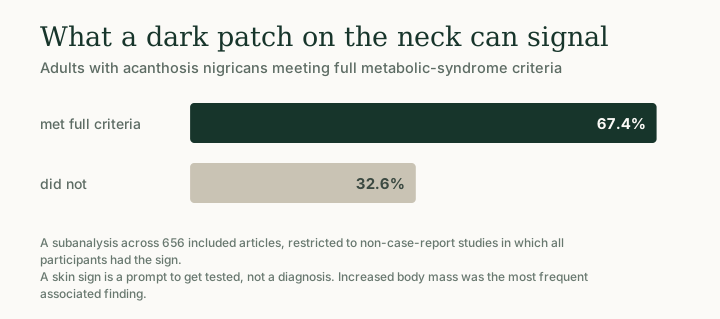
How strongly it points at a metabolic problem has now been reviewed systematically across 656 articles. In the subset of studies where every participant had acanthosis nigricans, 67.4% met the full criteria for metabolic syndrome, and the most frequently reported individual criterion was increased body mass, at 89.7% (Gillespie 2026). Looking at it from the other direction, of the individual metabolic syndrome criteria, insulin resistance had the highest mean prevalence of acanthosis nigricans, at 72.6% (Gillespie 2026).
Two things to hold about that review, because it is careful about itself and the article should be too. Its overall figure across all included articles carries a standard deviation of 34.9% around a mean of 70.8%, which the authors attribute to studies evaluating quite different populations (Gillespie 2026). And 67.4% meeting the criteria means roughly a third did not. This is a strong association, not a rule.
Skin tags, and why one is not a pattern
A single skin tag is a very common thing that most people acquire with age. The evidence is about clusters, and about company.
In 371 South Asian adults, the useful analysis was not skin tags alone. Acanthosis nigricans and skin tags combined with central obesity predicted metabolic syndrome more accurately than either the skin signs or the central obesity on its own, with significant differences between groups in metabolic syndrome, type 2 diabetes and insulin-resistance scores (Saxena 2025).
That is the honest shape of it. A skin tag is not a metabolic finding. Several in one fold, on someone who also carries weight around the middle, alongside a darkened patch — that combination is what the research is actually about, and it is the pattern rather than any single item that carries the signal.
South Asian participants are a relevant population for Singapore, and it is worth saying that this is one study of 371 people rather than a settled literature.
What none of this tells you
The section that keeps this page honest, and it is not a formality.
These are associations, not diagnoses. Acanthosis nigricans occurs in people whose glucose is entirely normal. Insulin resistance occurs, very commonly, in people whose skin shows nothing at all — it is a silent condition, and the reason it goes undetected for years is precisely that most people carrying it have no visible sign.
So the reasoning runs one way only. A dark patch is a reason to get tested. Clear skin is not a reason to skip a test, and it is not evidence that your glucose is fine. Skin cannot be substituted for a blood test in either direction.
Anyone finishing this page believing they have been told what they have has read it wrong, and that would be our fault rather than theirs. The correct takeaway is a question to ask a doctor.
How this is actually checked in Singapore
With a blood test your doctor orders, and on local criteria that differ from the ones you will read internationally.
Singapore's clinical guidance states plainly that glycated haemoglobin is not currently indicated as a diagnostic test for pre-diabetes here, setting the thresholds on fasting glucose or a 2-hour post-load glucose instead (ACE 2021). So the HbA1c band that appears throughout international content is not what a Singapore doctor is working to. Around 14% of Singaporeans have impaired glucose tolerance (ACE 2021).
If something is found, it is not a one-way street. In a Singapore study that re-examined 297 people with impaired glucose tolerance eight years later, 41.4% had reverted to normal glucose tolerance, 23.0% were unchanged, and 35.1% had developed diabetes (Wong 2003).
The route is your own doctor. Diabetes and pre-diabetes are named together as the first of the 23 conditions on MOH's Chronic Disease Management Programme, which makes their management MediSave-claimable (MOH). Test prices and waiting times vary, so ask about those at the same time as you ask about the test.
Where this sits beside our criteria
Our eligibility criteria are a BMI of 25 and above alongside a related health condition. Prediabetes is one of the conditions that can qualify. Being eligible on account of a condition and being treated for that condition are different things: GetLean is a weight-management service. We do not treat prediabetes or diabetes, and glucose is managed by the doctor already looking after it.
That line matters more here than almost anywhere else on this site. This page exists to help someone recognise something and take it to a doctor — not to enrol them in anything. If the skin sign turns out to mean nothing metabolically, that is a good outcome and it has nothing to do with us.
If you also wake repeatedly at night, that has more than one possible route, and the airway one is covered in sleep apnoea: the signs. The wider set of conditions is in weight-related conditions, and how our BMI figures work is in am I eligible.
Common questions
I have been scrubbing it. Why will it not come off?
Because it is not dirt. The darkening is a change in the skin itself — thickened, more pigmented tissue — so washing cannot shift it, and scrubbing tends to irritate the area rather than lighten it.
Does a dark patch on my neck mean I have diabetes?
No. It means a blood test is worth asking for. In studies where all participants had acanthosis nigricans, 67.4% met the criteria for metabolic syndrome (Gillespie 2026) — which also means a substantial minority did not. The sign raises the question; only the test answers it.
Do skin tags mean anything?
On their own, not much. In 371 South Asian adults, skin tags and acanthosis nigricans together with central obesity predicted metabolic syndrome more accurately than either the skin signs or the central obesity alone (Saxena 2025). It is the combination that carries information, not a single tag.
What test should I ask for in Singapore?
That is a decision for your doctor, and the local criteria are not the ones you will read internationally. Singapore's guidance states that HbA1c is not currently indicated as a diagnostic test for pre-diabetes here, and sets the thresholds on fasting or post-load glucose instead (ACE 2021).
If it does turn out to be prediabetes, what happens?
It is not a one-way street. In a Singapore study that re-examined 297 people with impaired glucose tolerance after eight years, 41.4% had reverted to normal glucose tolerance, 23.0% were unchanged and 35.1% had developed diabetes (Wong 2003).