Sleep apnoea is common in Singapore and mostly undiagnosed — in a community study here, 91% of people with the moderate-to-severe form had never been told they had it. The reason is not that the signs are subtle. It is that the signs which actually carry information happen while you are asleep, and the ones you can notice yourself turn out to predict it poorly.
AHI, the apnoea–hypopnoea index: the number of times an hour that breathing stops or becomes shallow during sleep. Five to 14 is mild, 15 to 29 moderate, 30 and above severe. Remission is conventionally an AHI under 5.
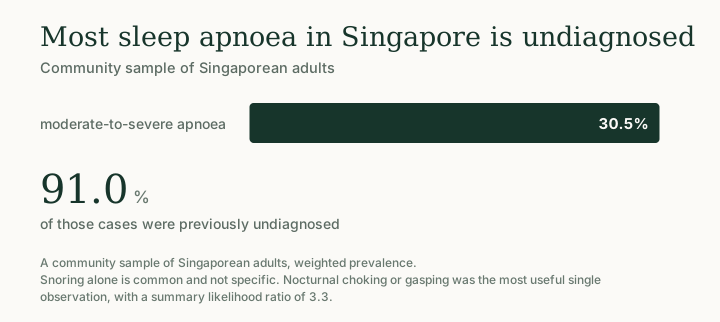
Ninety-one per cent did not know
That is the finding this whole page is built on.
A community study of a multiethnic Singaporean sample found moderate-to-severe sleep-disordered breathing in 30.5% of participants, and 91.0% of them had never been diagnosed (Tan 2016). Nine in ten people with a significant, treatable condition were walking around unaware.
Two caveats travel with that number and both matter. The estimate rests on 242 home sleep tests using portable monitors rather than full overnight polysomnography, and it is a community study rather than national surveillance — there is no national figure, because Singapore's National Population Health Survey does not measure sleep apnoea at all (NPHS 2024).
Which is itself part of the answer to why it goes unfound. A condition nobody counts is a condition nobody looks for.
Why you cannot tell from the inside
Because the information is not available to you, and the evidence says so quite precisely.
The most rigorous review of this question examined how well each clinical sign identifies sleep apnoea. The single most useful observation is nocturnal choking or gasping, with a summary likelihood ratio of 3.3 (Myers 2013). A likelihood ratio above 1 means the sign shifts the odds towards the diagnosis; 3.3 is a meaningful shift.
Now notice what that sign requires. Choking and gasping happen while you are asleep. Somebody else has to see it. The best single indicator in the literature is one you cannot supply about yourself.
Meanwhile the sign you can report — snoring — carries a likelihood ratio of 1.1 (Myers 2013). A ratio of 1.0 means the sign tells you nothing at all. Snoring is common in people with sleep apnoea, and it is common in people without it, so on its own it barely moves the odds in either direction.
That asymmetry is the article. The thing you notice is nearly uninformative, and the thing that is informative is invisible to you. It is not that people with sleep apnoea are bad at introspection. It is that the diagnostic signal is generated at a time and in a form that self-report cannot reach.
What the night looks like from outside
The highest-value conversation you can have about this is with whoever sleeps in the room.
Witnessed pauses, choking or gasping is the observation to ask about specifically — not "do I snore", which almost everyone's partner will say yes to, but whether the breathing stops and restarts (Myers 2013). If a partner has moved to another room, that is worth treating as information rather than as a domestic matter.
Getting up at night to urinate has a recognised route through the airway, and it surprises people. Breathing hard against a blocked throat generates negative pressure inside the chest; the heart is stretched by it; and the stretched heart releases a hormone that makes the kidneys excrete sodium and water, while also suppressing the hormones that would normally conserve fluid overnight. Treating the airway problem has been shown to reverse it (Umlauf 2003).
That is one route among several, and waking to urinate has plenty of other causes — a raised blood sugar is another, covered in the prediabetes article. It belongs in the conversation with a doctor rather than in a conclusion you draw yourself.
Which signs actually predict it
This is the section worth keeping, because most symptom lists imply every item counts equally and they do not.
| Sign | What it does to the odds |
|---|---|
| Nocturnal choking or gasping | Likelihood ratio 3.3 (95% CI 2.1–4.6) — the most useful single observation |
| Snoring | Likelihood ratio 1.1 (95% CI 1.0–1.1) — essentially uninformative on its own |
| Mild snoring and a BMI under 26 | Likelihood ratio 0.07 (95% CI 0.03–0.19) — argues strongly against moderate or severe apnoea |
All three are from the same systematic review (Myers 2013). Body weight appears in the picture too: among patients referred for sleep evaluation, those found to have sleep apnoea had a higher summary BMI, 31.4 against 28.3 (Myers 2013).
The bottom row is the one people find most useful, because it is the only combination on this page that can reassure rather than alarm. Mild snoring in someone who is not carrying extra weight argues meaningfully against moderate or severe sleep apnoea.
None of these is a test. A likelihood ratio adjusts a probability; it does not produce an answer. What this table is for is deciding whether the conversation is worth having, and the review's own conclusion is exactly that — the clinical examination is useful for selecting patients for more definitive testing (Myers 2013).
What actually happens if you get it checked
Sleep apnoea is diagnosed on a sleep study, which measures breathing during sleep rather than asking you about it. Both home-based testing and in-laboratory polysomnography are used; the Singapore community study above was run on home tests (Tan 2016).
Who to raise it with is your own doctor, and there is a documented case for raising it if you already have certain conditions. Singapore's 2025 consensus recommends screening for obstructive sleep apnoea in patients with hypertension, cardiovascular disease, diabetes or obesity, and in preoperative patients (Academy of Medicine Singapore 2025).
Waiting times, costs and referral requirements vary, so ask about those at the same time as you ask about the study itself.
Where this sits beside our criteria
Our eligibility criteria are a BMI of 25 and above alongside a related health condition. Obstructive sleep apnoea is one of the conditions that can qualify. Being eligible on account of a condition and being treated for that condition are different things: GetLean is a weight-management service, and sleep apnoea is managed by the doctor or sleep service already looking after it.
Nothing on this page is a diagnosis, and it is not designed to produce one. There is no score to add up here on purpose — the whole finding is that self-assessment performs poorly, and a page that handed you a verdict would be contradicting the evidence it just cited.
If you already know you have sleep apnoea and the question is what losing weight would change, that is the sibling article: sleep apnoea and body weight covers what the randomised evidence shows weight loss does, and what it does not. The wider set of conditions is in weight-related conditions, and how the BMI figures work is in am I eligible.
You can check your eligibility and speak to a doctor about whether this is suitable for you.
Common questions
How do I know if I have sleep apnoea?
From the outside rather than the inside. The most useful single observation is nocturnal choking or gasping, which someone else has to witness — its likelihood ratio is 3.3 (Myers 2013). Only a sleep study settles it.
Does snoring mean I have sleep apnoea?
On its own, barely. Snoring is common in people with sleep apnoea but is not useful for establishing the diagnosis, with a likelihood ratio of 1.1 — statistically almost no information (Myers 2013).
How common is undiagnosed sleep apnoea in Singapore?
In a community study of a multiethnic Singaporean sample, 30.5% had moderate-to-severe sleep-disordered breathing and 91.0% of them had never been diagnosed (Tan 2016). There is no national figure — the National Population Health Survey does not measure it (NPHS 2024).
Why do I get up to urinate at night?
One recognised route runs through the airway. Breathing hard against a blocked throat creates negative pressure in the chest, the heart stretches, and it releases a hormone that makes the kidneys shed salt and water — treating the airway problem has been shown to reverse it (Umlauf 2003). There are other causes, and this is a question for a doctor rather than a self-diagnosis.
Who should be screened for sleep apnoea?
Singapore's 2025 consensus recommends screening in patients with hypertension, cardiovascular disease, diabetes or obesity, and in preoperative patients (Academy of Medicine Singapore 2025).