Getting lean has two phases, and almost all the attention goes to the first one. Phase one is the energy deficit that takes fat off. Phase two is everything that holds the result afterwards — maintenance eating, continued resistance training, protein, self-monitoring, and for patients using medication, the plan for coming off it. Phase one has an end. Phase two does not, which is why most of what is lost in phase one comes back. This article covers what each phase is for, what the evidence says holds a result, and where medication fits in the second half.
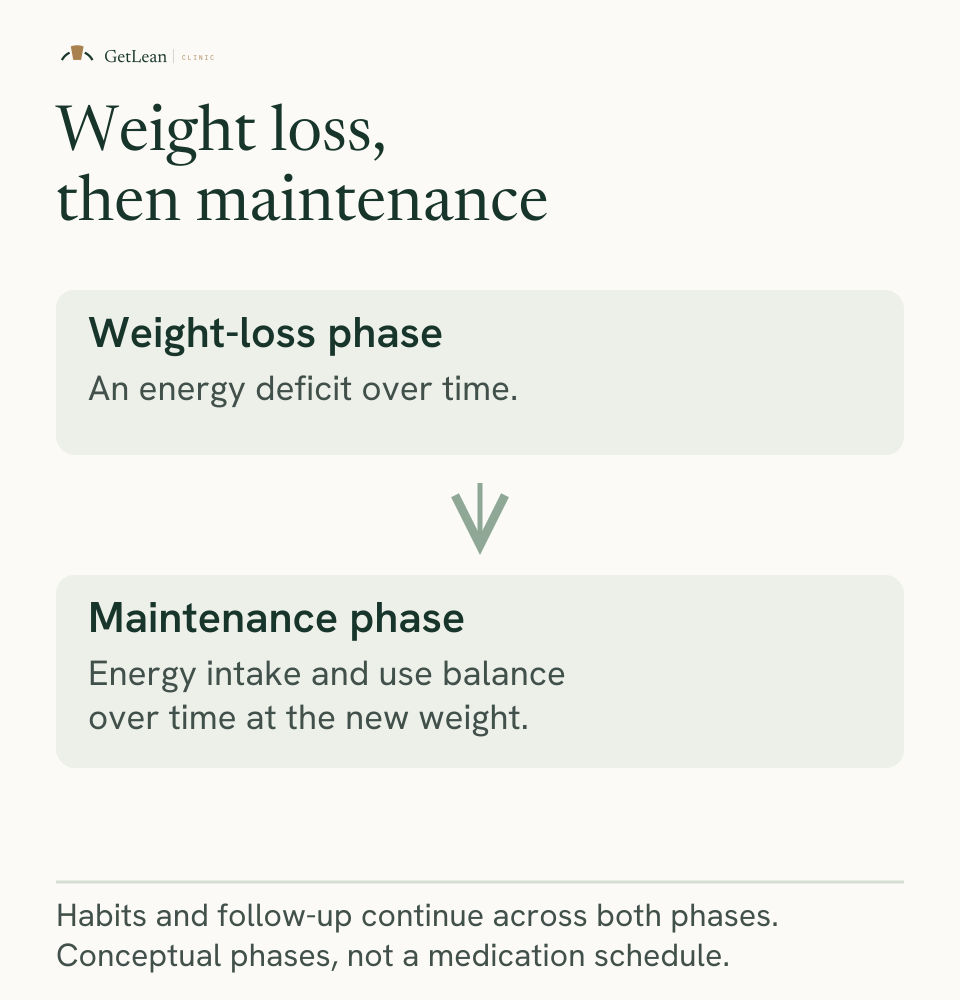
Maintenance: in the research literature, intentionally losing at least 10% of initial body weight and keeping it off for at least a year (Wing and Hill 2001). It is defined as an outcome held over time, not as a target reached once.
What is phase one actually for?
Removing fat — and doing it in a way that leaves the body better composed at the end, not just smaller.
That distinction is the whole reason phase one deserves any planning at all. Every kilogram lost is a mixture. In the SURMOUNT-1 body-composition sub-study of 160 people, approximately 75% of the weight lost was fat and 25% was lean mass — and the split was the same in the placebo arm, which was diet alone (Look 2025). Substantial weight loss costs lean tissue regardless of how the deficit is produced.
Two inputs change that arithmetic, and both belong in phase one rather than being saved for later.
Resistance training. Across 114 trials covering 4,184 people with overweight and obesity, lean mass was statistically unchanged when resistance training accompanied caloric restriction (Lopez 2022).
Protein. Intakes of 1.2 to 1.6 g per kg of body weight per day during energy restriction improve appetite, body-weight management and lean-mass preservation compared with lower-protein diets (Leidy 2015). Note the denominator: that range is per kilogram of body weight, not of fat-free mass, and the two are routinely mixed up.
A phase one that ends with less muscle than it needed to hands phase two a harder job.
Why does phase two exist at all?
Because a reduced body does not simply stay reduced. Two separate things push back.
The first is metabolic. Maintaining a body weight at least 10% below usual weight reduces total energy expenditure by more than the change in body mass alone predicts — and that was seen in people who had never had obesity as well as in people who had (Leibel 1995). The reduced body runs on less than its new size would suggest.
How long that persists is less certain than the internet suggests. The most-quoted evidence is a follow-up of 14 people from a televised weight-loss competition, in whom resting metabolic rate was still several hundred kcal a day below what body composition predicted six years later (Fothergill 2016). That was a mean loss of 58 kg under competition conditions in 14 people. It should not be read as a description of ordinary or medically supervised weight loss, and the authors' own word for the adaptation is "incomplete" rather than permanent.
The second is behavioural, and it is the one that actually decides most outcomes: the conditions that produced phase one stop applying. The deficit ends. Attention moves on. Nothing replaces it.
What does the evidence say holds a result?
Most of what we know comes from one body of work, and it is important to be straight about what kind of evidence it is.
The National Weight Control Registry is a self-selected registry of people who had already succeeded — not a random sample, and not a trial. Entry required having lost at least 13.6 kg and kept it off for five years. Its first large description covered 784 members who had lost a mean of 30 kg, and who reported a low-fat diet and a high level of physical activity, in the region of an hour a day (Klem 1997). Survivorship is built into the design: everybody in it is a person for whom something worked, so it can describe what maintainers do and cannot show that doing those things causes maintenance.
Read with that limit in place, three findings are still worth having.
Time held matters. In a one-year prospective follow-up of registry members, 35% gained weight over the year and 59% maintained. Risk factors for regaining included more recent weight losses — under two years versus two years or more — larger losses relative to maximum weight, and higher levels of depression, dietary disinhibition and binge eating (McGuire 1999). A review of the same literature reports that once a loss has been held for two to five years, the chance of longer-term success rises substantially (Wing and Hill 2001).
Self-monitoring tracks with holding. Among 3,003 registry members followed for a year, those who reduced how often they weighed themselves regained a mean of 4.0 kg, against 1.8 kg in those whose frequency was unchanged and 1.1 kg in those who increased it (Butryn 2007). Observational, in a self-selected group — but the association held independently of the other factors measured.
Activity volume is high in maintainers. The ACSM position stand associates more than 250 minutes a week of physical activity with improved maintenance after weight loss (Donnelly 2009). The same document states that no well-designed randomised trials exist to judge whether physical activity prevents regain, which is a caveat worth carrying with the number rather than dropping.
We go through this evidence in more detail in habits that predict keeping it off.
Where does the medication fit into phase two?
It fits in whichever way the prescriber and patient decide — and the trials are clear about what each choice does.
Continuing works. In STEP 4, a 20-week run-in produced a mean 10.6% loss; over the following 48 weeks, those continuing semaglutide lost a further 7.9% while those switched to placebo regained 6.9% (Rubino 2021). In SURMOUNT-4, after a 36-week lead-in on tirzepatide, continuers lost a further 5.5% while those switched to placebo regained 14.0% over the following year — and 89.5% of continuers held at least 80% of the lead-in loss, against 16.6% of those on placebo (Aronne 2024).
Stopping has a documented trajectory. In the STEP 1 extension, adults who came off semaglutide regained roughly two-thirds of what they had lost within a year, and most cardiometabolic improvements moved back towards baseline (Wilding 2022). Pooling six cessation trials and 3,236 people, about 60% of the weight lost returned within a year, with the curve decelerating and modelled to plateau below the pre-treatment starting weight (Budini 2026).
Two things about that rebound are frequently overstated, and both matter here.
It is not a return to the starting point. In SURMOUNT-4 the placebo group was still 9.9% below baseline at week 88 (Aronne 2024). In STEP 1 the net was 5.6% below baseline at week 120 (Wilding 2022).
And nobody has measured what the returning weight is made of. The largest meta-analysis of discontinuation pooled body weight, waist circumference and BMI, with no fat-versus-lean split anywhere in it (Berg 2025). Claims that it all comes back as fat are extrapolated from a different literature.
On tapering the dose rather than stopping abruptly: no randomised trial has tested it. Every published withdrawal trial is a switch straight to placebo. The nearest evidence is a retrospective cohort from one commercial digital clinic, in which tapering was offered as a clinician-guided personal choice rather than randomised, with no control group (Seier 2025). A taper may be a sensible clinical decision; it is not an evidence-based one, and we say so in tapering off GLP-1 medication.
What does a phase two actually look like?
Concretely, five things, none of which is new — they are phase one's inputs, continued at maintenance energy intake.
- Resistance training, unchanged. The stimulus that protected lean mass in the deficit is the same stimulus that holds it afterwards (Lopez 2022).
- Protein, kept up. The 1.2–1.6 g per kg of body weight range was derived for energy restriction (Leidy 2015) and no source here sets a maintenance target — but dropping protein the week the deficit ends removes an input while the training load stays.
- Activity volume you can actually sustain, with the 250-minutes-a-week association as a reference point rather than a rule (Donnelly 2009).
- A measurement you keep taking. Weight, waist, or both — the registry association is with continuing to measure, not with any particular number (Butryn 2007).
- A decision about medication, made with your prescriber, rather than by default when a supply runs out.
At GetLean, our philosophy is that GLP-1 medication should act as a catalyst — not something to depend on indefinitely. That means phase two is part of the plan from the first consultation, not a conversation that starts when phase one ends. Individual results vary, and clinical-trial figures describe the populations that were studied. If you are considering treatment, check your eligibility and speak to a doctor about whether it is suitable for you.
Common questions
What are the two phases of getting lean?
Phase one is the energy deficit that removes fat. Phase two is everything that holds the result — maintenance eating, continued resistance training, protein, self-monitoring, and for patients on medication the plan for coming off it. Phase one is finite; phase two does not have an end date.
How long does phase two last?
There is no finish line, but the odds improve with time held. Registry follow-up found that having already maintained a loss for two years or more was associated with a lower chance of regaining over the next year (McGuire 1999), and a review of the same literature reports that once a loss has been held two to five years, the chance of longer-term success rises substantially (Wing and Hill 2001).
Do you regain the weight after stopping GLP-1 medication?
Most of it, on average, unless something changes. Adults who stopped semaglutide after 68 weeks regained about two-thirds of their loss within a year (Wilding 2022), and pooled cessation trials put regain near 60% at one year, decelerating and modelled to settle below the original starting weight (Budini 2026). Speak to your prescriber before changing or stopping any medication.
What does the National Weight Control Registry actually prove?
Less than it is usually made to. It is a self-selected registry of people who had already succeeded — 784 members who had each lost at least 13.6 kg and kept it off five years (Klem 1997). It describes what successful maintainers report doing. It cannot show those behaviours caused the outcome, because everyone in it is a survivor of the process.
How much activity does maintenance take?
The ACSM position stand associates more than 250 minutes a week of physical activity with better maintenance after weight loss (Donnelly 2009). That figure comes from cross-sectional and prospective data, and the same document states plainly that no well-designed randomised trials exist to judge whether physical activity prevents regain.