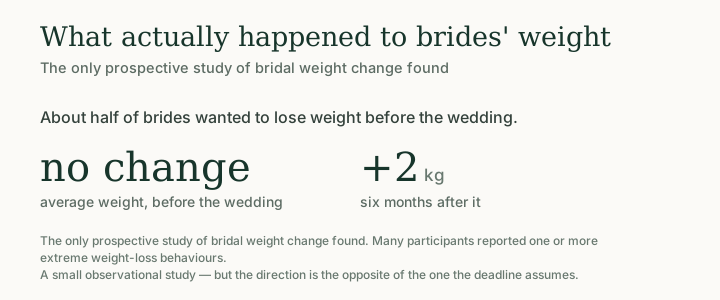
No trial has ever tested losing weight to a deadline. Searched exhaustively, the literature contains no interventional study of event-driven or deadline-driven weight loss — every randomised trial in this area randomised the rate of loss, never the presence of a date. What has been measured is what happens around one particular deadline: in a prospective study of 343 brides, average weight did not change before the wedding at all, and participants had gained about 2 kg six months afterwards (Prichard 2014). This article covers what that study found, what the rate-of-loss trials actually show, and what protects body composition when the timeline is short.
Fat-free mass: everything in the body that is not fat — muscle, bone, organs and water. When a diet "costs lean tissue", this is the quantity that fell.
The one time someone measured a deadline
Three hundred and forty-three women were recruited at bridal expos in South Australia and surveyed at three points: after recruitment, one month before the wedding, and six months after it. Close to 50% said they wanted to lose weight before the day. Linear mixed modelling found their average weight did not change in the lead-up to the wedding. Six months afterwards, participants had gained approximately 2 kg. And the women who had been told to lose weight before the wedding gained significantly more afterwards than those who had not (Prichard 2014).
The limits matter. Weight was self-reported. Attrition was heavy — 343 at recruitment, 130 at one month before, 112 at six months after. Every participant was an Australian woman, with no men and no Asian data. And the study measured weight and intention rather than diet method, so it cannot show that crash dieting caused the later gain. What it does show is that the intention was widespread, the result was not, and the direction six months on ran the other way.
The thing that has never been tested
The deadline itself. There is no interventional study of deadline-driven weight loss to cite, in any population, for any event. Every randomised trial that speaks to this subject randomised how fast people lost weight, not whether they had a date to hit. That distinction is worth holding onto through the rest of this article: the evidence below is about the severity and speed of a deficit, and it is being applied to the deadline case by inference, not by test.
It follows that a timeline cannot honestly be attached to a result. Nobody has run the study that would let anyone say what a given number of weeks produces for a given person, and a prediction of a specific outcome by a specific date would be a promise, not a finding.
What cutting hard and fast actually does
The severity of the deficit is the better-evidenced half. Across 16 dietary studies and 683 participants, the median share of weight lost as fat-free mass was 14.0% on standard low-calorie diets and 23.4% on very-low-calorie diets — and by sex, 27% in men against 20% in women. The degree of caloric restriction correlated with the proportion lost as fat-free mass (r²=0.31, p=0.006) (Chaston 2007). A 2024 review restates those same figures and cautions against treating any single percentage as fixed, since it moves with age, sex, training and starting body composition (Tinsley 2024).
Whether speed, independent of severity, costs extra is genuinely contested, and all three trials belong in the same paragraph. In 57 adults with a BMI of 28–35, fat-free mass made up 8.8% of the weight lost on a very-low-calorie protocol against 1.3% on a slower low-calorie one (P=0.034), and fat-free-mass loss was associated with later regain — though total regain did not differ between the rate groups (Vink 2016). In 42 adults matched for total weight lost at about 5–6%, the rapid group lost 1.51 ± 0.80 kg of lean mass against 0.52 ± 0.75 kg in the slow group, a between-group difference of 0.98 ± 0.25 kg (p<0.001) (Ashtary-Larky 2017). Against those, a third randomised trial compared a four-week rapid protocol with an eight-week gradual one at a matched 9% loss and reported that changes in body weight and composition "were similar in both groups" (Coutinho 2018).
So: some evidence indicates that faster loss costs more lean mass, and it is not established. The severity of the cut is the lever with the cleaner evidence behind it, and it is the one a deadline pushes hardest in the wrong direction. How fast you should lose weight goes through the same three trials in more detail.
What happens after the date
The measured answer in this exact population is the 2 kg six months on (Prichard 2014).
The mechanism people reach for is catch-up fat, and it needs its evidence base stated before the claim rather than after. That literature comes from severe catabolic states: a reanalysis of the Minnesota Starvation Experiment, in which 12 men were semi-starved for 24 weeks and then refed, found fat and fat-free mass recovering on separate, independently regulated trajectories (Dulloo 1997), and a later review argues from starvation refeeding, malnutrition rehabilitation, catch-up growth and anorexia recovery that preferential catch-up fat is a central feature of body-composition autoregulation in lean individuals (Dulloo 2015).
Those states are far more extreme than any diet a person runs before a wedding, and the pattern has not been demonstrated after ordinary or medically supervised weight loss. The concept is documented; it is not a prediction about someone who cut hard for eight weeks. What can be said without borrowing is simpler: the fat-free mass lost in a hard cut is measurable, and in one of the rate trials it was associated with later regain.
What protects body composition when time is short
Three things, and none of them is a faster diet.
Resistance training is the intervention with the strongest evidence here. Across 114 trials and 4,184 people, lean mass was statistically unchanged where resistance training accompanied caloric restriction, and resistance training alone increased lean mass by about 0.8 kg against untrained controls (Lopez 2022). The dose needed to start is smaller than most people assume: in resistance-trained men, a single hard set per exercise two to three times a week produced significant strength gains over 8–12 weeks, which the authors describe as a floor rather than a target (Androulakis-Korakakis 2020).
Protein is the second. During energy restriction, intakes of 1.2–1.6 g per kg of body weight per day, with roughly 25–30 g per meal, improve appetite and support lean-mass preservation compared with lower-protein diets (Leidy 2015). The trial that pushed hardest on this took 40 overweight untrained young men through four weeks of a roughly 40% energy deficit with six days a week of resistance and interval training: at 2.4 g/kg/day they gained 1.2 ± 1.0 kg of lean mass and lost 4.8 ± 1.6 kg of fat, while at 1.2 g/kg/day they gained 0.1 ± 1.0 kg of lean mass and lost 3.5 ± 1.4 kg of fat (Longland 2016). That result belongs to young untrained overweight men on a supervised protocol over four weeks, fat intake also differed between arms, and it should not be read as what any dieter gets from protein alone.
The third is a smaller deficit over a longer run-up, which is the only variable a date actually controls. Starting earlier lets the same total loss come out of a shallower cut, and the shallower cut is the one associated with a lower share of fat-free mass in the pooled dietary data (Chaston 2007).
The pressure around this is real
Two surveys describe it directly. Among 272 women preparing for a wedding, the average bride-to-be was overweight by clinical BMI standards and idealised a significantly lower wedding weight; most were attempting to lose weight and reported a small but significant loss; many used one or more extreme weight-loss behaviours, and some reported buying a smaller-sized dress, potentially to constrain their own behaviour (Neighbors 2008). The paper reports "many" without a percentage, and it is a cross-sectional US sample from 2008.
In 329 engaged women, appearance pressures — media most strongly, then peers and partners — explained 39% of the variance in disordered-eating scores, working through thin-ideal internalisation, appearance comparison and body dissatisfaction. Pressure from family was the one source not associated with disordered eating through any of the tested pathways (Nowicki 2024). This is a cross-sectional path model in which "disordered eating" is a questionnaire score, not a diagnosis, and it does not show that weddings cause eating disorders.
Eating disorders are named conditions, and diagnosis and treatment belong with clinicians who specialise in them. The one professional-society position on this ground recommends screening for binge eating disorder, anorexia nervosa, bulimia nervosa and night eating disorder before starting a GLP-1 medication, and states that restrictive eating disorder is a general contraindication to its use, with referral to an eating-disorder specialist for anyone who screens positive or has a history (joint advisory 2025). If any of the behaviours described above sound like your own, help exists and it is worth asking for.
TODO(clinic): Dr Quek to supply the Singapore eating-disorder support service he wants named here, with its published contact details. No helpline has been confirmed, so none is stated.
Working backwards from a date
At GetLean, our philosophy is that GLP-1 medication acts as a catalyst and the plan around it is what holds — protein, resistance training, and an exit planned from the start. A date on a calendar does not change any part of that, and no evidence exists that would let anyone promise a number by one.
What a date can usefully do is set the amount of time available, and the amount of time available should set the depth of the deficit rather than the other way round. A longer run-up allows a shallower cut, and the shallower cut is the one with the better composition data behind it. Training and protein come first because they are what the evidence supports in exactly this situation. Whether medication has any place is a separate clinical question, decided with a doctor on the full picture rather than on a wedding date — if you want that assessment, you can check your eligibility and raise it at consultation.
Common questions
Do brides actually lose weight before the wedding?
In the only prospective study that measured it, no. Among 343 Australian brides, about half wanted to lose weight and average weight did not change in the lead-up to the wedding; six months afterwards participants had gained about 2 kg, with the largest gain among women who had been told to lose weight (Prichard 2014). It is observational with self-reported weight and heavy attrition, so it describes what happened rather than why.
Has anyone studied dieting to a deadline?
No. There is no interventional study of event-driven or deadline-driven weight loss anywhere in the literature. Every randomised trial in this area randomised the rate of loss, never the presence of a deadline (Coutinho 2018, Vink 2016). Everything known is about how hard and how fast, not about having a date.
Does losing weight faster cost more muscle?
Some evidence indicates it does, and the trials disagree. One randomised trial found fat-free mass made up 8.8% of weight lost on a very-low-calorie protocol against 1.3% on a slower one (Vink 2016), and another found 1.51 kg of lean mass lost rapidly against 0.52 kg slowly for the same total weight (Ashtary-Larky 2017). A third found no difference in composition at all (Coutinho 2018).
Why do people regain after the event?
Nobody has measured the mechanism in this situation. What was measured is the pattern: brides had gained about 2 kg six months after the wedding (Prichard 2014). The catch-up fat literature that people reach for comes from severe semi-starvation and malnutrition recovery (Dulloo 1997, Dulloo 2015), and it has not been shown to apply after ordinary or medically supervised weight loss.
What protects body composition when the timeline is short?
Resistance training and enough protein, and cutting less hard than instinct suggests. Across 114 trials and 4,184 people, lean mass was statistically unchanged where resistance training accompanied caloric restriction (Lopez 2022), and the proportion of weight lost as fat-free mass rose from about 14% on standard low-calorie diets to about 23% on very-low-calorie ones (Chaston 2007).