No trial of GLP-1 medication has been run specifically in adults over 65. The whole evidence base is eight studies, five of them age-subgroup re-analyses of trials designed to answer something else, and not one of them measured muscle (Chen 2025). That absence is where an over-60 reader has to start. What is not absent is the training evidence: 151 randomised trials in more than six thousand adults aged 60 and over show that resistance training improves lean mass, muscle size and physical function in exactly this age group (Radaelli 2025). This article sets out both halves — how thin the medication evidence is after 65, and how strong the muscle evidence is after 60.
Sarcopenic obesity: carrying too much body fat and too little muscle at the same time. It is the combination that matters, and it is common enough after 60 to be the thing a weight-loss plan should be designed around rather than a footnote to it.
What the evidence in the over-65s actually consists of
Eight studies. A 2025 systematic review searched for any study of an anti-obesity medication that reported weight reduction separately for adults aged 65 and over, and found six experimental studies — five of them secondary analyses of randomised trial data and one a single-arm trial — plus two observational ones, across seven medications. The number of older adults in each ranged from 13 to 6,728. Every study found statistically significant weight reduction — against placebo or against baseline weight — few reported adverse events, and the review's own verdict is "limited evidence" (Chen 2025).
Two details in that review decide how far it can be carried. The first is population: the experimental studies "predominantly included patients with concurrent prediabetes or cardiovascular disease", and the review names semaglutide in older adults with obesity and cardiovascular disease as the strongest current evidence. Those are people being treated in a cardiovascular context by their own doctors; the finding does not transfer to a healthy 65-year-old who wants to change their body composition, and it is not a statement about treating heart disease or diabetes, which is not what a weight-management service does.
The second is what was measured. No included study examined body composition or muscle. So the position is that some weight comes off in older adults, measured on the weakest study designs that can address the question, and nobody has looked at what it was made of.
What is known about strength on the medication after 60
A 2026 narrative review is the nearest thing to an answer, and it points in two directions at once. Short-to-medium-term trials of semaglutide or liraglutide in adults with obesity showed handgrip strength statistically preserved despite reductions in lean soft tissue mass. Against that, longitudinal and retrospective research in older adults with type 2 diabetes reported reductions in handgrip strength and accelerated sarcopenia with prolonged semaglutide use (Prokopidis 2026).
Both halves come with limits. It is a single-author narrative review with no pooled estimate, and the concerning signal sits in a diabetes population — a group whose care belongs with the doctor managing that condition. The review's central conclusion is the part that generalises: lean soft tissue loss is not a reliable predictor of muscle strength change.
Why sarcopenic obesity is worth designing around: pooled across 23 studies and about 51,000 adults, it was associated with roughly 21% higher relative risk of all-cause mortality (Zhang 2019). Definitions varied across those studies and the association is observational, so it is a signal about a combination rather than a risk figure to apply to a person.
Strength is not a way of checking on muscle
This is the trap that costs people the most, because strength is the thing you can feel and lean mass is not.
In a randomised trial of about 7% weight loss over roughly seventeen weeks in sedentary adults aged 45 to 65, the diet-only arm lost about 2% of whole-body lean mass and about 4% of lower-extremity lean mass — and measured muscle strength did not change at all (Weiss 2017). Nothing in how those people performed would have told them what the scan showed.
The ageing data point the same way from the other side. Over three years in 1,880 older adults, annual leg-strength decline ran at 2.6% to 4.1% depending on sex and group — about three times the roughly 1% a year loss of leg lean mass — and the participants who gained lean mass showed no strength benefit for it (Goodpaster 2006). Mass and strength are correlated across a population and dissociable within a person.
Track both, and treat them as separate facts. Strength matters in its own right: the Asian consensus on sarcopenia sets low grip strength at under 28 kg for men and under 18 kg for women, a six-metre gait speed under 1.0 m/s, and a five-time chair stand of 12 seconds or more (Chen 2020). Those are clinical diagnostic thresholds a doctor applies — the same consensus requires confirmation by muscle mass before sarcopenia is diagnosed — and not fitness targets to train towards.
Protein: the claim that gets swapped
Older adults need more protein than the official recommendation. That is a different claim from needing more than younger adults, and only the first one has been measured.
Using indicator amino acid oxidation, the average protein requirement was 0.94 g per kg of body weight per day in six men over 65, with an RDA-equivalent of 1.24 (Rafii 2015), and 0.96 with an RDA-equivalent of 1.29 in twelve women over 65 (Rafii 2015). Both sit roughly 30% above the official 0.66 average requirement and 0.80 RDA. But the men's study states explicitly that these values "are not different from values we published using the same method in young men and older women". Read together, the finding is that the official figure is too low for everybody — not that ageing raises the requirement.
Expert panels land in the same range by judgement rather than measurement. PROT-AGE recommends 1.0–1.2 g per kg of body weight per day for healthy older adults, at least 1.2 for those exercising regularly, and 1.2–1.5 in acute or chronic illness (Bauer 2013); the ESPEN expert group recommends at least 1.0–1.2 g/kg/day and adds that daily activity including resistance training should be undertaken by all older people for as long as possible (Deutz 2014).
The only East Asian measurement is a 2024 study in nine men and seven women aged 65 to 80, healthy and without sarcopenia, which put the average requirement at 0.94 g/kg/day with derived recommended intakes of 1.13–1.36 — above China's current national figures (Wu 2024). Those are Chinese national reference values; Singapore publishes no equivalent number.
Every figure above uses a body-weight denominator. The much higher 2.3–3.1 g/kg range that circulates is per kg of fat-free mass, and it comes from lean, resistance-trained athletes in a calorie deficit (Helms 2014) — a different measure and a different population. At 1.0–1.2 g/kg of body weight, a 70 kg person is aiming at 70–84 g of protein a day.
Resistance training is where the evidence is strongest
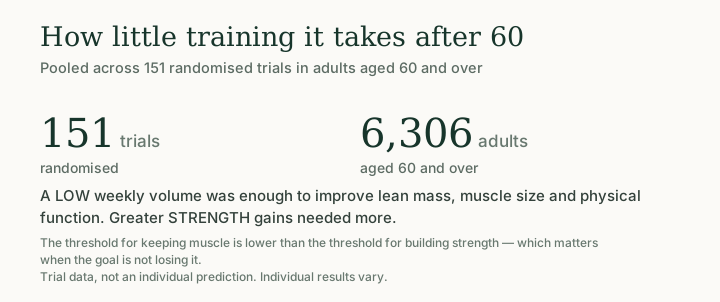
Across 151 randomised trials and 6,306 adults aged 60 and over, a low weekly volume of resistance training was the most effective category for lean body mass, muscle size, timed up-and-go and six-minute walk distance; moderate and high volumes were the most effective for lower-limb strength (Radaelli 2025). The results are standardised mean differences, so they do not convert into kilograms of muscle, and the evidence in physically impaired older adults was limited. None of those participants were dieting or on medication.
Strength gains in this age group are reliable and large in relative terms. Across 47 studies and 1,079 participants aged 50 and over, resistance training raised leg press by about 29%, knee extension by 33%, chest press by 24% and lat pull-down by 25%, with higher-intensity programmes producing larger gains (Peterson 2010).
Add a calorie deficit and the training earns its place twice over. Pooling six randomised trials in obese older adults, resistance training alongside calorie restriction prevented an estimated 93.5% of the lean-mass loss otherwise seen — and did so without blunting fat or total weight loss (Sardeli 2018). The trial that compared modes directly, in previously sedentary obese adults averaging about 70 years, found lean mass falling roughly 5% with aerobic exercise alone, 2% with resistance alone and 3% with both, while the combined group gained the most physical function (Villareal 2017).
Singapore's own guidance asks adults for 150–300 minutes a week of moderate-intensity activity plus muscle-strengthening work on at least two days a week, at 8–12 repetitions per set. The national survey figures reproduced in the same document show 76.4% of adults aged 18–74 meeting the activity target and only 33.8% doing sufficient muscle-strengthening activity — falling to 25.5% among those aged 60 to 74 (SPAG 2022). Our reading of that gap is that the aerobic half of the guideline is being met and the strength half is being skipped, in the age group with the least muscle to spare.
Bone, which is the other tissue at stake
Weight loss costs a small amount of bone. Pooling 41 trials in overweight or obese adults, diet-induced weight loss was associated with significant decreases of 0.010 to 0.015 g/cm² in total hip bone mineral density at 6, 12 and 24 months, with no significant effect at the lumbar spine and markers of bone breakdown rising early. The authors' own framing is that "this decrease is small in comparison to known metabolic benefits of losing excess weight" (Zibellini 2015). That review is not age-stratified and no fracture outcome was measured, so it describes adults with excess weight generally rather than older adults specifically.
The older-adult version of the finding comes from the exercise-mode trial: in dieting adults around 70, total hip bone mineral density fell about 3% in the aerobic-only group against about 0.5% with resistance training and about 1% with both (Villareal 2017). The same choice that protects lean mass appears to protect the hip.
What a muscle-first plan looks like after 60
Four things, in this order. Protein at 1.0–1.2 g per kg of body weight a day as a floor, more if training regularly, with the denominator stated so the target is not accidentally inflated. Resistance training at least twice a week, at a volume that is lower than most people fear. A body-composition measurement rather than a bathroom scale, because the scale cannot separate the two tissues that matter. And strength recorded as its own outcome — worth having, and not evidence about muscle mass either way.
Whether medication belongs in that plan is an individual clinical decision, made with a doctor who has your full history, and one where the published evidence in your age group is thinner than most people are told. If you want that conversation, you can check your eligibility and put the question directly.
Common questions
Has GLP-1 medication been tested in people over 65?
Not in a dedicated trial. A systematic review that required results to be reported separately for the over-65s found only eight studies, five of them re-analyses of trials designed for other purposes, with older-adult samples from 13 to 6,728 people, and concluded that the evidence is limited (Chen 2025). None of them examined body composition or muscle.
Do older adults need more protein than younger adults?
The measured evidence says older adults need more than the official recommendation, not more than younger adults. Indicator amino acid oxidation put the requirement at 0.94 g per kg of body weight per day in men over 65 and 0.96 in women over 65 — roughly 30% above the official figures — and the authors of the men's study state their values are not different from their own values in young men (Rafii 2015, Rafii 2015). The finding is that the official number is too low for everyone.
Does losing weight after 60 cost bone?
Some. Pooling 41 trials, dieting produced a small but significant fall in hip bone mineral density at 6, 12 and 24 months, with no significant effect at the lumbar spine, and the authors describe the decrease as small relative to the metabolic benefits of losing excess weight (Zibellini 2015). In the one trial that compared exercise modes in dieting adults around age 70, total hip bone density fell most in the aerobic-only group (Villareal 2017).
How much resistance training is enough after 60?
Less than most people assume. Across 151 randomised trials in 6,306 adults aged 60 and over, a low weekly volume was the most effective category for lean body mass, muscle size and physical function, while greater strength gains needed more volume (Radaelli 2025). Singapore's national guidelines ask for muscle-strengthening work on at least two days a week at 8 to 12 repetitions per set (SPAG 2022).
Can I tell whether I am keeping muscle from how strong I feel?
No. In a randomised trial of about 7% weight loss, lean mass fell around 2% whole-body and 4% in the legs while measured strength did not change at all (Weiss 2017). Over three years in nearly 1,900 older adults, strength fell about three times faster than muscle mass, and gaining mass did not protect strength (Goodpaster 2006). Strength is worth tracking for its own sake, not as a proxy.