After 40, getting lean becomes a different problem. Two processes are already under way — a gradual, progressive loss of skeletal muscle mass and a declining muscle response to the protein you eat — and both mean that defending lean mass requires more deliberate effort than it did in your twenties. The standard advice of "eat less, move more" still applies, but it is no longer sufficient on its own. This article explains what is changing in the body from midlife, what the evidence says about adjusting protein intake and training, and why these considerations become even more important if you are using GLP-1 medication.
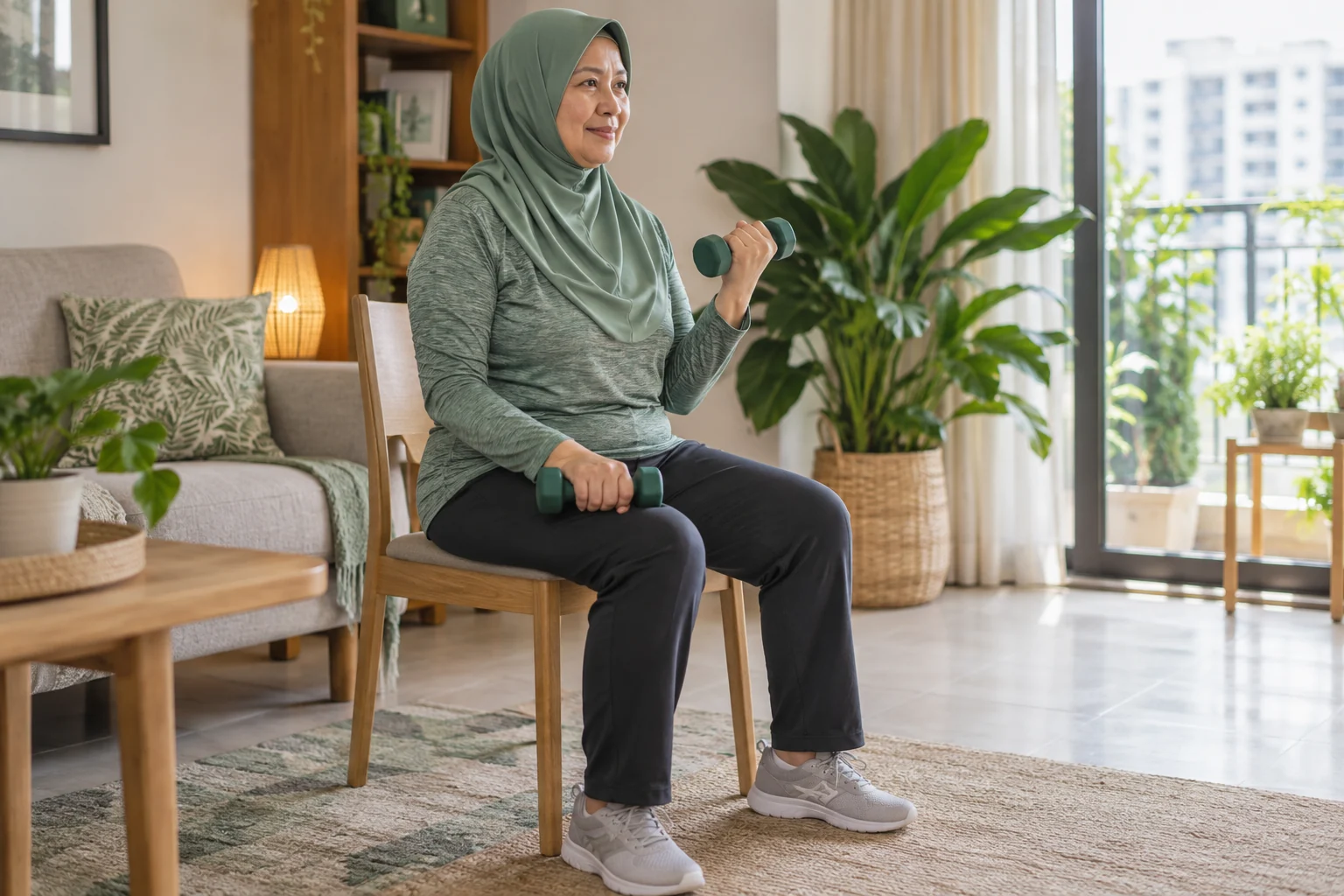
Sarcopenia: the age-related, progressive loss of skeletal muscle mass and strength.
Do you really lose muscle as you age?
Yes — the loss begins well before old age and is measurable from midlife. Cross-sectional data show that skeletal muscle mass declines at a median of approximately 0.47% per year in men and 0.37% per year in women (Mitchell 2012). Expressed another way, muscle mass falls by roughly 8% per decade until age 70, after which the rate accelerates to somewhere between 13% and 24% per decade (Filippin 2015).
These figures come from population-level cross-sectional studies, so individual trajectories vary. But the direction is consistent: without deliberate resistance training and adequate protein, lean mass quietly and continuously erodes. The consequence for body composition is significant. Muscle is metabolically active tissue — it burns more energy at rest than fat. Less muscle means a lower resting metabolic rate, which makes energy balance harder to manage over time.
Now put a calorie deficit on top of that. Pooled dietary studies found a median of about 14% of weight lost as fat-free mass on standard low-calorie diets, rising to roughly 23% on very-low-calorie diets (Chaston 2007). At 30 that cost is recoverable at leisure. At 55 it is added to an annual loss already running, in a body with less headroom — the same intervention, different arithmetic. Everything below applies from 40 onward and gets sharper, not softer, with each decade after it.
Why is protein "less effective" after 40?
The mechanism is called anabolic resistance: older muscle responds less efficiently to a given dose of ingested protein than younger muscle does (Bauer 2013). To put it plainly, the same meal that would reliably trigger muscle protein synthesis in a 25-year-old produces a blunted signal in a 50-year-old.
The practical consequence is that protein requirements rise with age, not because the body becomes inefficient at using protein in general, but because you need a larger stimulus to get the same anabolic response. This is why standard dietary guidelines — which are set for the general adult population and calibrated on younger cohorts — tend to underestimate what older adults need to maintain and rebuild muscle.
It is worth being precise about the evidence here. The bulk of the anabolic resistance research has been conducted in adults aged 65 and over, not specifically in adults in their forties. The trajectory from midlife is progressive, but the degree of anabolic resistance at age 42 is not the same as at age 72. Framing this honestly: if you are over 40, you are earlier on this trajectory; the biology does not switch on at a specific birthday.
How much protein do you need after 40?
More than the standard 0.8 g per kilogram of body weight per day that applies to the general adult population. The PROT-AGE Study Group — a panel of nutrition and geriatric medicine specialists — recommends that healthy older adults consume approximately 1.0–1.2 g/kg/day as a baseline, with higher intakes for those who are physically active (Bauer 2013). The European Society for Clinical Nutrition and Metabolism (ESPEN) expert group aligns with this, recommending at least 1.0–1.2 g/kg/day for healthy older adults above the standard RDA (Deutz 2014).
These recommendations are grounded primarily in research on adults aged 65 and over. For someone in their forties or fifties, the appropriate intake sits somewhere in a range informed by these guidelines, individual activity levels, and clinical judgement. A doctor or dietitian can help you determine what is right for your profile.
In practical terms, for a 70 kg person, the PROT-AGE target of 1.0–1.2 g/kg/day translates to 70–84 g of protein daily as a baseline — meaningfully above what a default Singaporean diet tends to deliver, particularly if meals are hawker-centre rice-and-vegetable combinations without a deliberate protein source. If you are navigating this at a local food court, a serving of sliced fish soup, chicken breast from an economy rice stall, or tofu and egg dishes can all contribute — but it typically requires planning, not just eating normally. The article hawker dishes ranked by protein per calorie maps this out in more detail.
Why resistance training stops being optional
Resistance training — lifting weights, using resistance machines, or bodyweight exercises with sufficient load — is the most effective intervention available to counteract age-related muscle loss. It does not merely slow the decline; in adequately dosed programmes, it can partially reverse it.
In the context of getting lean, this matters for two reasons. First, resistance training preserves the muscle you have while in a calorie deficit. Six randomised trials in obese older adults, pooled, found that adding resistance training to caloric restriction prevented an estimated 93.5% of the lean-body-mass loss otherwise seen — and did so without reducing fat loss or total weight loss (Sardeli 2018). That last clause answers the objection people actually have: training does not slow the weight loss down, it changes what the weight is made of. It is a small evidence base in a specific population, so the exact percentage should not be treated as a constant; the direction is not in doubt. Second, preserving muscle protects your resting metabolic rate, making it easier to sustain a healthy body composition over the long term.
If you are carrying a belief that cardio is the primary tool for losing fat and weights are for "bulking," this is the part worth revisiting. One trial randomised 160 previously sedentary adults with obesity, mean age around 70, to a control group or to diet plus aerobic, resistance, or combined exercise (Villareal 2017). All the exercise groups lost about 9% of body weight, but lean mass fell 5% with aerobic-only training against 2% with resistance training and 3% with both, and hip bone mineral density fell most in the aerobic-only group. Combined training produced the largest gain in physical performance. So keep the walking and the swimming, and add resistance work — the combination is what the trial supports. The article losing weight vs getting lean covers the distinction in more detail.
Nor is it too late to start. Across 47 studies covering 1,079 adults aged 50 and over, resistance training produced strength increases of roughly 24–33% across major lifts, with higher-intensity programmes producing larger gains (Peterson 2010). The adaptive response is smaller and slower than at 25, and it is far from absent.
If you are using GLP-1 medication after 40
GLP-1 medication is the most effective drug class ever studied for weight reduction. The question worth asking — and the one this clinic was built around — is what you are losing.
Rapid weight loss, by any mechanism, carries a risk of muscle loss alongside fat loss. When the two forces of age-related muscle decline and a significant calorie deficit both operate at the same time, the stakes for protecting lean mass are higher. This is not an argument against using GLP-1 medication after 40; it is an argument for surrounding it with the right plan.
Suitability for GLP-1 medication is an individual medical determination — a doctor's decision based on your health history, current medications, and clinical profile, not a function of age alone. What the biology of midlife does is raise the importance of the supporting structure: adequate protein intake, consistent resistance training, and a planned exit strategy that does not leave muscle behind. The articles on protein while on GLP-1 medication and losing weight vs getting lean set out what that structure looks like in practice.
Common questions
Why is it harder to get lean after 40?
From midlife, two biological processes compound each other. Skeletal muscle mass declines gradually and progressively — at roughly 0.47% per year in men and 0.37% per year in women (Mitchell 2012) — and muscle becomes less responsive to ingested protein, a phenomenon called anabolic resistance (Bauer 2013). Both forces mean that defending lean mass during a calorie deficit requires more deliberate effort than it did in your twenties.
How much protein do I need after 40?
More than the 0.8 g per kilogram per day that applies to the general adult population. The PROT-AGE Study Group recommends approximately 1.0–1.2 g/kg/day for healthy older adults, with higher intakes for those who are physically active (Bauer 2013). ESPEN experts recommend a minimum of 1.0–1.2 g/kg/day above the standard RDA (Deutz 2014). The primary evidence base for these figures is in adults aged 65 and over; what is appropriate at 40 or 50 sits in a range — speak to a doctor about your specific situation.
Do I actually lose muscle as I age?
Yes. Cross-sectional data show skeletal muscle mass declining at approximately 0.47% per year in men and 0.37% per year in women (Mitchell 2012), with decline accelerating after age 70 to somewhere between 13% and 24% per decade (Filippin 2015). The process begins well before old age and is progressive from midlife.
Is resistance training necessary after 40?
It is the strongest available defence against age-related muscle loss. Pooling six randomised trials in obese older adults, adding resistance training to caloric restriction prevented an estimated 93.5% of the lean-mass loss otherwise seen, without reducing fat loss or total weight loss (Sardeli 2018). Starting later still works: across 47 studies of adults aged 50 and over, resistance training produced strength gains of roughly 24–33% across major lifts (Peterson 2010).
Is cardio enough on its own after 40?
It is worth doing and it is not sufficient alone. In a trial of dieting adults with obesity, aerobic-only exercise was followed by a 5% fall in lean mass against 2% with resistance training and 3% with both, and combined training produced the largest gain in physical performance (Villareal 2017).
Is GLP-1 medication suitable after 40?
Suitability is individual and determined by a doctor based on your full health profile — not by age alone. What does become more important with age is the muscle-protection structure surrounding any weight-loss approach: adequate protein, consistent resistance training, and a planned exit strategy. A doctor can advise whether GLP-1 medication is clinically appropriate and what that structure should look like for you.