No. In the pivotal trials most participants reached a 5% weight loss and a minority did not, and the exact proportions depend on which official document you read — the journal report and the European regulator publish different numbers for the same trial, and both are correct. This article gives the full threshold ladder from one source, reports what the placebo groups did, sets out why nobody can predict in advance who will respond less well, and covers what is actually looked at when the weight is not moving.
Responder: in these trials, a participant reaching a set percentage of starting body weight lost — usually 5%, 10%, 15% or 20% — by the trial's end point. It is a threshold convention rather than a clinical diagnosis, and a 2026 review notes that definitions of response differ from study to study (Front Endocrinol 2026).
The full ladder, from one document
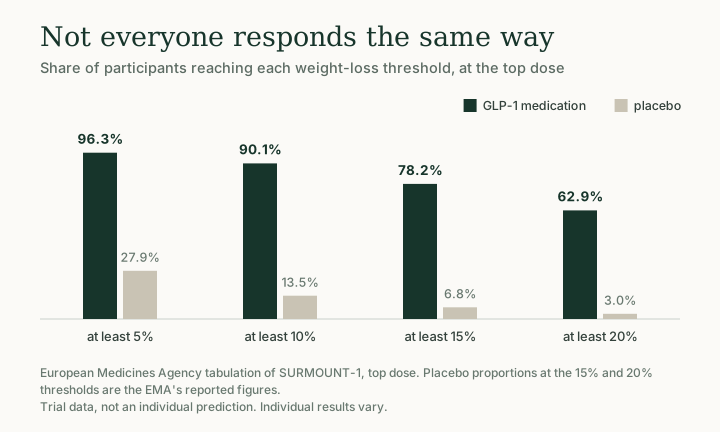
Most participants cleared 5%, fewer cleared 10%, fewer again cleared 15%, and a smaller group cleared 20%. Every figure in this section comes from the European regulator's own section 5.1 tables, so the rungs are comparable with each other.
Semaglutide 2.4 mg, STEP 1, 68 weeks, adults without diabetes (EU summary of product characteristics):
| Threshold | Semaglutide | Placebo |
|---|---|---|
| At least 5% | 83.5% | 31.1% |
| At least 10% | 66.1% | 12.0% |
| At least 15% | 47.9% | 4.8% |
That table stops at 15%. The regulator publishes no 20% figure for this trial, so there is not one to quote.
Tirzepatide 15 mg, SURMOUNT-1, 72 weeks, diabetes excluded (EU summary of product characteristics):
| Threshold | Tirzepatide 15 mg | Placebo |
|---|---|---|
| At least 5% | 96.3% | 27.9% |
| At least 10% | 90.1% | 13.5% |
| At least 15% | 78.2% | 6.0% |
| At least 20% | 62.9% | 1.3% |
Two things to hold alongside those tables. Individual results vary, and a trial population is not a clinic population — so these are reported here as trial results, not as outcomes to expect.
The diabetes comparison is the one population-level difference that shows up clearly. In the semaglutide regulator's own tables, STEP 2 — the equivalent trial in adults with type 2 diabetes — records 67.4% reaching at least 5%, 44.5% at least 10% and 25.0% at least 15% (EU summary of product characteristics). That is a real and reproducible gap, and it is covered in GLP-1 with diabetes and without.
Why the same trial has two sets of numbers
Because the journal and the regulator analyse the same data in two different ways, and both publish. This is the single most citable-looking trap on this subject, and it catches people who are being careful.
For STEP 1, the journal report gives 86.4% reaching at least 5%, 69.1% at least 10% and 50.5% at least 15% (N Engl J Med 2021). The regulator's table for the same trial gives 83.5%, 66.1% and 47.9% (EU summary of product characteristics). For SURMOUNT-1 on the 15 mg dose, the journal gives 91% reaching at least 5% and a mean reduction of 20.9% (N Engl J Med 2022); the regulator's table gives 96.3% and a mean of 22.5% (EU summary of product characteristics).
The difference is the question being answered. The journals report what happened across everyone randomised, whether or not they stayed on treatment. The regulator's tables report what happens among those who stay on it. The semaglutide document spells the difference out in a footnote: 17.1% of the semaglutide group and 22.4% of the placebo group permanently discontinued, and had everyone stayed on treatment the estimated change would have been 16.9% rather than 14.9%.
Neither number is wrong. But a figure quoted from one document and set against a figure from the other is a comparison of two different analyses wearing the appearance of one. If a percentage matters to you, the useful question is which document it came from.
What the placebo groups did
They lost weight, and roughly three in ten of them cleared 5%. Leaving this out is the commonest way accounts of this subject mislead.
In STEP 1, the placebo group's mean change was 2.4%, and 31.1% of them reached at least 5% (EU summary of product characteristics). In SURMOUNT-1, the placebo group's mean change was also 2.4%, and 27.9% reached at least 5% (EU summary of product characteristics).
Those groups were not doing nothing. Everyone in these trials received a lifestyle programme — reduced-calorie diet, increased physical activity, regular contact with the study team. So about three in ten people on that programme alone reached the 5% threshold. The medication moved the whole distribution up sharply. It did not create the distribution from scratch.
How many did not reach 5%?
A minority — and the number is a subtraction rather than something the trials reported directly, which is why it moves depending on where you take the threshold from.
Working from STEP 1: 13.6% did not reach 5% if you start from the journal's 86.4%, or 16.5% if you start from the regulator's 83.5%. Working from SURMOUNT-1 at 15 mg: 9% or 3.7% on the same logic (derived comparison). In the diabetes population the figure is larger — roughly a third did not reach 5% in STEP 2, on either document's threshold (derived comparison).
There is a second reason to handle that number carefully. "Did not reach 5% at week 68" is not the same statement as "the medicine did nothing". The journal's analysis counts everyone randomised, whether or not they stayed on treatment, so the 13.6% and 9% figures include people who stopped early for any reason (derived comparison). In STEP 1, 4.5% of the semaglutide group discontinued because of gastrointestinal events against 0.8% on placebo (STEP 1), and 4.3% of semaglutide-treated adults in the pooled label data discontinued permanently for a gastrointestinal reaction against 0.7% on placebo (US prescribing information). Someone who could not stay on the medicine and someone at full dose whose weight did not move are two different situations that land in the same column of the same table.
Can anyone predict who will respond less well?
No. No validated predictor of poor response exists in the published trial literature (status finding).
That is worth stating flatly, because the gap tends to get filled with folklore. Repeated searches of the trial literature for a prespecified or validated baseline predictor of semaglutide or tirzepatide weight-loss response returned nothing. Sex, age, BMI, starting weight, diet, genetics and gut bacteria are not established predictors of response, and a 2026 review of the microbiome question states directly that definitions of response are heterogeneous, the human studies are small, and causality has not been established (Front Endocrinol 2026).
The one quantified signal that exists is narrow on every axis. Within the diabetes population of SURMOUNT-2, weight loss was progressively smaller the higher the starting HbA1c (Sattar 2025). That analysis was post hoc, published as a Letter, sits inside a population this article's readers may not belong to, and has already drawn a published Comment. It is a signal, not a test.
What the evidence supports is narrow: response varies, the trials show the spread, and the only clear population-level difference anyone has established is the diabetes one.
Is there a rule for stopping when it is not working?
There is one formal rule in the labelling. It belongs to liraglutide, and its two jurisdictional versions disagree with each other.
The US liraglutide 3 mg label instructs prescribers, verbatim, to evaluate the change in body weight at 16 weeks and discontinue if the patient has not lost at least 4% of baseline body weight (US prescribing information). The EU label for the same medicine, in its indication section, says to discontinue after 12 weeks on the 3.0 mg dose if at least 5% of initial body weight has not been lost (EU summary of product characteristics). Different clock, different threshold, same molecule.
That rule does not carry across the class. A full-text search of the current US semaglutide and tirzepatide weight-management labels for every variant of that sentence returned nothing in either; both say only to consider treatment response and tolerability when selecting the maintenance dose. The EU semaglutide label sets a discontinuation-for-non-response rule only for adolescents (negative finding). Singapore's public formulary publishes no such rule at all.
A verified absence is a finding. It also means the review point for any individual patient is a clinical judgement rather than a number that can be looked up.
At GetLean, response is reviewed at a monthly check-in with Dr Quek. There is no fixed percentage threshold: whether to continue, adjust or stop is a clinical decision taken at that review, on how the individual has responded to the medication and how well they tolerate it.
What actually gets looked at when the weight is not moving
Three things, and the decision at the end of them belongs to the prescriber rather than to the patient or to an article.
First, whether the dose has actually reached maintenance. Singapore's registered semaglutide schedule climbs from 0.25 mg to 1.7 mg across weeks 1 to 16 before the 2.4 mg maintenance dose (Singapore NDF). The registered tirzepatide schedule starts at 2.5 mg and increases in 2.5 mg steps with a minimum of four weeks at each (Singapore NDF). A verdict reached in week 10 is a verdict on a partial dose. How that schedule works is set out in GLP-1 dose titration.
Second, whether tolerability is the actual problem. Someone stepping back down or stalling because of nausea is in a different situation from someone sitting comfortably at full dose with a flat weight trend. The labels treat these differently and so should the conversation.
Third, what surrounds the medication. The placebo arms above are the evidence that the lifestyle programme does real work on its own. Where protein, resistance training and sleep have not been in place, the medication has been asked to carry more than it can.
There is also a measurement question underneath all of this, which is whether scale weight is the right thing to be judging. Body composition can move while weight stalls, and the two are not interchangeable — losing weight vs getting lean sets out the difference, and how fast should you lose weight covers what a reasonable rate looks like.
What none of this can promise is that a small response becomes a large one. The decision to continue, change or stop is the prescribing doctor's, made with the person in front of them.
Common questions
Do GLP-1 medications work for everyone?
No. In the European regulator's tabulation of STEP 1, 83.5% of adults on semaglutide 2.4 mg reached at least 5% weight loss over 68 weeks (EU summary of product characteristics), which means roughly one in six did not. In its tabulation of SURMOUNT-1, 96.3% on tirzepatide 15 mg reached 5% (EU summary of product characteristics). Individual results vary.
What counts as a non-responder to GLP-1 medication?
There is no agreed definition. The trials report thresholds — 5%, 10%, 15% and 20% of starting body weight — and a person below a threshold at the trial's end point is counted as not having reached it. A 2026 review states plainly that definitions of response differ between studies and that no causal predictor has been established (Front Endocrinol 2026).
Why do different sources give different response rates for the same trial?
Because they use different statistical analyses. For STEP 1, the journal report gives 86.4% reaching at least 5%, 69.1% at least 10% and 50.5% at least 15% (N Engl J Med 2021); the European regulator's table for the same trial gives 83.5%, 66.1% and 47.9% (EU summary of product characteristics). Both are authoritative. Figures from the two should never be mixed in one comparison.
Is there a rule for stopping GLP-1 medication if it is not working?
There is one, it belongs to liraglutide, and its two versions disagree. The US liraglutide 3 mg label says to evaluate at 16 weeks and discontinue if at least 4% of baseline body weight has not been lost (US prescribing information); the EU label for the same medicine says 12 weeks and 5% (EU summary of product characteristics). A full-text search of the current US semaglutide and tirzepatide weight-management labels found no such rule (negative finding).
Can a doctor tell in advance whether GLP-1 medication will work for me?
No. No validated predictor of poor response was found in the published trial literature (status finding). The one quantified signal is a post hoc analysis inside the diabetes population showing smaller weight loss at higher starting HbA1c (Sattar 2025), and it has already drawn a published Comment. Sex, age, BMI, diet, genetics and gut bacteria are not established predictors.