Prescribing a GLP-1 medication to someone with type 2 diabetes and prescribing it for weight management are two different clinical conversations. In the pivotal trials, participants with type 2 diabetes lost about a third less weight at matched durations and matched doses. The safety picture shifts too, mainly because of the other medicines a person with diabetes is usually taking. And in Singapore the two uses are registered on different products. GetLean is a weight-management service and does not treat diabetes — if you have it, your diabetes care stays with the doctor who manages it. This article sets out what actually changes between the two conversations.
Glycaemic control: the clinical goal of keeping blood glucose within a target range in a person with diabetes. It is a separate treatment goal from weight management, and in Singapore it sits on separate registered medicines.
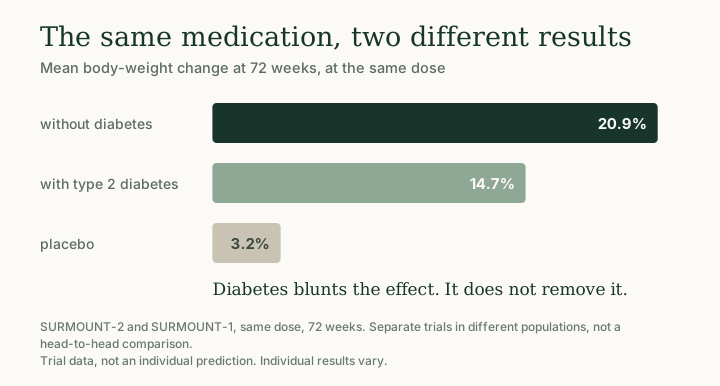
How much less weight did trial participants with diabetes lose?
About a third less, for both medicines, at matched durations. This is one of the larger and better-replicated findings in the whole literature, and it has been reproduced in two independent drug programmes.
Semaglutide 2.4 mg over 68 weeks. In STEP 1, which enrolled adults with overweight or obesity and no diabetes, mean body weight fell 14.9% against 2.4% on placebo (STEP 1). In STEP 2, the equivalent trial in adults with type 2 diabetes, mean body weight fell 9.6% against 3.4% on placebo (STEP 2).
Tirzepatide 15 mg over 72 weeks. In SURMOUNT-1, which excluded diabetes, mean body weight fell 20.9% against 3.1% on placebo (SURMOUNT-1). In SURMOUNT-2, in adults with type 2 diabetes, it fell 14.7% against 3.2% (SURMOUNT-2).
Two things about reading those numbers. All four are the figures published in the journals. The European regulator tabulates the same four trials under a different statistical analysis and publishes different percentages, so numbers from the two kinds of document should never be combined in one comparison. And these are trial means in trial populations. Individual results vary.
The threshold view tells the same story from a different angle. In the European regulator's tables for semaglutide, 47.9% of participants without diabetes reached at least 15% weight loss in STEP 1, against 25.0% of participants with type 2 diabetes in STEP 2 (EU summary of product characteristics). In the regulator's tables for tirzepatide, 62.9% of participants without diabetes reached at least 20% on the 15 mg dose, against 34.0% of participants with type 2 diabetes on the same dose (EU summary of product characteristics).
The smaller figure describes a different population, not a disappointing one. A mean 9.6% reduction in a group of people who also have type 2 diabetes is a substantial result in its own right. It is simply not the number a reader without diabetes should carry across to themselves, or the reverse.
One caveat runs underneath everything below. Tirzepatide's weight-management results appear here as trial results and nothing more.
Why the gap exists is not settled
Nobody has established the mechanism. One explanation has been published — by the trial's own authors, in a post hoc analysis released as a Letter — and it has already drawn a formal reply in the same journal.
That analysis split the SURMOUNT-2 population by starting HbA1c and found that placebo-corrected weight reduction on the 15 mg dose fell steadily as starting HbA1c rose: 17.7% in those below 7%, 13.6% at 7 to under 8%, 11.0% at 8 to under 9%, and 9.0% at 9% and above (Sattar 2025). The authors' proposed explanation is that when very high blood glucose comes down, glucose that had been leaving the body in the urine is retained instead, and the energy conserved offsets part of the weight loss.
The status of that matters as much as the content. It is a hypothesis put forward by the trial's own authors, in an analysis that was not prespecified, published in the shortest article format the journal has, and the journal has since published a Comment on it. So the accurate phrasing is that the trial's authors have suggested this — not that this is the reason.
Which leaves the position honestly stated: the gap is real, it has been reproduced across two drug programmes, and nobody can currently tell you why.
Hypoglycaemia is the sharpest safety difference, and it is mostly about the other medicines
The clearest safety divergence between the two conversations is hypoglycaemia — blood glucose falling too low. Every label examined here agrees that the risk rises mainly when a GLP-1 medication is combined with insulin or a sulfonylurea, which are diabetes medicines rather than anything a weight-management patient would ordinarily be taking.
Sulfonylurea: an older class of oral diabetes medicine that makes the pancreas release insulin regardless of what blood glucose is doing at the time. It is one of the two drug types the GLP-1 labels single out for hypoglycaemia risk. The other is insulin itself.
The numbers, each belonging to a specific document in a specific country:
- The US tirzepatide weight-management label carries the only incidence figures. In its trial in people with type 2 diabetes and a BMI of 27 or above, hypoglycaemia — defined there as plasma glucose below 54 mg/dL — occurred in 4.2% of those on tirzepatide against 1.3% on placebo. Among those also taking a sulfonylurea it was 10.3%, against 2.1% among those not (US prescribing information). The same section states that hypoglycaemia has also been associated with this medicine class in adults without type 2 diabetes, so it is not a diabetes-only concern.
- The US semaglutide weight-management label carries the warning without a rate attached. It states that combining semaglutide with insulin or an insulin secretagogue may increase the risk of hypoglycaemia including severe hypoglycaemia, directs that blood glucose be monitored before starting and during treatment in patients with diabetes, and tells prescribers to consider reducing the dose of the insulin or secretagogue when initiating (US prescribing information). It also records that use in type 1 diabetes, or in combination with insulin, has not been evaluated.
- The EU labels for semaglutide, tirzepatide and liraglutide all carry this warning in the same place, section 4.4, with the same remedy: the risk may be lowered by reducing the dose of the sulfonylurea or the insulin (EU summaries of product characteristics). One detail is easy to skip past. The semaglutide and liraglutide headings read "Hypoglycaemia in patients with type 2 diabetes". The tirzepatide heading reads simply "Hypoglycaemia", with no such qualifier.
- Singapore's public formulary publishes indication, dosing and contraindications for these products. Section 4.4, where these warnings live, is not published there (Singapore NDF) — so the Singapore wording cannot be set alongside the others.
Every one of those instructions is addressed to a prescriber. None is an instruction to a patient. Nobody should reduce their own insulin or sulfonylurea dose on the strength of an article, and that adjustment belongs to the doctor who prescribed it. It is also one of the concrete reasons the two conversations need to stay connected to each other rather than running in parallel.
In Singapore, the two uses sit on different registered products
Three registrations, and only one of them is a weight-management registration (Singapore NDF):
- Semaglutide 2.4 mg (SIN16748P) carries the weight-management indication — an adjunct to a reduced-calorie diet and increased physical activity, in adults with a BMI of 30 or above, or 27 to under 30 with at least one weight-related comorbidity.
- The semaglutide 1 mg product (SIN16164P) is registered for the treatment of adults with insufficiently controlled type 2 diabetes. It carries no weight-management indication.
- The tirzepatide product (SIN16718P) is registered for the treatment of adults with insufficiently controlled type 2 diabetes. Its registered indication contains no mention of weight management or weight loss anywhere.
The European position on the last of those is different: the EU tirzepatide document carries two headed indications, type 2 diabetes and weight management. That difference does not transfer. What is registered in Singapore is what is registered in Singapore, and a reader comparing overseas material against local material will find the two do not line up.
One further detail rewards careful reading. The Singapore weight-management indication lists dysglycaemia — prediabetes or type 2 diabetes — among the weight-related comorbidities that qualify an adult with a BMI between 27 and 30. Having type 2 diabetes can therefore form part of what makes someone eligible for weight-management treatment. Being eligible for treatment aimed at weight is a separate thing from the medicine being indicated to treat the diabetes, and the two must not be allowed to collapse into one.
What if nobody has checked your blood sugar?
No guideline requiring a screen for undiagnosed diabetes before weight-management medication appears in the sources this article rests on. What the labels instruct is narrower, and applies to people already known to have diabetes: monitor blood glucose before starting treatment and during it (US prescribing information).
There is one figure worth knowing, and it is a prevalence figure rather than a rule. SURMOUNT-1 excluded people with diabetes — and 40.6% of the participants it did enrol already had prediabetes at baseline (SURMOUNT-1). In a trial that had specifically screened diabetes out, four in ten people were still sitting in the range short of it. That says something useful about how common the intermediate state is among people seeking weight-management treatment. It describes a trial population and nothing else: it is not a diagnosis, a prediction, or a threshold.
Who manages what
If you have type 2 diabetes, your diabetes care stays with the doctor who manages it. GetLean is a weight-management service. We do not treat diabetes or prediabetes, we do not manage blood glucose, and we do not adjust diabetes medicines.
The separation is practical rather than administrative. The medicines that generate the hypoglycaemia risk described above — insulin, sulfonylureas — are prescribed and titrated by your diabetes doctor, who holds your glucose records and your history. A weight-management prescriber adjusting them in isolation would be working without the information the decision needs.
If a doctor asks for more detail before prescribing, or asks you to speak to your diabetes doctor first, it is a normal step in an assessment and not a verdict on you. A concern about suitability does not mean a patient cannot use GLP-1 medication. It can mean further checks are sensible first.
Two conversations, then, connected but distinct. They can both be live for the same person at the same time. They are answered by different doctors, against different registered indications, using different numbers.
There is a third position, before either conversation applies: raised glucose that has not reached the diabetes threshold. Prediabetes and body weight covers what Singapore's own follow-up study found happens next, including how it is diagnosed here, and weight-related conditions puts it beside the other conditions that can qualify someone for weight management.
That split runs through the register itself. Some products here are licensed for diabetes only, and some carry a weight-management indication as well: the semaglutide injection registrations and the tirzepatide registrations.
Common questions
Does GLP-1 medication work less well if you have type 2 diabetes?
In the pivotal trials the average weight reduction was about a third smaller in the diabetes populations. Semaglutide 2.4 mg gave a mean 9.6% reduction over 68 weeks in adults with type 2 diabetes (STEP 2) against 14.9% in adults without (STEP 1); tirzepatide 15 mg gave 14.7% over 72 weeks with diabetes (SURMOUNT-2) against 20.9% without (SURMOUNT-1). Individual results vary.
Why do people with type 2 diabetes lose less weight on GLP-1 medication?
Nobody has established the reason. The only published explanation comes from a post hoc analysis by the trial's own authors, who suggested that as very high blood glucose falls, glucose that had been leaving the body in the urine is retained instead and offsets some of the weight loss (Sattar 2025). That analysis has already drawn a published Comment, and it is a hypothesis rather than a settled mechanism.
Can GLP-1 medication cause low blood sugar?
The labels say the risk rises mainly when it is combined with insulin or a sulfonylurea. The US tirzepatide weight-management label reports hypoglycaemia in 4.2% of treated patients with type 2 diabetes against 1.3% on placebo, rising to 10.3% among those also on a sulfonylurea (US prescribing information). That same label also states hypoglycaemia has been associated with this medicine class in adults without type 2 diabetes.
Is tirzepatide registered in Singapore for weight management?
No. The tirzepatide product registered here (SIN16718P) is registered for the treatment of adults with insufficiently controlled type 2 diabetes, and its registered indication contains no mention of weight management (Singapore NDF). The European document for the same molecule carries a weight-management indication as well, and that position does not transfer to Singapore.
Does GetLean treat diabetes or prediabetes?
No. GetLean is a weight-management service. We do not treat diabetes or prediabetes, do not manage blood glucose, and do not adjust diabetes medicines. If you have type 2 diabetes, your diabetes care stays with the doctor who manages it.