GLP-1 medication is a class of injected prescription medicines that activate the receptor for a hormone the gut already releases after a meal, and in weight management their main effect is on appetite. That is most of what they do. They do not build muscle, they do not decide which tissue comes off, they do not work equally well for everyone, and their effect on weight holds only while treatment continues. This guide covers where the class came from, what the mechanism is and how well it is evidenced, how the dose is built up, how much the trials varied between people, what is actually registered in Singapore, and how a reader here can tell licensed supply from the grey market.
GLP-1 medication: a prescription medicine that activates the receptor for glucagon-like peptide-1, a hormone released from the gut after eating. The two molecules discussed throughout are semaglutide and tirzepatide. In Singapore they sit on different registered indications, which the section on registration below sets out.
Where the class came from
The starting observation is older than the drugs by forty years. From the 1960s it was known in humans that swallowed glucose produces a much larger insulin response than the same glucose delivered into a vein — Perley and Kipnis reported the intravenous response was only 30 to 40% of the oral one, and concluded that something in the intestinal tract was involved (Perley & Kipnis 1967). That gap is the incretin effect, and finding the hormone responsible for it took another twenty years.
GLP-1 was identified in the mid-1980s through work on the proglucagon gene by several groups. Almost all of that work was in animal tissue or cell lines: the active truncated form was shown to stimulate insulin release in perfused rat and pig pancreas in 1987, and the first demonstration in humans was a seven-volunteer infusion study published in December of that year (discovery papers).
Who should be credited for that is still argued in the literature, and it is worth saying so rather than flattening it into a single origin story. The 2024 Lasker~DeBakey Clinical Medical Research Award named Joel Habener, Svetlana Mojsov and Lotte Bjerre Knudsen, and did not include Daniel Drucker or Jens Juul Holst. The most-cited historical review of the field was written by Drucker, Habener and Holst, without Mojsov. Mojsov has since published her own account of the discovery in JAMA, twice (contested attribution). Several groups, over more than a decade, with the credit still being settled.
The lizard belongs to a different thread, and the popular version of it is wrong. In 1992, John Eng and colleagues isolated a 39-amino-acid peptide from the venom of the Gila monster, Heloderma suspectum, and named it exendin-4; the pharmacology in that paper was cyclic AMP in guinea-pig pancreatic tissue, with no human work (Eng 1992). Exendin-4 is not lizard GLP-1. Molecular cloning showed it is made in the salivary gland — the venom gland — and is the product of a gene separate from the lizard's own GLP-1 gene (Chen & Drucker 1997). What made it useful is that it is roughly 50% homologous to human GLP-1 and binds the mammalian GLP-1 receptor with equal or higher affinity and efficacy, while humans have no equivalent of it (Pohl & Wank 1998). So "GLP-1 was discovered in lizard venom" collapses two different molecules from two different genes.
Every date in this history belongs to a jurisdiction. Exenatide — synthetic exendin-4 — was the first GLP-1 receptor agonist approved in the United States, on 28 April 2005, with semaglutide and tirzepatide products following between 2017 and 2023 (FDA). The European Union authorised exenatide on 20 November 2006, and its registered indication there was type 2 diabetes, not weight management (EMA). Singapore's own registration events are different again — semaglutide products from April 2021, tirzepatide from March 2023 (HSA register). The history of GLP-1, from lizard venom to a drug class works through each paper and each date.
What the medication actually does
Appetite regulation is the mechanism. A peer-reviewed review of GLP-1 receptor signalling places appetite regulation among its actions, alongside effects on gastric emptying and glucose control (Drucker 2018). In mouse work, a long-acting GLP-1 receptor agonist acted directly on appetite centres in the brain, activating the neurons that signal fullness and suppressing those that drive hunger (Knudsen 2016); the same receptor is present in humans, which is why the finding is relevant, but the direct brain-level demonstration is animal work.
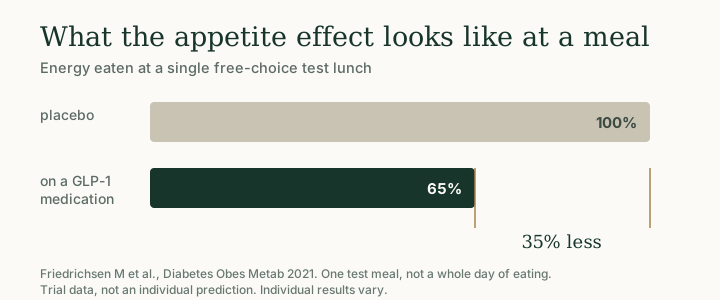
What has been measured in humans is intake, and the measurements are narrower than they are usually reported. After 12 weeks on semaglutide 1.0 mg weekly, total energy intake across a single laboratory test day was about 24% lower than placebo (Blundell 2017). At week 20 on semaglutide 2.4 mg, intake at a single ad libitum test lunch was 35% lower than placebo (Friedrichsen 2021). Those are test meals in a laboratory, not tracked free-living eating over months, and the difference matters — nobody has shown that a person eats 24% or 35% less every day.
The gastric-emptying story is more equivocal than the shorthand suggests. In that same trial, gastric emptying assessed by paracetamol absorption showed an 8% higher area under the curve over five hours at week 20 (P=0.005), which did not remain statistically significant once corrected for week-20 body weight (P=0.12), with no effect on the one-hour measures (Friedrichsen 2021). Slower stomach emptying is real enough as a labelled effect and it explains much of the nausea; it is not the whole account of why intake falls.
One number that circulates without its meaning attached is the half-life. Semaglutide's elimination half-life is about one week, and it is present in the circulation for roughly 5 to 7 weeks after a last 2.4 mg dose; tirzepatide's is about 5 to 6 days (prescribing information). Half-life describes how long the drug is measurable, not how long its effects last. How GLP-1 medications work sets out the mechanism in full.
Food noise, and what is actually known about it
"Food noise" entered clinical conversation from patients, not from a study, and the measurement caught up later. A 2023 narrative review proposed a conceptual model for the phenomenon and stated that systematic investigation and a means of measurement were still needed (Hayashi 2023). Reviewers writing in 2025 stated that a formal clinical definition and method of measurement of food noise were lacking, and proposed one (Dhurandhar 2025). The first psychometrically validated food-noise questionnaire was published in 2025, its authors stating that none existed before (Diktas 2025) — and a second, competing instrument appeared the same year, so there is no settled tool.
The consequence for reading trial results is direct: no GLP-1 trial has measured food noise, because there was nothing validated to measure it with. What the trials did measure is adjacent. Semaglutide studies using a self-report eating-control instrument found improved craving-control scores versus placebo, and the instrument's own authors describe its validation as preliminary (Control of Eating Questionnaire outcomes). "Clinically validated food-noise reduction" is a claim the evidence does not carry. What food noise is, and whether it is a real clinical thing traces the term from patient report to instrument.
What the medication does not do
It does not build muscle. In the SURMOUNT-1 body-composition sub-study, absolute lean mass fell 10.9% on tirzepatide, and roughly a quarter of the weight lost was lean mass — a ratio indistinguishable from the placebo arm, which was diet alone (Look 2025). What rises on a scan is the share of remaining body mass that is lean, because fat falls faster. Those are opposite claims and they are easy to conflate. At GetLean, our philosophy is that GLP-1 medication should act as a catalyst — not something to depend on indefinitely — and the muscle side of the result comes from training and protein rather than from the injection. Getting lean vs losing weight covers what the composition evidence shows.
It does not target a body region. The medication creates an energy deficit; the deficit is neutral about which tissue and which depot it draws from.
It does not hold the result after it is stopped. The withdrawal evidence is unambiguous on that, and it is the subject of its own cluster — coming off GLP-1 sets out what the cessation trials measured.
It does not come with a way of predicting who it will suit. Apart from having type 2 diabetes — and, within that group, a higher starting HbA1c — no validated predictor of who responds less well was found in the published trial literature (status finding). Sex, age, BMI, diet, genetics and gut bacteria are not established predictors, so a claim to identify responders in advance is not supported by the published trial literature.
And it is not a diabetes treatment, from us. GetLean is a weight-management service and does not treat, manage or claim to improve diabetes. Singapore's registration makes the line unusually clean: registered indications differ by product, with the registered semaglutide 2.4 mg product carrying the weight-management indication, the registered semaglutide 1 mg product carrying a type 2 diabetes indication only, and tirzepatide's current registrations carry both a type 2 diabetes and a weight-management indication (NDF indications). Anyone with diabetes should have it managed by their own doctor.
How the dose is built up
Slowly, in fixed steps, over about four months — and the schedule itself is the same wherever you read it. Singapore's registered semaglutide escalation runs 0.25 mg, 0.5 mg, 1 mg and 1.7 mg across weeks 1 to 16, reaching a 2.4 mg maintenance dose (Singapore product information). The US injectable schedule has identical steps, and adds an option to increase to a maximum of 7.2 mg after at least four weeks tolerating 2.4 mg (US prescribing information) — an option Singapore's registered product information does not carry (Singapore product information). Tirzepatide starts at 2.5 mg once weekly and rises in 2.5 mg increments after a minimum of four weeks on the current dose, to a maximum of 15 mg (Singapore product information).
The difference between the two molecules that patients actually notice is in the tolerability wording. Singapore's semaglutide dosing section says that in the case of significant gastrointestinal symptoms, delaying dose escalation or lowering to the previous dose should be considered (Singapore product information). The registered tirzepatide dosing section contains no equivalent sentence anywhere (Singapore product information). "You can hold at a dose if it does not suit you" is confirmed for semaglutide and is not a class-wide fact.
Escalation is also when side effects cluster. In the pooled trials behind the US semaglutide label, nausea occurred in 44% of treated adults against 16% on placebo, diarrhoea in 30% against 16%, and vomiting in 24% against 6%, with the label recording that these reactions were most frequently reported during dosage escalation (prescribing information). The US tirzepatide label reports nausea at 25 to 29% against 8% on placebo, and states that the majority of nausea, vomiting and diarrhoea events occurred during dose escalation and decreased over time (prescribing information). Both sets of figures are from US documents — GLP-1 safety: how the Singapore label reads sets out what is common, what is uncommon but serious, and how the same effects are described on the label registered here.
A missed dose has a Singapore-specific rule, and it is not the American one. In Singapore, a missed semaglutide dose should be taken within 5 days of the missed dose and a missed tirzepatide dose within 4 days; past that, the dose is skipped and the next one taken on the regular day (NDF dosing). How GLP-1 dose titration works sets out each schedule and each jurisdiction's wording side by side.
How much it varies between people
A great deal, and the honest way to show that is the responder ladder rather than a single average. One caution has to come first: the same trial reports different responder percentages depending on which official document you open, because the journal and the regulator use different statistical analyses. Both are authoritative, neither is wrong, and figures from the two must never be combined.
In the journal report of STEP 1, mean body weight fell 14.9% against 2.4% on placebo, and weight reductions of at least 5% were reached by 86.4% of the semaglutide group and 31.5% of the placebo group (Wilding 2021). In the European regulator's tabulation of the same trial, 83.5% reached at least 5%, 66.1% at least 10% and 47.9% at least 15% (EU summary of product characteristics).
In the journal report of SURMOUNT-1, mean body weight fell 20.9% on tirzepatide 15 mg against 3.1% on placebo, with 91% of that group reaching at least 5% against 35% on placebo (Jastreboff 2022). In the European regulator's tabulation, 96.3% on the same dose reached at least 5% and 62.9% reached at least 20%, against 27.9% and 1.3% on placebo (EU summary of product characteristics).
Two things in those numbers are routinely dropped. The first is that the placebo arms lost real weight and a substantial minority of them cleared 5% — everyone in these trials also received a lifestyle programme. The second is that "did not reach 5%" is a subtraction from a reported threshold rather than a reported figure in its own right, it changes depending on which document the threshold came from, and because these are intention-to-treat analyses it includes people who stopped treatment early (derived comparison).
There is a published stopping rule for non-response, and it belongs to one molecule, with its two jurisdictional versions disagreeing. The US liraglutide 3 mg label says to evaluate at 16 weeks and discontinue if the patient has not lost at least 4% of baseline body weight (US prescribing information); the EU label for the same medicine says 12 weeks and 5% (EU summary of product characteristics). A full-text search of the current US semaglutide and tirzepatide weight-management labels found no such rule at all, and the EU semaglutide label sets one only for adolescents (negative finding). Singapore publishes none.
At GetLean, response is reviewed at a monthly check-in with Dr Quek. There is no fixed percentage threshold: whether to continue, adjust or stop is a clinical decision taken at that review, on how the individual has responded to the medication and how well they tolerate it.
Do GLP-1 medications work for everyone works through the full ladder, both source documents and the placebo arms.
What is registered in Singapore, and at what BMI
Every registered semaglutide, tirzepatide and liraglutide product in Singapore is classified Prescription Only (HSA register). Registered indications differ by product: the registered semaglutide 2.4 mg product carries a weight-management indication, the registered semaglutide 1 mg product carries a type 2 diabetes indication only, and tirzepatide's current registrations carry both a type 2 diabetes and a weight-management indication (NDF indications).
The BMI numbers are where two scales run in parallel and get confused. Singapore's registered product information for semaglutide sets the weight-management indication at BMI 30 or above, or 27 to under 30 with at least one weight-related comorbidity (NDF indication). Those are the international cut-offs. Singapore's own national obesity guideline, published jointly by HPB and MOH, classifies overweight from BMI 23 and obesity from 27.5 for the local population (HPB–MOH 2016). A Singaporean can therefore be classified obese nationally while sitting below the registered label's threshold for an uncomplicated prescription. Both numbers are correct; they are answering different questions, and neither of them is a GetLean eligibility criterion — who is suitable is a clinical judgement Dr Quek makes at the consultation. GLP-1 medication in Singapore: what is legal and licensed covers the registrations and the statutes.
Licensed supply, and what the grey market actually is
The lawful routes are narrow and specified. A prescription-only medicine may be supplied by retail only from a licensed retail pharmacy, by a licensed healthcare service to its own patient on the written instructions of a doctor who is that licensee's personnel, or by a doctor to a patient under their care — and a prescription is valid only if it is signed by a doctor registered under the Medical Registration Act 1997 (Therapeutic Products Regulations 2016). A prescription written by a doctor who is not registered here does not authorise supply here. Separately, MOH has stated in Parliament that GLP-1 medicines may only be dispensed by a registered doctor or a licensed retail pharmacy against a valid prescription, and that their advertisement and sale on local online platforms is strictly prohibited; HSA had investigated 16 unauthorised sales or illegal advertisements and removed 82 non-compliant listings since 2022 (MOH 2024).
What sits outside those routes is not a cheaper version of the same product. HSA has published named cases of weight-loss products sold online in Singapore as "all-natural" that were found on analysis to contain sibutramine — disallowed for sale here since 2010 because of increased heart-attack and stroke risk — alongside undeclared diclofenac, phenolphthalein and laxatives, with consumers left symptomatic or hospitalised (HSA 2026). In 2024 HSA seized 970,707 units of illegal health products and removed 7,351 online listings, 5% of those listings being weight-loss products (HSA 2024 summary). Selling an unregistered health product carries a fine of up to $50,000 or two years' imprisonment, and an adulterated, counterfeit or tampered one up to $100,000 or three years (Health Products Act 2007); MOH puts the current penalty for sellers of illegal products at up to $100,000 and up to three years, and notes that HSA has no extra-territorial powers over overseas sellers (MOH 2024).
Falsification reaches the legitimate supply chain too. WHO issued a global alert in June 2024 after falsified semaglutide pens were found in the regulated supply chains of Brazil, the United Kingdom and the United States, warning that falsified product may be ineffective, contaminated, or contain unknown substituted ingredients (WHO 2024). No Singapore detection was found in that alert.
One lawful route is worth stating precisely, because it is often described loosely: Singapore permits personal import of up to three months' supply of a person's own prescribed medicine, with a valid prescription or doctor's letter and in original labelled packaging, and not for supply to anyone other than immediate family for whom it was prescribed (HSA personal medications). Compounded semaglutide and Telegram sellers goes through the specific channels, how each one is regulated, and where that personal-import allowance stops.
What the telemedicine framework requires
Telemedicine in Singapore is licensed as the remote provision of Outpatient Medical Service under the Healthcare Services Act 2020 and the Healthcare Services (OMS) Regulations 2023 (HCSA). The requirements on a licensee are specific. Before any service is provided remotely, the licensee must ascertain the patient's identity, contact information and location. A first-time patient may not be seen by remote provision at all unless it is through real-time two-way interactive audiovisual communications. The licensee must hold written guidelines on which patients are suited to remote care, taking account of the patient's condition and history and the practitioner's competence. And where a physical examination cannot be carried out remotely, alternative arrangements must be made for the patient to receive it (OMS Regulations 2023).
The joint MOH–HSA–SMC circular adds two things that bear directly on this medicine class. Teleconsultations must not be provided solely by way of self-service, text-only questions, and medicines must not be prescribed just by getting a patient to fill in a questionnaire. And a licensee's own guidelines must address the types of medication that should not be prescribed remotely, or not in certain scenarios — with the circular naming, among its examples, medicines requiring the patient to be first taught to be proficient in their use, "such as bronchodilators in asthma or insulin or GLP-1 injections" (Circular 87/2024). That is a duty on the licensee to hold a considered protocol.
Above the licensing regime sits the professional one. Singapore's medical regulator requires a doctor to have sufficient information, from good history-taking and adequate clinical evaluation, before offering any opinion or treatment, and states plainly that telemedicine is not equal to conventional in-person care and must be provided responsibly to the same standard (SMC Ethical Code).
For a reader checking any provider, the practical tools are public: MOH publishes a watchlist of enforcement actions against healthcare institutions and practitioners, and directs the public to the HealthHub licensed-services directory and the Singapore Medical Council register (MOH registers). The rules governing telehealth GLP-1 treatment in Singapore sets out each instrument and what it requires.
Clinical-trial and label figures describe the populations that were studied; individual results vary and are not guaranteed. This guide is education about a medicine class and about the framework governing it, not a substitute for the product information supplied with your medicine or for your doctor's instructions. If you are considering treatment, check your eligibility and speak to a doctor about whether it is suitable for you.
Common questions
How does GLP-1 medication work?
Mainly through appetite. GLP-1 receptor signalling acts on appetite regulation as part of its mechanism (Drucker 2018), and in mouse work a long-acting GLP-1 receptor agonist acted directly on appetite centres in the brain, activating the neurons that signal fullness and suppressing those that drive hunger (Knudsen 2016). Measured in humans, semaglutide reduced intake across a single laboratory test day by about 24% (Blundell 2017) and at a single test lunch by 35% (Friedrichsen 2021) — both single test meals rather than tracked daily eating.
Was GLP-1 discovered in lizard venom?
No. The peptide isolated from Gila monster venom in 1992 is exendin-4 (Eng 1992), and it is the product of a separate gene expressed in the lizard's salivary gland rather than the lizard's version of GLP-1 (Chen & Drucker 1997). GLP-1 itself was identified in the mid-1980s through work on the proglucagon gene, with the first human demonstration in December 1987 (discovery papers).
Does GLP-1 medication work for everyone?
No, and the exact proportion depends on which document you read. In the journal report of STEP 1, 86.4% of the semaglutide group reached at least 5% weight loss (Wilding 2021); in the European regulator's table for the same trial it was 83.5% (EU summary of product characteristics). Both are authoritative and figures from the two should never be mixed in one comparison. No validated predictor of who will respond less well was found in the published trial literature (status finding).
Is 'food noise' a real clinical thing?
It is a patient-derived description that researchers have only recently begun to measure. A 2023 narrative review proposed a conceptual model and said measurement was still required (Hayashi 2023), reviewers in 2025 stated no formal clinical definition or validated measurement had previously existed (Dhurandhar 2025), and the first psychometrically validated questionnaire appeared in 2025 (Diktas 2025).
Is GLP-1 medication legal in Singapore?
Yes, as a prescription medicine. Every registered semaglutide and tirzepatide product here is classified Prescription Only (HSA register), and MOH has stated in Parliament that these medicines may only be dispensed by a registered doctor or a licensed retail pharmacy against a valid prescription, with advertisement and sale on local online platforms strictly prohibited (MOH 2024).
How can you tell a licensed service from a grey-market seller?
Check rather than judge. MOH publishes a watchlist of enforcement actions and directs the public to the HealthHub licensed-services directory and the Singapore Medical Council register (MOH registers). The legal markers are also concrete: supply must come from a licensed retail pharmacy, from a licensed healthcare service to its own patient, or from a doctor to a patient under their care, and a valid prescription must be signed by a doctor registered under the Medical Registration Act 1997 (Therapeutic Products Regulations 2016).