When appetite is suppressed, how much protein you eat in a day matters far more than how you arrange it. Pooled across randomised trials, timing protein around training has no significant effect on strength, muscle size or fat-free mass once total daily intake is accounted for — and total intake is the strongest single predictor of the result (Schoenfeld 2013). The per-meal targets that circulate online are real recommendations, but they were derived in people who were eating at or above their energy needs, and nobody has tested protein distribution in people eating as little as a suppressed appetite allows. This article covers what the timing evidence shows, which population each number came from, and what to do when the total is the thing you are struggling to reach.
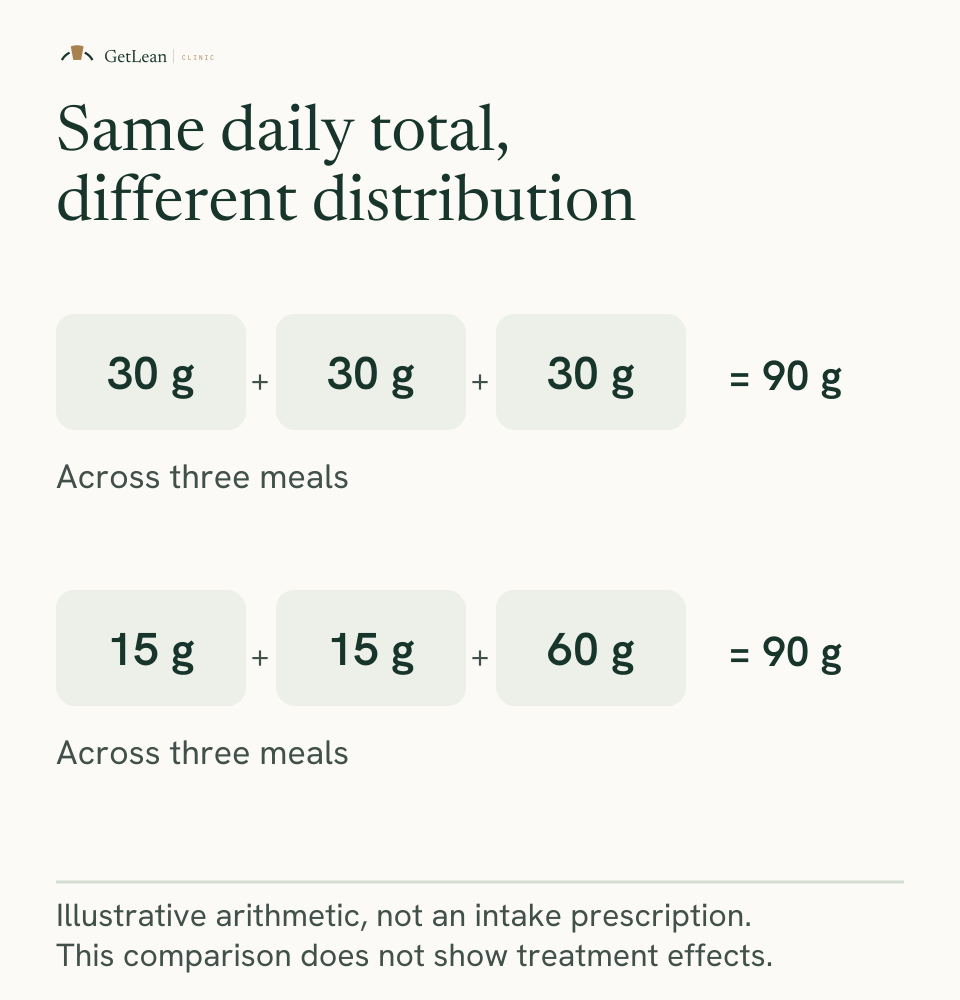
Protein distribution: how a day's protein is divided across eating occasions — 30 g at each of three meals rather than 15 g, 15 g and 60 g at dinner. Distinct from total daily protein, which is simply the sum of those occasions.
Does when you eat protein change what you keep?
Not once total intake is accounted for. That is the finding of the meta-regression that owns this question, and it is more decisive than most people expect.
Pooling 20 studies for strength and 23 for muscle size — 478 and 525 participants respectively — the simple unadjusted model did show an advantage for protein timed around training. Once the analysis controlled for the covariates, that advantage disappeared: no significant difference for strength (P=0.49), for muscle size (P=0.18) or for fat-free mass (P=0.27). What did predict the result was total daily protein, the strongest predictor in the model (Schoenfeld 2013).
The mechanism behind the disappearing effect is worth knowing, because it explains a great deal of what you will read elsewhere. In the trials where groups were not matched for intake, the timed-protein arms averaged 1.66 g/kg/day against 1.33 g/kg/day in the controls. The apparent timing benefit was a total-intake difference wearing a timing costume.
Two limits on that paper. It is about protein around a training session, not about how meals are spread through the day and not about protein before bed — both are covered below. And quoting only the unadjusted model, which found a significant effect on muscle size (P=0.02), reverses the authors' own conclusion. Their conclusion is that adequate total protein combined with resistance exercise is the key factor.
Where the per-meal numbers came from, and who was in the room
The widely quoted figure is 0.4 g of protein per kg of body weight per meal, across at least four meals. It is a genuine recommendation from a genuine review — and its own authors fence the daily total it is built on, in their own words, to "non-dieting (eucaloric or hypercaloric) conditions" (Schoenfeld 2018).
That fence is the whole point for our readers. Someone taking GLP-1 medication is eating less because appetite has been reduced. In one randomised trial, intake at a single laboratory test lunch was 35% lower on semaglutide 2.4 mg than on placebo (Friedrichsen 2021) — a test-meal measurement rather than tracked daily eating, but the direction is not in doubt. A per-meal target anchored to a 1.6 g/kg/day total that the authors scope to people who are not in a deficit is being applied outside its stated population every time it appears in a weight-loss article.
Two further details about that number. It was derived by taking a 0.25 g/kg/meal figure and adding two standard deviations, and the review itself argues against treating it as a hard ceiling — noting that longitudinal body-composition studies have not consistently corroborated the acute studies behind it (Schoenfeld 2018).
The anchors that were derived in people losing weight look different. During energy restriction, 1.2–1.6 g of protein per kg of body weight per day improves appetite, body-weight management and lean-mass preservation compared with lower-protein diets, with meal-specific quantities of at least roughly 25–30 g per meal (Leidy 2015). The higher figure people sometimes quote — 2.3–3.1 g/kg/day — is per kg of fat-free mass, not body weight, and it was derived in lean resistance-trained athletes in a deficit, a population most people starting treatment are not in (Helms 2014). Mixing up those two denominators overstates the target by roughly 43% at 30% body fat, and more as body fat rises. Our protein guide works through the arithmetic.
The one study that tested distribution in a deficit disagreed with itself
This is the most useful thing in the timing literature, and almost nobody reports it.
Twenty older men with overweight or obesity — mean age 66, mean BMI 31 — ate 1.3 g of protein per kg per day through a four-week energy deficit. Half took it evenly across four meals; half took 72% of it at dinner. Measured acutely, over a 13-hour stable-isotope infusion, even distribution produced significantly higher fed-state myofibrillar protein synthesis than the skewed pattern (P=0.014), and even distribution combined with resistance training returned synthesis to pre-diet levels (Murphy 2015).
The same investigators then measured the same men over two weeks, using deuterated water rather than an infusion. Distribution made no difference whatsoever: 1.24 versus 1.26 %/day in the deficit, 1.64 versus 1.52 %/day in the deficit plus training. What did move was training. Adding resistance training raised muscle protein synthesis by about 26%, and raised the synthesis rate of 175 of 190 individual muscle proteins measured (Murphy 2018).
Same laboratory, same participants, opposite answers depending on how long the measurement window was. That disagreement is itself the finding, and it is the reason the meta-analytic conclusion lands on total intake rather than arrangement. Both papers carry Nestlé Research Center co-authors, and Nestlé supplied the whey beverage used in the evenly-distributed arm of the acute study. Both studies had 20 participants, all men, all older, at one deficit size and one protein intake — and neither measured muscle mass or strength, only synthesis rates.
The other frequently cited distribution study points the same way as the acute measurement and carries the same limits. In eight healthy adults who were not dieting, roughly 30 g of protein at each of three meals produced a 24-hour muscle protein synthesis rate 25% higher than the same daily total concentrated into dinner (0.075 versus 0.056 %/h) (Mamerow 2014). Eight people, one day of measurement, a synthesis rate rather than a body-composition outcome.
Short-window measurements favour spreading protein out. The longest measurement of the same question in dieting people found nothing. And no study on either side measured muscle.
What about protein before bed?
No trial has tested pre-sleep protein against the same amount of protein eaten earlier in the day. That single sentence disposes of most of what is written about it.
The study everyone cites gave 44 young men a 27.5 g protein drink before sleep for 12 weeks of resistance training, against a non-caloric placebo. The protein group gained more strength (+164 versus +130 kg), more quadriceps cross-sectional area (+8.4 versus +4.8 cm²) and more type II fibre size (Snijders 2015). Read the comparator again: the placebo contained no protein at all, so the pre-sleep group also ate more protein across the day. The design cannot separate the timing from the extra protein.
The systematic review of this literature — nine studies, no pooled effect size — reaches the same place. Pre-sleep casein of 20–40 g does raise overnight whole-body protein synthesis in young and elderly men, and in young men it appears to augment training adaptations over 10–12 weeks, but not in elderly men. The reviewers then say in their own words that these conclusions need caution because total protein intakes were uneven between groups, and that more data are needed before pre-sleep protein is considered an effective nutritional intervention (Reis 2021).
The practical reading is narrow and useful. A bedtime protein drink is a good way to add protein you would otherwise miss, which on a suppressed appetite is often the whole problem. It is not an established way to rearrange protein you were already going to eat.
The gap that matters most is the one nobody has filled
Nobody has tested protein distribution when total protein is genuinely low — which is precisely the situation of a patient eating less because their appetite has been reduced.
Look at where the distribution studies sat. The energy-restricted trials ran at 1.3 g/kg/day, which is modest but adequate (Murphy 2015, Murphy 2018). The three-meal controlled-feeding study ran at roughly 90 g a day in normal-weight adults who were not dieting (Mamerow 2014). The per-meal recommendation is scoped to people eating at or above their energy needs (Schoenfeld 2018).
Nobody has run the study in someone landing at 0.8 g/kg/day because two of their three meals did not happen. It is reasonable to guess that how you arrange protein matters more when there is less of it to arrange — and it stays a guess. Anyone who tells you that distribution becomes critical at low intakes is describing an intuition, not a trial.
What to do when the total is the binding constraint
Four things follow from all of the above, in order of how much evidence stands behind them.
Get the daily total first. During energy restriction the range that has been studied is 1.2–1.6 g per kg of body weight per day (Leidy 2015). Everything about arrangement is second-order to landing inside it. If reaching it is the problem, the tactics in hitting your protein target with no appetite are the place to start.
Spread it because it is easier to eat, not because it is proven anabolic. Three or four moderate servings are more manageable on a reduced appetite than one large one, and roughly 25–30 g per occasion is the meal-specific quantity that appears alongside the deficit-appropriate daily range (Leidy 2015). That is a capacity and tolerability argument. The muscle argument for distribution held over 13 hours and did not hold over two weeks.
Train. In the deficit study where distribution changed nothing, resistance training raised muscle protein synthesis by about 26% (Murphy 2018), and across 114 trials and 4,184 people, lean mass was statistically unchanged when resistance training accompanied caloric restriction (Lopez 2022). The minimum effective training routine covers what that looks like when time is short.
Do not let arranging protein become a substitute for eating it. Timing is the most discussed and least consequential variable in this whole area. A person hitting 1.4 g/kg/day in two badly timed meals is in better shape than a person hitting 0.8 g/kg/day in a textbook four.
The reason any of this matters is what substantial weight loss is made of. In the SURMOUNT-1 body-composition sub-study, roughly 75% of the weight lost was fat and about 25% was lean mass — and the ratio was the same in the tirzepatide arm and the placebo arm (Look 2025). At GetLean, our philosophy is that the medication is the catalyst and what you keep is the result. Protein arithmetic is where that gets decided, and clock-watching is not. Individual results vary, and clinical-trial figures describe the populations studied.
Common questions
Does protein timing matter, or only the daily total?
The daily total dominates. In a meta-regression of around 20 randomised trials, timing protein around training had no significant effect on strength, muscle size or fat-free mass once total intake was accounted for, and total daily protein was the strongest predictor of the result (Schoenfeld 2013).
Is 0.4 g of protein per kg per meal the right target on a GLP-1 medication?
It is a real recommendation, but its authors fence it to non-dieting conditions, meaning people eating at or above their energy needs (Schoenfeld 2018). Someone in a deficit on a suppressed appetite is outside the population it was written for. The deficit-appropriate anchor is 1.2–1.6 g per kg of body weight per day (Leidy 2015).
Should you spread protein across the day or is one big meal fine?
Short-window measurements favour spreading, and the longest measurement did not. In the same 20 energy-restricted older men, even distribution beat a dinner-heavy pattern when synthesis was measured over 13 hours (Murphy 2015) and made no difference at all when it was measured over two weeks (Murphy 2018). Spreading it is worth doing because it is easier to eat, not because a body-composition benefit has been shown.
Does protein before bed help?
No trial has tested pre-sleep protein against the same amount of protein eaten earlier in the day. The trial people cite compared a 27.5 g bedtime drink with a non-caloric placebo, so the protein group also ate more protein in total (Snijders 2015), and the systematic review of this literature says its own conclusions need caution because intakes were not matched (Reis 2021). A bedtime shake is a way of adding protein you would otherwise miss.
If I can only manage a small amount of protein a day, does spreading it out matter more?
Nobody has tested that. The distribution studies ran at 1.3 g/kg/day or around 90 g a day, which is modest but adequate, and no trial has looked at distribution when total intake is genuinely low. It would be reasonable to guess that arrangement matters more when there is less to arrange, and it remains a guess.