DEXA, InBody and consumer smart scales all report a body-fat percentage, and they will not agree with each other. DEXA is the most accurate of the three and is the reference the others are validated against. InBody and similar multi-frequency bioimpedance devices are highly repeatable but systematically biased. Consumer scales are best treated as trend indicators rather than as a source of a number. The single most useful principle across all three: every one of them is better at detecting change than at reporting a true value — so pick one, use it the same way each time, and read the direction rather than the digits.
Body composition: the proportions of fat mass and lean mass that make up body weight. Every method here estimates it indirectly; none of them weigh your fat.
What does a DEXA scan measure?
DEXA passes two X-ray energies through the body and infers fat, lean tissue and bone mineral from how each absorbs them. It is a scan on a table, takes a few minutes, and produces regional breakdowns as well as whole-body figures.
Its precision has been measured directly, although the published figures are old. An early validation study of a 1991-generation scanner reported precision error of 1.1 kg for fat mass (coefficient of variation 6.4%), 1.6 percentage points for fat percentage, and 1.4 kg for lean tissue mass (Haarbo 1991). Current scanners are not the same instrument, so treat those numbers as an order of magnitude rather than a current specification. The wider point holds: DEXA is precise enough to be the reference standard in clinical body-composition research, and that is not the same as exact.
Two limitations are worth understanding before paying for one.
It assumes a fixed hydration fraction. DEXA treats the water content of fat-free mass as constant at 73%. When true hydration departs from that, some water gets misclassified as fat, although the modelled error stays under 0.5 kg even at extremes (Kohrt 1997).
It is weaker at tracking change than at a single snapshot. Compared against a four-compartment reference model in 27 elite male judo athletes, DEXA explained only 29–38% of the variance in body-composition change, with 95% limits of agreement for individual change of −2.6 to +3.7 kg for fat mass (Santos 2010). That study was in lean, highly trained athletes, who are an edge case for hydration-shift error, so the numbers should not be read across to a general clinic population unchanged. The direction of the finding still stands.
Results from different manufacturers and scanner models are also not directly interchangeable (Kohrt 1997). Changing clinic means starting a new baseline.
What does an InBody or bioimpedance test measure?
It measures electrical resistance, not tissue. A small current is passed through the body, and because lean tissue conducts better than fat, the resistance is used to estimate composition through a prediction equation.
The consequence is a specific and consistent pattern: very repeatable, systematically off.
On repeatability, InBody devices are excellent. Test-retest reliability came out at an intraclass correlation of 0.98 or higher for body fat percentage and fat mass, and 0.99 or higher for fat-free mass (McLester 2020); a separate study of the InBody 770 reported ICC above 0.998 (Looney 2024).
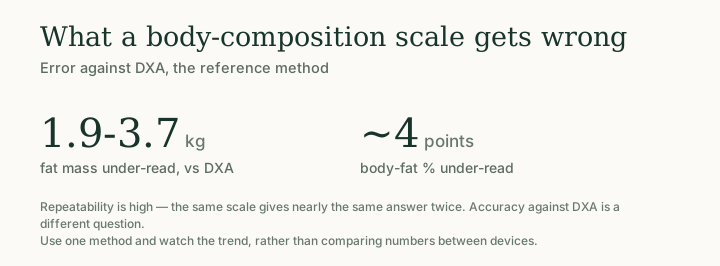
On accuracy against DEXA, the same studies found a consistent bias — underestimating fat mass and overestimating fat-free mass. In the 14-person study, body fat percentage was underestimated by an average of 4.0 percentage points (Looney 2024). In a much larger field study of 1,000 active-duty US Marines, fat mass was underestimated by an average of 3.7 kg in men and 1.9 kg in women (Potter 2025). Both of those populations were young and fit, so the exact bias in an older or higher-BMI person may differ.
Read together, the practical instruction is clear. An InBody body-fat percentage is not the truth about your body, and it will generally read leaner than a DEXA would. But because it is so repeatable, the change it reports over months is meaningful — as long as it is the same device, ideally under similar conditions of hydration and time of day.
Bioimpedance devices are sometimes marketed with a headline accuracy percentage measured against DEXA. Those figures are vendor claims rather than published findings, and the peer-reviewed comparisons above do not support them.
Are consumer smart scales worth using?
For direction over months, yes. For a number you can quote, no.
Three consumer smart scales were tested against DEXA in 153 hospital patients. All three underestimated fat mass, with median errors of −2.2 kg, −4.4 kg and −3.7 kg, and wide interquartile ranges — one spanning −8.0 to +0.28 kg (Frija-Masson 2021). An individual reading could be several kilograms out in either direction.
The broader picture across device types is the same. Testing fifteen bioimpedance devices against a four-compartment reference model, only five of fifteen met a ±2% equivalence standard for a single cross-sectional measurement — yet nine of fifteen met a stricter ±1% standard for tracking change over 12–16 weeks (Siedler 2022).
That asymmetry is the whole case for owning one. A smart scale is a poor instrument for answering "what is my body-fat percentage" and a reasonable one for answering "is it going in the right direction over the last three months".
What does each cost in Singapore?
At the time of writing, one Singapore provider published a price of $308.47 nett for a DEXA body-composition scan with visceral adipose tissue, and $43.60 nett for an InBody body-composition test (ATA Medical, July 2026). Prices change and providers update them, so check the current page rather than relying on a figure in an article.
Many gyms and health-screening clinics also offer InBody tests, sometimes bundled with a package or a membership. Consumer smart scales are a one-off purchase in the tens of dollars.
The reasonable allocation for most people: a smart scale or a gym InBody for the running trend, and a DEXA only if there is a specific reason to want the more accurate regional breakdown — establishing a baseline at the start of a programme being the most common one.
One Singapore-specific reason to measure composition at all rather than relying on BMI: in a four-compartment study of 291 Singaporean Chinese, Malay and Indian adults, a Caucasian-derived BMI equation under-predicted body-fat percentage by 2.7 to 5.6 percentage points (Deurenberg-Yap 2000). A normal BMI here can sit alongside a body-fat percentage that would be flagged elsewhere.
How often should you measure?
Roughly every three to four months for a scan, and closer to six before a lean-mass change should be treated as real. Measuring more often does not make the measurement error smaller.
The interval follows from that error. Scan the same unchanged person twice and the two results will not match; the spread is the device's precision error. An early validation study of a 1991-generation DXA scanner reported precision error of 1.1 kg for fat mass and 1.4 kg for lean tissue mass, with 1.6 percentage points for fat percentage (Haarbo 1991). Current scanners are not that instrument, so read those figures as an order of magnitude: the uncertainty on a single tissue reading is around a kilogram, not a few hundred grams.
There is no single threshold a change has to clear. In 60 collegiate athletes given two same-day scans with repositioning between them, the least significant change varied significantly by body region, tissue type, sex and mass (Buehring 2014). And DXA is better at describing a body once than at describing how it has changed: against a four-compartment reference model in 27 elite male judo athletes, DXA explained only 29 to 38% of the variance in body-composition change (Santos 2010). Athletes near competition weight are an edge case for hydration-shift error, so that figure does not read across unchanged — but change is the harder measurement, and it is the one a repeat scan is for.
Bioimpedance lands in the same place from a different direction. Of fifteen devices tested against a four-compartment reference model, only five met a ±2% standard for a single measurement, yet nine met a stricter ±1% standard for tracking change across a 12 to 16-week window (Siedler 2022) — roughly three to four months, and the interval over which these devices were actually shown to track change. We found no published guideline setting a scanning interval for people on GLP-1 medication, so treat the figure above as derived from device error rather than issued by anyone.
Three rules make any of these methods far more useful:
- Same device every time. Cross-manufacturer results are not interchangeable (Kohrt 1997).
- Same conditions. Similar time of day, similar hydration, similar time since eating and training.
- Read the trend, not the reading. Two points are a line, not a pattern.
Between scans, the cheap measures still do most of the work — waist circumference, strength in training, and how clothes fit. We cover those in why the scale is the worst way to track progress.
Common questions
Is DEXA or InBody more accurate for body composition?
DEXA is more accurate and is the reference standard these devices are validated against. InBody is highly repeatable but systematically underestimates fat mass and overestimates fat-free mass compared with DEXA (McLester 2020), by around four percentage points of body fat in one study (Looney 2024).
How much does a DEXA body composition scan cost in Singapore?
At the time of writing, one Singapore provider published $308.47 nett for a DEXA body-composition scan and $43.60 nett for an InBody test (ATA Medical, July 2026). Prices change — check the provider's current page.
Are smart scales accurate for body fat?
Not for an absolute number. Three consumer scales tested against DEXA in 153 patients all underestimated fat mass, with median errors of roughly 2 to 4 kg and wide individual variability (Frija-Masson 2021). They are more useful for direction over months than for any single reading.
How often should you get a body composition scan?
About every three months for most people. Measurement error does not shrink with more frequent testing, and bioimpedance devices tracked change acceptably over a 12–16 week window in a fifteen-device comparison (Siedler 2022).
Can I compare results from two different machines?
No. DXA results are not directly interchangeable between manufacturers and scanner models (Kohrt 1997), and bioimpedance devices differ substantially from one another. Switching machines means starting a new baseline.