On a suppressed appetite the thing that runs out first is not your calorie budget — it is stomach capacity. That single change turns hawker ordering into a different problem. The dishes carrying the most protein in Singapore's national food database are also, almost without exception, the largest portions: the economy rice plate holding 53.7 g of protein weighs 526 g, and the fishball noodle soup holding 33.52 g is a 798 g bowl (HPB). When you can finish half of what arrives, which half you eat decides the entire nutritional outcome of the meal. This article covers how to choose and sequence a hawker order when capacity is the binding constraint.
Capacity ceiling: the amount of food you can comfortably finish at one sitting. On GLP-1 medication this is usually a lower ceiling than your calorie target, which reverses the usual advice about ordering.
Why volume, not calories, becomes the limit
The calorie side of the arithmetic largely takes care of itself once appetite is suppressed. In a randomised trial of 72 adults with obesity, intake at a single ad libitum test lunch was 35% lower on semaglutide 2.4 mg than on placebo (Friedrichsen 2021). That is one measured laboratory meal rather than tracked daily eating, so read it as a marker of appetite suppression rather than a description of an ordinary day — but the direction is not in question.
What does not fall alongside appetite is the protein requirement. Guidance during active weight loss sits at roughly 1.2 to 1.6 g of protein per kilogram of body weight per day (Leidy 2015) — for a 70 to 90 kg person, about 85 to 145 g daily. Note the denominator: body weight, not fat-free mass. The higher figures circulating online use the smaller denominator and belong to a different population.
So the gap widens from both ends. The medication shrinks how much food fits; the protein target stays where it was. Ordering habits built for a normal appetite — order the whole set, eat around the plate, stop when full — reliably deliver the starch and leave the protein behind.
What HPB's own database says about hawker portions
Singapore's Health Promotion Board maintains a public food-composition database, the Singapore Food Insights Database, which publishes per-serving energy and nutrient values for foods sold here, each tagged with the year it was last checked and how the value was obtained (HPB). The table below is a direct read of that database at HPB's own stated portions, retrieved on 1 August 2026 (HPB).
| Dish variant, as HPB names it | HPB portion | Energy | Protein | Source tag |
|---|---|---|---|---|
| Economic rice, 2 meats | 1 plate, 526 g | 768 kcal | 53.7 g | Derived, 2026 |
| Economic rice, 1 vegetable + 1 meat | 1 plate, 553 g | 697 kcal | 34.51 g | Derived, 2026 |
| Fishball noodles, soup | 1 bowl, 798 g | 519 kcal | 33.52 g | Lab analysis, 2025 |
| Roasted chicken rice | 1 plate, 363 g | 643 kcal | 29.67 g | Lab analysis, 2025 |
| Char kway teow | 1 plate, 480 g | 989 kcal | 25.73 g | Lab analysis, 2025 |
| Laksa | 1 bowl, 604 g | 429 kcal | 19.99 g | Lab analysis, 2025 |
| Steamed chicken rice | 1 plate, 346 g | 488 kcal | 19.22 g | Lab analysis, 2025 |
| Sliced fish soup, no milk | 1 bowl, 561 g | 84 kcal | 17.05 g | Lab analysis, 2023 |
| Plain prata | 1 piece, 141 g | 496 kcal | 12.52 g | Lab analysis, 2025 |
Four things about this table matter more than the numbers in it.
The portion weight is part of the figure. HPB's serving weights are not uniform, and the heaviest portions are near the top. A 798 g bowl and a 141 g piece of prata are not comparable eating tasks even before you look at what is in them.
"Derived" is not a measurement. HPB defines four data sources, and only Lab Analysis means the item was sent to a laboratory. Derived means the value was calculated from a recipe (HPB). Both economy rice records above are derived, so treat those two as recipe arithmetic rather than analysis of a real plate.
The dish variant is load-bearing. HPB indexes at least twenty economy rice permutations by number of vegetables, meats and fried items, and nine prata variants. "Economic rice, 2 meats" and "Economic rice, 1 vegetable + 1 meat" are separate records with different numbers, and neither describes whatever you assembled at the counter.
No published per-stall range exists. Neither HPB nor the peer-reviewed literature has sampled multiple stalls of the same dish and published a spread. Figures vary between stalls, and nobody has measured by how much. HPB's own disclaimer states it makes no guarantees the data is error-free.
The protein is not spread evenly through the bowl
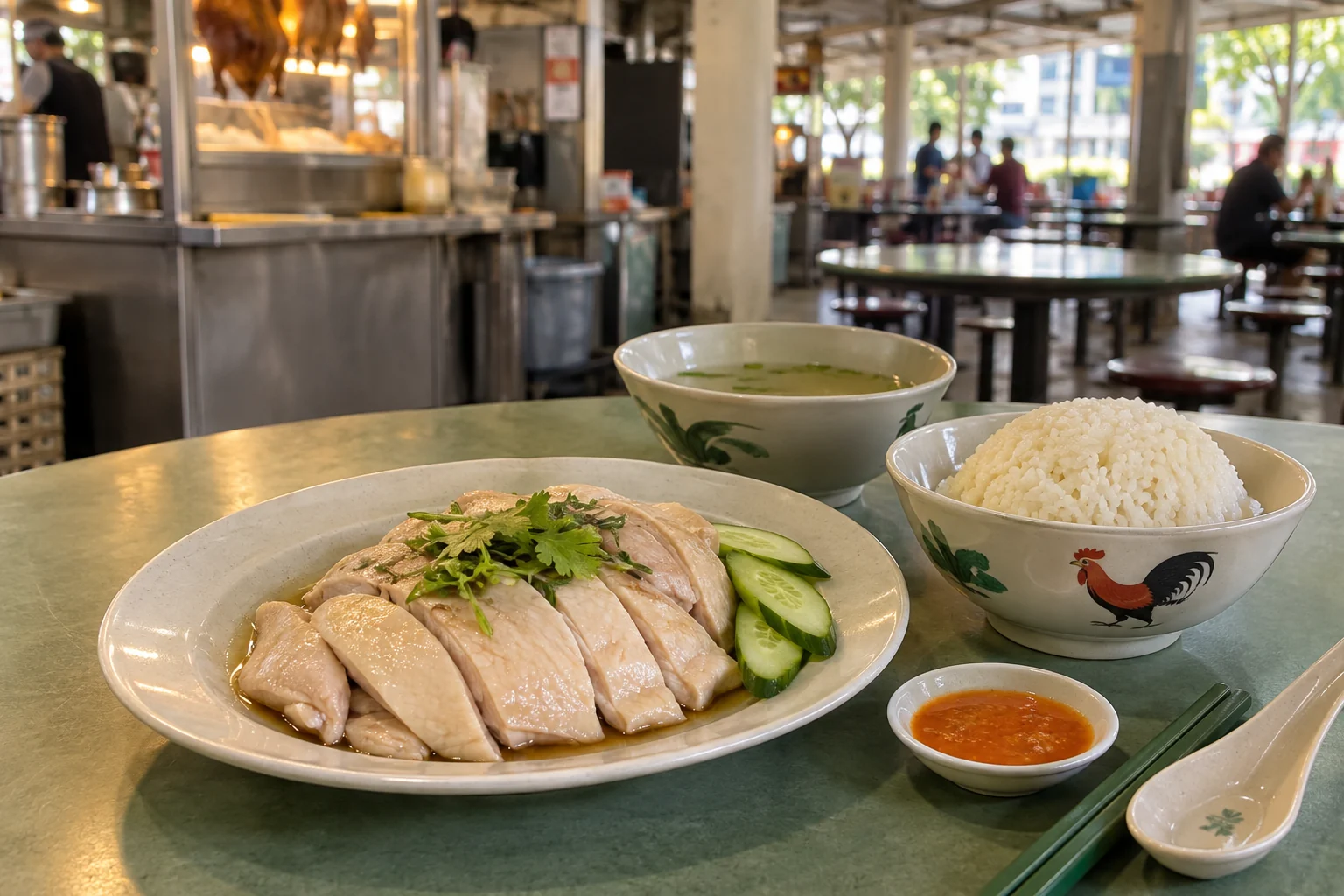
This is the part that matters when you cannot finish. Every figure above is for the complete portion as HPB defines it, and the database publishes no ingredient breakdown — so no one can tell you how much of chicken rice's 19.22 g sits in the meat rather than the rice. What you can act on is the shape of the plate: in fish soup, chicken rice and yong tau foo, the protein arrives as separate, visible objects. In fried noodle dishes it is dispersed through the whole portion.
That difference decides what happens when you stop halfway. Leave half a plate of chicken rice after eating the meat and you have taken most of the protein and left most of the energy. Leave half a plate of char kway teow and you have taken roughly half of each, including half of 989 kcal.
So the practical rule is not "eat less" — it is order a dish whose protein you can identify and finish first.
Five ordering rules when you can finish half a portion
1. Pick dishes where the protein is a separate object. Sliced fish soup, steamed or roasted chicken rice, yong tau foo, fishball noodle soup. In each, the protein can go first and the starch can be abandoned without loss.
2. Choose the variant with more meat, not the one with more vegetables. HPB's two economy rice records make the point: two meats gives 53.7 g of protein for 768 kcal, while one vegetable and one meat gives 34.51 g for 697 kcal (HPB). Nineteen grams of protein for seventy-one calories is an unusually favourable trade at a cai fan counter, and both figures are HPB's recipe-derived values rather than measurements.
3. Ask for less rice, not less meat. Reducing the rice lowers the volume you have to get through without touching the part you came for. Reducing the meat does the opposite.
4. Split a portion rather than skipping the rest. Half a bowl at noon and the remainder at three o'clock usually totals more than one attempted full meal. A suppressed appetite tends to cut the tail off a large portion rather than shrinking it evenly, and the tail is where the leftovers of a good order sit.
5. Treat the HPB healthier-dining list as a shortlist, not a ranking. HPB identifies dish categories providing 500 kcal or less under its Healthier Dining Programme, including fish sliced soup, yong tau foo with no more than two fried items of six, economy rice with two non-fried vegetables, and fishball noodles (HPB). That list gives a calorie ceiling and no protein figure at all — and one of its entries, economy rice with two non-fried vegetables, is exactly the low-protein plate rule 2 warns against. A calorie ceiling and a protein target are two different goals, and at a cai fan stall they pull apart.
Why the figures here differ from our other hawker article
Every dish number above comes from HPB's database. Our companion piece, hawker dishes ranked by protein per calorie, is built entirely on a peer-reviewed laboratory analysis of dishes bought at one Singapore food court.
Those two sources disagree materially on several of the same dishes — different portion definitions, different samples, and both independently verified. Neither is wrong, and neither is "the" figure for a dish. The rule that follows is simple: use one article's figures or the other's, and never carry a number from one into a calculation built on the other. Anyone quoting hawker composition data should be able to say which source it came from, what portion weight it assumes, and what year it was checked.
When half a plate is still not enough
Some days the ceiling is low enough that no ordering strategy closes the gap. Two things help.
Add small protein-only occasions rather than another meal — an egg, a packet of milk, a soya milk, a shake. Volume-for-volume they cost less capacity than a second plate. Our guide to hitting your protein target when you have no appetite sets out the full set of tactics, and hawker dishes ranked by protein per calorie covers a whole day of ordering.
And if you are persistently unable to eat, tell your doctor rather than working around it. Being unable to finish meals for weeks is clinical information, not a personal shortcoming, and it belongs in a consultation rather than in an ordering strategy.
At GetLean, our philosophy is that the medication is the catalyst and what you keep is the result. On a small appetite, what you keep is decided by which part of the plate you eat first.
Figures describe the specific database records named, at HPB's stated portion weights and years. Individual dishes vary by stall. Anyone with a medical condition affecting diet should speak to a doctor or dietitian.
Common questions
What should I order at a hawker centre if I can only finish half?
Order a dish where the protein is a separate object you can eat first — sliced fish soup, chicken rice with the meat on the side of the plate, yong tau foo. Then eat that part before the rice or noodles, so the half you leave is the starch.
Which hawker dishes carry the most protein per portion?
In HPB's database, economy rice with two meats carries 53.7 g of protein in a 526 g plate and fishball noodle soup 33.52 g in a 798 g bowl (HPB). Both are large portions, which is the difficulty when appetite is suppressed.
Are these HPB figures or from somewhere else?
Every dish figure in this article comes from HPB's Singapore Food Insights Database, retrieved on 1 August 2026. A separate peer-reviewed laboratory analysis of Singapore dishes reports materially different numbers for some of the same dishes, so figures from the two sources should not be combined.
Is it better to order one dish or two small ones?
Two eating occasions usually deliver more protein than one attempted full meal, because a suppressed appetite tends to cut the tail off a large portion rather than shrinking it evenly. Splitting one hawker portion across lunch and mid-afternoon works the same way.
Should I stop ordering rice altogether?
There is no need to remove it, only to stop it going first. Rice occupies capacity you no longer have to spare, so ask for less of it rather than less meat, and eat the protein before you touch it.