The drinks are where a careful day quietly stops being careful. HPB's own database puts a regular 250 ml kopi at 193 kcal and 19.05 g of sugar, and the same cup ordered as kopi O kosong at 33 kcal and 0 g (HPB). Two of those a day is the difference between roughly 390 kcal and roughly 66. That comparison is clean, it is HPB's own, and it is the one this article is built on — because the other comparison everyone reaches for, the siu dai one, turns out to be a contradiction between two HPB documents rather than a number.
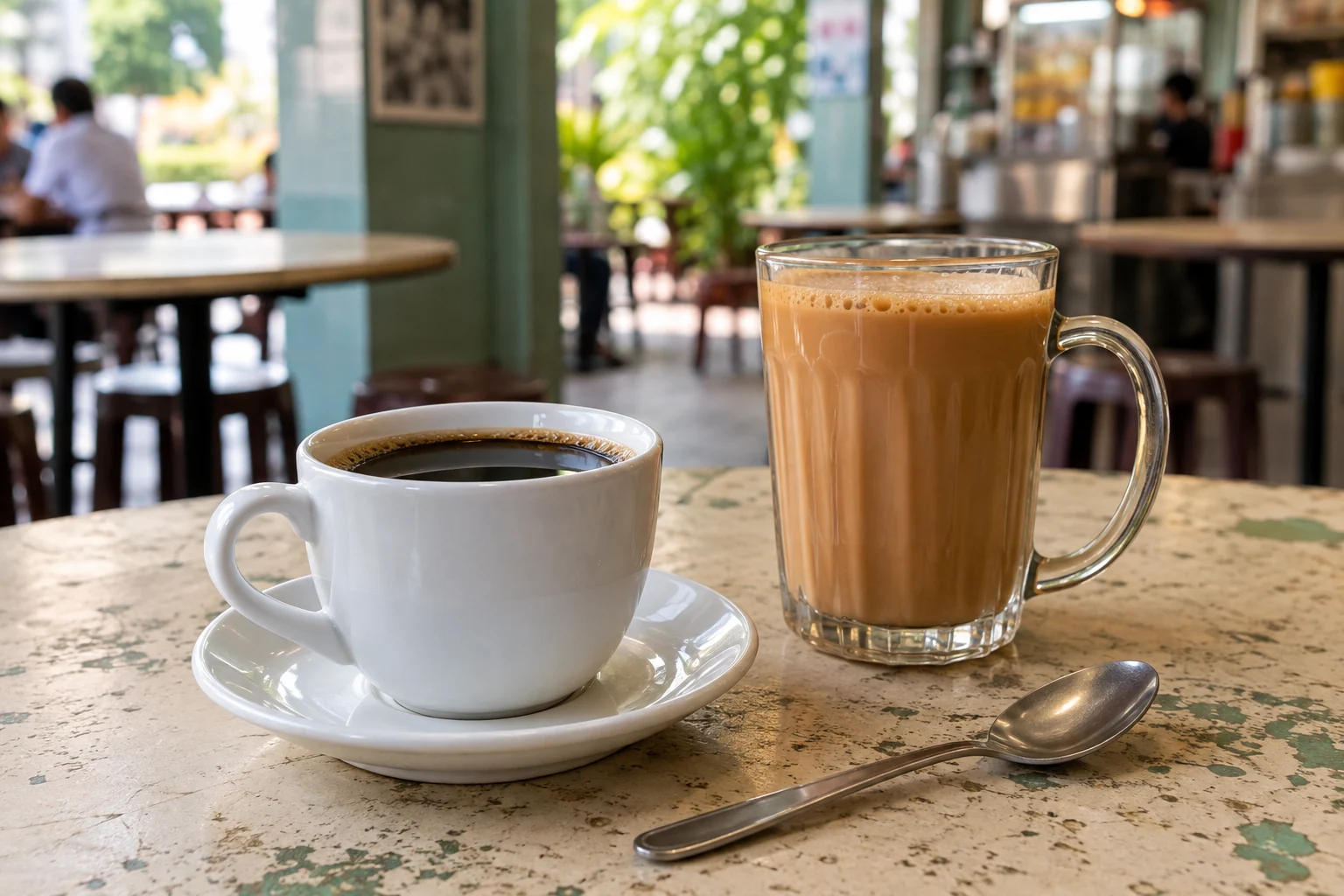
Kosong: HPB's database defines it as no sugar — the record for kopi O kosong reads "traditional black coffee without sugar or milk". HealthHub glosses the word as "zero in Malay".
HPB's own ordering vocabulary
The database publishes definitions alongside the numbers, which settles a set of arguments that otherwise run on folk knowledge (HPB).
| Term | HPB's definition |
|---|---|
| Kopi | Traditional coffee with condensed milk and evaporated milk |
| C | Local coffee with evaporated milk and sugar |
| O | Local coffee with sugar only; local black tea |
| Kosong | No sugar |
| Siu dai | Less sugar, less sweet |
| Teh tarik | Traditional tea with condensed milk, evaporated milk and a frothy texture from pulling |
The one that surprises people is O. Ordering kopi O removes the milk and keeps the sugar — HPB's record for kopi O still carries 11.73 g of it. Only kosong removes the sugar.
The ladder, per 250 ml
All values below are at HPB's default portion of one regular cup, 250 ml, and all are tagged Derived and last checked in 2026 (HPB).
| Drink | Energy | Sugar |
|---|---|---|
| Kopi | 193 kcal | 19.05 g |
| Kopi siu dai | 150 kcal | 20.1 g |
| Kopi C | 130 kcal | 15.4 g |
| Kopi C siu dai | 113 kcal | 10.7 g |
| Kopi C kosong | 93 kcal | 4.25 g |
| Kopi O | 78 kcal | 11.73 g |
| Kopi O siu dai | 70 kcal | 10.65 g |
| Kopi O kosong | 33 kcal | 0 g |
| Teh | 150 kcal | 23.42 g |
| Teh C | 125 kcal | 18.23 g |
| Teh siu dai | 98 kcal | 16.33 g |
| Teh O | 48 kcal | 10.05 g |
| Teh O siu dai | 43 kcal | 9.45 g |
| Teh O kosong | 5 kcal | 0.6 g |
Teh tarik sits outside the table on purpose. Its record is the only laboratory-analysed one in the set, from 2023, and it is published at a 150 ml small cup — 72 kcal and 9.87 g of sugar. A 150 ml measurement and a 250 ml calculation are not comparable, and lining them up in the same column would be the first mistake this article is trying to prevent.
The siu dai problem: two HPB documents, two answers
Here is where a widely repeated claim stops being publishable.
HPB's consumer guidance on HealthHub gives teaspoon counts rather than grams: about 4 teaspoons of sugar in a kopi, about 5 in a teh, and ordering siu dai removes "approximately one-and-a-half teaspoons" (HPB). That is the figure almost every article about local coffee repeats.
HPB's own database, in its 2026 derived data, records kopi siu dai at 20.1 g of sugar against plain kopi's 19.05 g (HPB). Higher, not lower.
Both documents are HPB's. They cannot both be describing the same drink correctly, and no amount of arithmetic reconciles them, so neither can be published as what siu dai saves. The inconsistency is reproducible and it is worth knowing about, because a claim repeated confidently across dozens of pages traces back to one of two official sources that disagree.
Two related traps sit in the same place. HPB's teaspoon figures and its gram figures are different documents with different numbers, so converting grams into teaspoons and attributing the teaspoon figure back to HPB produces a number HPB never published. And even within the consumer pages the figures move: one gives kopi siu dai as 3.5 teaspoons, another gives kopi C siu dai as 2.9.
What survives all of this intact is the kosong comparison at the top of this article. That one is internally consistent, sits within a single document, and is also the larger change.
These are calculations, not measurements
Every kopi and teh figure above carries HPB's Derived tag, which the database defines as a value calculated from a recipe rather than obtained from a laboratory (HPB). Only teh tarik was lab-analysed.
That distinction matters more for drinks than for food, because a hawker drink is assembled to taste in about eight seconds. How much condensed milk goes in is a habit, not a recipe, and it differs between uncles at the same coffee shop. HPB's own disclaimer applies: it makes no guarantee the data is error-free. Read these as national reference values for a standard preparation, and not as a description of the cup in your hand.
The portion assumption is the other thing to hold lightly. HPB's default is one regular cup at 250 ml, and a takeaway cup, a large order or a refill is a different volume carrying proportionally different numbers. The database also indexes iced versions of each variant separately, along with records such as Milo siu dai and yuan yang siu dai, so an iced drink is its own record rather than the hot one with ice in it.
"Gah dai" is not in any HPB source
Searched directly, the term returns zero records in HPB's database, and it appears in neither of HPB's consumer pages on drink vocabulary. HPB indexes kosong, siu dai, C and O — and nothing else.
That does not mean the term is wrong or that stalls will not understand it. It means it is folk vocabulary rather than a defined category, and there is no authoritative sugar figure attached to it in either direction. Anyone quoting one has made it up.
Nutri-Grade: what it covers, and what a grade means
Since 30 December 2022 Singapore has graded beverages A to D, and the rules were extended to freshly prepared drinks — those "prepared by hand at the place/premise where they are sold" — on 30 December 2023 (HPB). The thresholds are per 100 ml of drink as consumed.
| Grade | Sugar | Saturated fat |
|---|---|---|
| A | ≤1 g, and no sweetener | ≤0.7 g |
| B | >1 to 5 g | >0.7 to 1.2 g |
| C | >5 to 10 g | >1.2 to 2.8 g |
| D | >10 g | >2.8 g |
Where the two disagree, HPB states the poorer grade wins: a drink graded B on sugar and C on saturated fat takes the C. Drinks graded C or D must carry the mark front-of-pack; A and B may display it. Advertising of grade-D beverages is prohibited across all media, with a point-of-sale exception. Alcoholic beverages and special-purpose foods are outside the scheme, and MOH has announced an extension to key sources of sodium and saturated fat from mid-2027.
Three limits are worth holding onto. Nutri-Grade is a beverage scheme — it says nothing about food. A grade describes two nutrients and nothing else, so it is a threshold rather than a verdict on the drink. And SG FoodID does not publish Nutri-Grade grades: dividing a 250 ml sugar figure by 2.5 to work out which band a hawker drink falls in is arithmetic anyone can do, but the result is not HPB's assignment and should never be quoted as one.
What this is worth on a small appetite
The reason drinks matter more during treatment than before it is capacity, not sugar. When appetite is suppressed the daily energy budget is easy to meet and the daily protein target is hard. A 193 kcal kopi takes a meaningful bite out of the first while contributing nothing towards the second, and it does so without occupying much stomach.
That makes drinks the highest-return change available, because it costs no capacity to make. Switching one kopi a day to kopi O kosong is a 160 kcal change with no effect at all on what you can eat afterwards — which is a rare combination. The intermediate rungs are real too: kopi C kosong at 93 kcal and 4.25 g keeps the milk and drops the sugar.
For the food half of the same day, see eating at a hawker centre on a small appetite and what the numbers say about mala, prata and cai fan. For the other liquid calories, alcohol on GLP-1 medication covers what is established and what is not.
At GetLean, our philosophy is that the medication is the catalyst and what you keep is the result. Drinks are the cheapest place to protect that, and the easiest place to lose it without noticing.
Figures describe the specific database records named, at HPB's stated portions, tags and years. Anyone with a medical condition affecting diet should speak to a doctor or dietitian.
Common questions
How much sugar is in a kopi?
HPB's database puts a regular 250 ml kopi at 193 kcal and 19.05 g of sugar, against 33 kcal and 0 g for kopi O kosong (HPB). The kopi values are calculated from recipes rather than laboratory-measured.
Does ordering siu dai actually save sugar?
HPB's two documents disagree. Its consumer page says siu dai removes roughly one and a half teaspoons (HPB), while its own 2026 database records kopi siu dai at 20.1 g of sugar against plain kopi's 19.05 g (HPB) — higher, not lower. No saving figure can be sourced from HPB while those two stand.
What do kosong, siu dai, C and O actually mean?
HPB's own database definitions: kosong is no sugar, siu dai is less sugar, C is made with evaporated milk, and O is black with sugar and no milk (HPB).
What does gah dai mean?
It appears nowhere in HPB's database or its consumer pages, which index only kosong, siu dai, C and O. It is folk vocabulary understood at the stall, and no authoritative source attaches a sugar figure to it.
Does Nutri-Grade apply to my kopi?
The scheme was extended to freshly prepared beverages on 30 December 2023 (HPB). It grades drinks A to D on sugar and saturated fat per 100 ml, and a grade describes those two nutrients and nothing else.