Singapore has over 3,400 publicly accessible outdoor fitness corners, and the Government's own description of the equipment in most of them is "fixed-resistance or body-weight". That single phrase is the whole story of training at one: the load cannot be increased, so everything that normally drives progression has to come from somewhere else. This article covers what is actually at a fitness corner, why the fixed load is a real constraint rather than a small inconvenience, where Singapore's two official prescriptions disagree with each other, and what a home setup has to add.
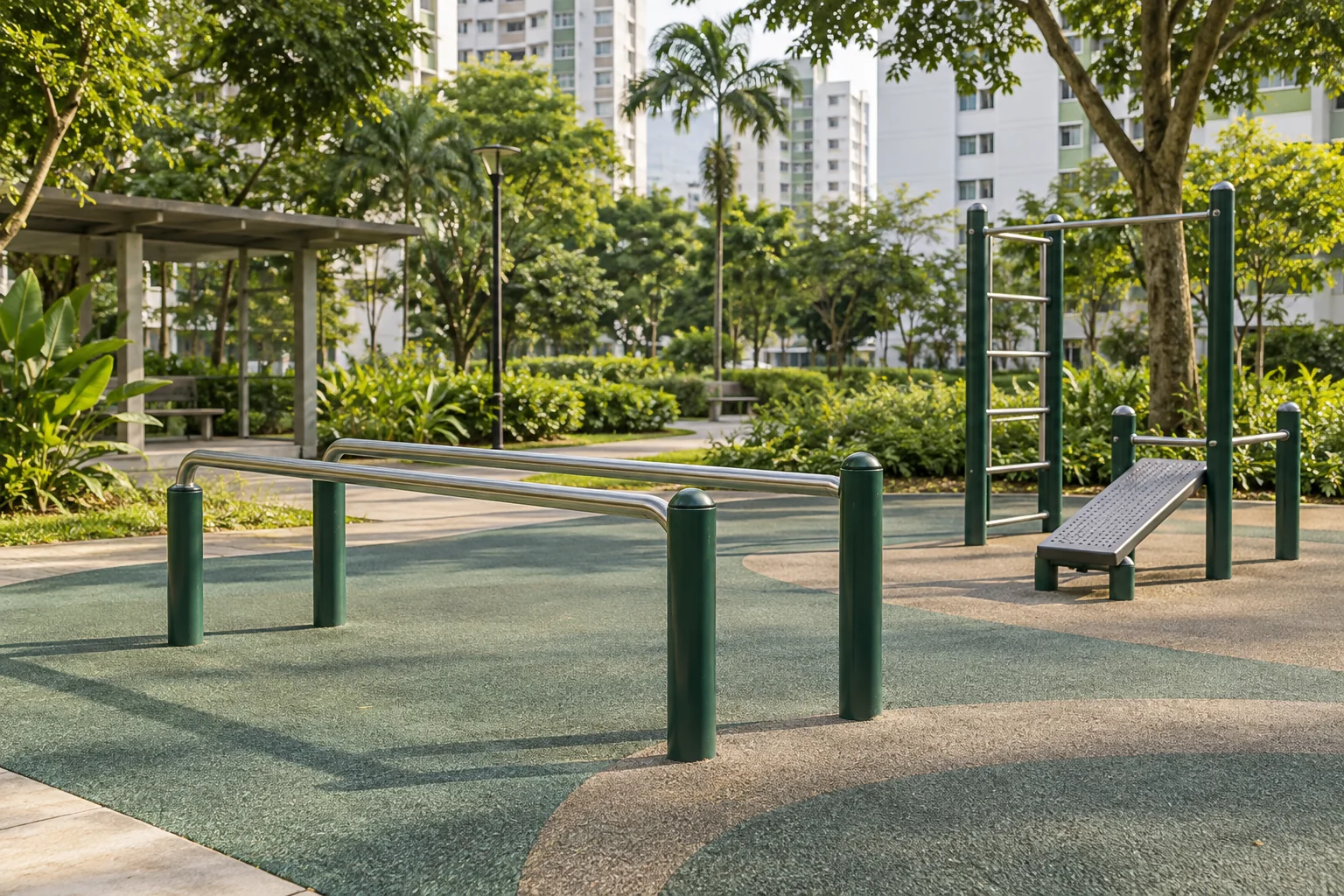
Fixed-resistance equipment: a station whose resistance is set by its construction — your own bodyweight, a lever at a built-in ratio, or a hydraulic cylinder — with no way to select a heavier setting. It can be trained hard. It cannot be made heavier.
What is actually at a Singapore fitness corner
Machines that press, and your own bodyweight.
In a statement dated 12 February 2026, the Ministry of Culture, Community and Youth records "over 3,400 fitness corners installed in HDB estates, Sport-in-Precinct" locations and public parks maintained by NParks, most of them multi-generational corners catering to different ages. On equipment, the wording is unambiguous: most fitness corners feature "equipment that use fixed-resistance or body-weight". Free-weight and variable-resistance machines, along with pneumatic equipment, sit in the 28 ActiveSG gyms instead (MCCY 2026). The Ministry of Health independently gave the same "over 3,400" figure in March 2026.
HPB's own fitness-corner workout names the stations it expects to find: a shoulder press, a chest press and a leg press, all machine-based, plus push-ups, sit-ups and squats marked as requiring no equipment. Its aerobic options are stationary cycling, elliptical and hand cycling (HPB fitness corner workout, 2023).
That is a genuine full-body set of movement patterns, publicly accessible, within walking distance of most homes in Singapore. The constraint is not the exercise list.
The structural limit: the load cannot go up
Resistance training works by asking the body for slightly more than it is currently comfortable supplying, repeatedly, over months. On fixed-resistance equipment, the most direct way of asking — add weight — is not available.
That matters more the better you get. Each additional weekly set per muscle group is associated with an effect-size increase of 0.023, roughly 0.37% more growth per set, with diminishing returns (Schoenfeld, volume, 2017) — so adding sets works, but it works on a curve, and a station that felt hard in month one will not feel hard in month six no matter how many sets you do.
The honest position is that this is a real ceiling, not a technicality. It is also not a reason to skip the fitness corner. Across 114 trials and 4,184 people with overweight and obesity, lean mass was statistically unchanged where resistance training accompanied caloric restriction (Lopez 2022) — and the dose that produced significant strength gains in resistance-trained men was a single set of 6 to 12 repetitions taken to failure, two to three times a week, a dose those authors themselves call suboptimal rather than ideal (Androulakis-Korakakis 2020). The floor is low. The ceiling is what fixed resistance takes away.
Two official Singapore prescriptions that do not agree
HPB publishes a fitness-corner workout. HPB and Sport Singapore jointly publish the national physical activity guidelines. They give different repetition numbers, and it is worth knowing which is which rather than averaging them.
HPB's fitness-corner resource, verbatim: "For a holistic workout session, start with warm-up exercises, continue with at least 3 strength, 1 aerobic, 1 balance and 1 flexibility exercise, and end with cool-down exercises." For the strength portion: "Choose at least 3 exercises to complete 2-3 sets of 15 reps." The aerobic instruction is one exercise for 15 minutes; balance and flexibility are also 2–3 sets of 15 (HPB fitness corner workout, 2023).
The Singapore Physical Activity Guidelines, issued jointly by Sport Singapore and HPB on 12 June 2022, say something different about repetitions: adults should do moderate-intensity muscle-strengthening activities targeting the major muscle groups at least twice per week, and "a general good practice is to complete 8 to 12 repetitions per set" (SPAG 2022).
Two HPB documents, two numbers, no published reconciliation between them. Neither has been withdrawn and both are current, so anyone quoting a repetition range should name which document it came from. What both agree on, and what WHO's 2020 guidelines make a strong recommendation on moderate-certainty evidence, is the twice-a-week floor for muscle-strengthening work (Bull 2020). HPB's fitness-corner resource closes on the same point, asking readers to meet "at least 2 days of muscle-strengthening activity weekly".
One more thing HPB's document says, verbatim, and which belongs here: "Do consult a health professional if you are unsure about a new exercise and take the Get Active Questionnaire (GAQ) before exercising. Always build intensity gradually and stop if you feel unwell."
How to progress when the weight is fixed
No Singapore agency publishes guidance on progressive overload for these machines. HPB's resource prescribes sets and repetitions and says nothing at all about progression, load selection, or how close to failure a set should be taken. So what follows is our reading of the general training evidence applied to fixed equipment, not an official prescription.
The one finding that makes fixed, light resistance defensible for muscle is about effort rather than equipment. Pooling 21 studies in which every set was taken to muscular failure, muscle growth was similar whether the load was at or below 60% of one-rep max or above it, while strength gains were significantly greater with heavier loads (Schoenfeld, load, 2017). A 12-week randomised trial in 49 trained young men found 30–50% of one-rep max taken to failure produced the same Type I and Type II fibre growth as 75–90% (Morton 2016).
Read the condition carefully, because it is doing all the work: the equivalence was produced with sets taken to the point where another good repetition was not possible. A comfortable set of 15 on a leg press station does not inherit that finding. A set of 25 that ends with you unable to do a 26th might.
Given that, the levers left on fixed equipment are:
- Repetitions. More of them, on the same station, until the set is long enough to become genuinely hard.
- Proximity to failure. The variable that the light-load evidence actually depends on, and the one most often left on the table.
- Leverage. Changing body position so the same station or the same bodyweight is harder — feet elevated on a push-up, a slower descent out of a squat.
- Tempo. A three- or four-second lowering phase makes a fixed load meaningfully more demanding.
- Single-limb work. One leg or one arm at a time roughly doubles the relative load without changing the equipment.
- Sets. More weekly sets is the graded, evidence-supported lever (Schoenfeld, volume, 2017), with diminishing returns.
The evidence for bodyweight training specifically is thin rather than negative. The only direct head-to-head located is a four-week randomised study in 23 moderately trained young men, where progressive push-up variations raised bench-press one-rep max as much as bench pressing did — and muscle thickness did not change significantly in either group over those four weeks (Kotarsky 2018). No systematic review of bodyweight-only training exists to lean on. Under-studied is the accurate description.
What a home setup has to add
One thing: a way to make the load go up.
Bands in ascending strengths, dumbbells in small increments, or an adjustable set all solve the problem that a fixed station cannot. Elastic resistance has been shown to produce strength gains statistically indistinguishable from machines and dumbbells across eight pooled trials — though that analysis covered 224 people, was rated moderate quality by its own authors, and pooled strength only, with no muscle-size outcome and no equivalent analysis existing (Lopes 2019).
The weakness the home-training literature actually names is precisely the one this article is about. A meta-analysis of resistance-training programmes split by setting attributed its findings to "the limited availability of equipment or imprecise load dosing during home workouts", alongside motivation and adherence (Bärg 2025). Three limits on how much that carries: every participant had type 2 diabetes, a condition we do not treat; the outcome measured was glycaemic control rather than muscle or strength; and each setting was compared against its own control rather than head to head. Its senior author also declares payments from several pharmaceutical companies, including the maker of a medicine we prescribe, so it is not an independent verdict on home training.
Training at home or at a gym covers the equipment evidence in full. The short version for anyone choosing between a fitness corner and a corner of a bedroom: the fitness corner supplies a broader set of movement patterns and is publicly accessible, and a set of bands supplies a load that can rise. Many people will want both.
What nobody knows about fitness corners
Two gaps worth naming, because content about fitness corners routinely fills them in.
No usage or effectiveness figure exists. MOH's March 2026 parliamentary reply contains no usage statistics and none was found elsewhere. The 3,400 figure counts installations, not people, and it says nothing about how many are used or how often.
No study in this library has tested outdoor fitness-corner equipment, and no agency publishes progression guidance for it. Everything above is extrapolated from general resistance-training research conducted in gyms and laboratories. That is the same position as most training advice, but it should be stated rather than assumed.
At GetLean, our philosophy is that GLP-1 medication should act as a catalyst rather than something to depend on indefinitely — and the training around it is what decides how much of the result survives. A fitness corner within walking distance is a perfectly serious place to do that work, provided the sets are hard and something about the demand keeps rising.
Individual results vary, and clinical-trial figures describe the populations that were studied. Before starting resistance training — particularly with any existing joint, cardiac or metabolic condition, or after a long period without exercise — ask a doctor whether it is suitable for you.
Common questions
Can you build muscle at an HDB fitness corner?
The route that supports it is effort rather than equipment. Pooling 21 studies in which every set was taken to muscular failure, muscle growth was similar whether the load was at or below 60% of one-rep max or above it (Schoenfeld, load, 2017), and a randomised trial in 49 trained young men found 30–50% of one-rep max taken to failure produced the same fibre growth as 75–90% (Morton 2016). Both findings depend on the sets being taken to failure, so a comfortable set at a fixed station does not inherit them. No study has tested outdoor fitness-corner equipment specifically.
Why can you not add weight at a fitness corner?
Because of how the equipment is built. The Government's own description of Singapore's 3,400-plus outdoor fitness corners is that most feature equipment that is fixed-resistance or bodyweight, with free weights and variable-resistance machines confined to the 28 ActiveSG gyms (MCCY 2026). A fixed-resistance station gives whatever load it gives, so progression has to come from something other than the weight.
How many sets and repetitions does HPB recommend at a fitness corner?
HPB's own fitness-corner resource asks adults to choose at least three strength exercises and complete 2 to 3 sets of 15 repetitions, alongside one aerobic exercise for 15 minutes, one balance exercise and one flexibility exercise (HPB fitness corner workout, 2023). Note that this does not match Singapore's national physical activity guidelines, which state 8 to 12 repetitions per set (SPAG 2022). Two HPB documents give two different numbers, neither has been withdrawn, and quoting one means naming which.
Is a fitness corner enough to protect muscle while losing weight?
Nobody has tested that specific question. What has been tested is resistance training generally: across 114 trials and 4,184 people, lean mass was statistically unchanged where resistance training accompanied caloric restriction (Lopez 2022). Whether a fixed-resistance station supplies enough stimulus depends on whether the sets are genuinely hard and whether the demand keeps rising, and the equipment supplies neither on its own. Individual results vary.
What does a home setup need that a fitness corner does not have?
A way to make the load go up. Bands in ascending strengths, dumbbells that increase in small steps, or an adjustable set all solve the problem a fixed station cannot. Elastic resistance has been shown to produce strength gains statistically indistinguishable from machines and dumbbells (Lopes 2019), though that analysis pooled strength only and no equivalent analysis exists for muscle size. Imprecise load dosing at home is the specific weakness the home-training literature points at (Bärg 2025).