ActiveSG membership is free to sign up for, and as displayed on Sport Singapore's own individual-rates page on 1 August 2026, a gym entry cost $2.50 for a Singapore citizen or permanent resident aged 18 to 54, and $1.50 for a student or a senior. What that buys is the specific thing a park fitness corner cannot supply: equipment whose load can be increased. This article covers what the entry actually gets you, how to use adjustable load once you are inside, and what a rising lift number does and does not prove.
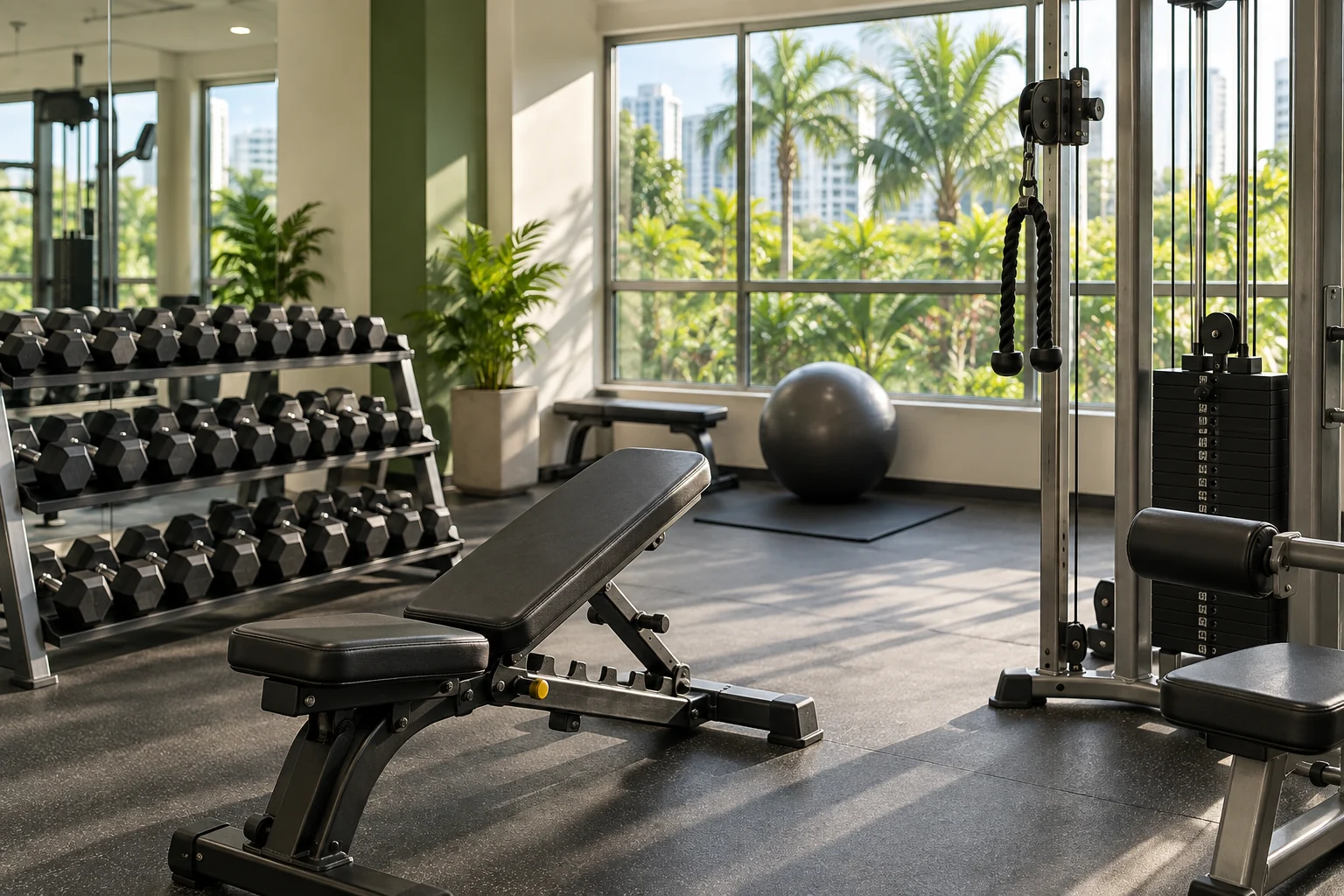
Variable-resistance equipment: machines and free weights whose load can be selected and increased — a pin moved down a weight stack, or the next dumbbell up the rack. It is what lets a training plan get harder as you get stronger, rather than staying the same demand indefinitely.
What an ActiveSG entry costs, and who can use it
Sport Singapore publishes the figures itself, and they are low enough that cost is rarely the reason someone is not training.
As displayed on 1 August 2026: ActiveGYM entry was $2.50 for a Singapore citizen or permanent resident aged 18 to 54, $3.30 at the standard rate, and $1.50 for a student aged 12 to 17 or a senior aged 55 and over. Swimming at a normal complex was $1.00 on weekdays for a citizen or PR adult. Membership is free to sign up for, and Sport Singapore describes ActiveSG as "an all-encompassing and inclusive national movement for mass participation". Members can use ActiveSG facilities islandwide, and the island-wide gym and swim schemes are named MyActiveGYM and MyActiveSWIM, the gym scheme being stated as available to members aged 12 and above (ActiveSG rates and membership, 1 August 2026).
Discounted passes of varying duration are listed on the same membership page. Their prices belong on that page rather than in this article, and so does the entry fee above in six months' time: these are live government pages, the rates change, and the figures here carry the date they were read.
What is in an ActiveSG gym that a fitness corner does not have
An adjustable load, and that is the whole difference.
The Government's own account, in a February 2026 statement, is that Singapore has "over 3,400 fitness corners installed in HDB estates, Sport-in-Precinct" locations and public parks, and that most of them feature "equipment that use fixed-resistance or body-weight". The same statement records 28 ActiveSG gyms offering more advanced options including "free-weight or variable resistance machines" and pneumatic equipment for users of all abilities (MCCY 2026).
That is a structural distinction rather than a quality one. A fixed-resistance station can be trained genuinely hard, and fitness corners and home setups covers how progression works when the load cannot move. But a weight stack with a pin removes the problem entirely, which is worth $2.50 to most people who intend to train for more than a few months.
Why any of this matters during weight loss
Because resistance training changes what the weight loss is made of.
Across 114 trials and 4,184 people with overweight and obesity, lean mass was statistically unchanged where resistance training accompanied caloric restriction (Lopez 2022). That is the finding the whole method rests on, and it is why a gym entry is a clinical variable rather than a lifestyle one. Individual results vary, and the trials describe the populations that were studied.
What to do once you are inside
Less than the room implies. The dose that produces something measurable is small.
In resistance-trained men, a single set of 6 to 12 repetitions at about 70–85% of one-rep max, performed two to three times a week and taken to failure, produced significant strength gains over 8 to 12 weeks — 12.09 kg on one-rep max overall (95% CI 8.16–16.03), 17.48 kg on squat and 8.25 kg on bench press. The authors themselves call that dose suboptimal: it is a floor, not a target, and the participants were already training, so it has not been shown to transfer unchanged to beginners or to women (Androulakis-Korakakis 2020).
Singapore's own national guidance asks adults for muscle-strengthening work on the major muscle groups at least twice a week, and adds a detail the WHO guidelines do not give: "a general good practice is to complete 8 to 12 repetitions per set" (SPAG 2022). Between the two, a session built on a handful of hard sets in the 6-to-12 range, twice a week, is inside both.
The minimum resistance training that works sets out the session itself — which movement patterns, how many sets. What an ActiveSG gym adds to that plan is the mechanism below.
How to make the load go up
Pick a starting weight that makes the last repetition of a set genuinely difficult, write it down, and move it in the smallest increment the equipment allows.
Three findings decide how much detail is worth agonising over.
Volume moves the result continuously, not in steps. Each additional weekly set per muscle group was associated with an effect-size increase of 0.023, roughly 0.37% more growth per set, with diminishing returns (Schoenfeld, volume, 2017). The widely quoted "ten sets a week" threshold does not come out of that analysis as a significant result — the categorical comparison was only a trend — so there is no magic number to hit or miss.
Frequency is mostly scheduling. When weekly volume is held constant, "resistance training frequency does not significantly or meaningfully impact muscle hypertrophy" (Schoenfeld 2019). Two visits or three, at the same total work, land in a similar place. Choose whichever fits the week you actually have.
Load matters less than effort. Pooling 21 studies in which every set was taken to muscular failure, muscle growth was similar whether the load was at or below 60% of one-rep max or above it, while strength gains were significantly greater with heavier loads (Schoenfeld, load, 2017). A 12-week randomised trial in 49 trained young men found 30–50% of one-rep max taken to failure produced the same Type I and Type II fibre growth as 75–90%, with the heavier group gaining more bench-press strength (Morton 2016).
So the pin on the stack is not what builds the muscle — the effort is. What the pin gives you is a clean, unarguable way to keep the effort where it needs to be as you adapt, without having to invent new leverage tricks every month.
What to track, and what tracking cannot tell you
Track the loads. They are the honest signal that the training is doing something, and they are available every session.
What a rising load is not is evidence that muscle is being preserved, and this is the single most common error in self-monitoring. In a randomised trial of about 7% weight loss, the diet-only arm lost roughly 2% of whole-body lean mass and 4% of lower-extremity lean mass on DXA — and the trial reports, verbatim, "No changes in muscle strength or bone were observed" (Weiss 2017). In nearly 1,900 older adults followed for three years, leg strength fell about three times faster than leg lean mass, and the participants who gained lean mass showed no strength benefit for it (Goodpaster 2006).
Strength and muscle mass are correlated across people and dissociable within one person over months. Both are worth having. Neither substitutes for the other, which is why what a body-composition scan measures, and how often it is worth repeating is a separate question from what your lifts are doing.
On timing: in previously sedentary men trained and tested weekly, the first significant strength increase appeared at week 4, and the authors concluded meaningful muscle growth "likely occurred around weeks 3–4", cautioning that an apparent week-1 change may partly reflect exercise-induced swelling (DeFreitas 2011). Age is not a barrier either: across 47 studies of adults aged 50 and over, resistance training produced strength gains of roughly 24–33% across major lifts (Peterson 2010).
The half of the guideline Singapore skips
Singapore's national survey makes the gap unusually easy to see.
In 2024, 84.7% of Singapore residents aged 18 to 74 had sufficient total physical activity — 85.4% of men and 84.0% of women. In the same survey year, 35.7% reported sufficient muscle-strengthening activities: 45.2% at ages 18 to 29, around a third or less from 30 to 74, 41.0% of men and 30.6% of women (NPHS 2024). Both figures are 2024 interview data, and they supersede the 76.4% and 33.8% figures from the 2020 survey that still circulate widely.
Those are MOH and HPB's numbers. The reading of them is ours: a country that has largely absorbed the aerobic half of its own guideline has not absorbed the strengthening half, and no Singapore agency has published that conclusion. At GetLean, our philosophy is that GLP-1 medication should act as a catalyst rather than something to depend on indefinitely — and the strengthening half is what decides how much of the result is still there afterwards.
Individual results vary, and clinical-trial figures describe the populations that were studied. Before starting resistance training — particularly with any existing joint, cardiac or metabolic condition, or after a long period without exercise — ask a doctor whether it is suitable for you.
Common questions
How much does it cost to use an ActiveSG gym?
As displayed on Sport Singapore's own individual-rates page on 1 August 2026, ActiveGYM entry was $2.50 for a Singapore citizen or permanent resident aged 18 to 54, $3.30 at the standard rate, and $1.50 for a student aged 12 to 17 or a senior aged 55 and over (ActiveSG rates, 1 August 2026). Discounted passes are also listed. These are live government pages and the rates change, so check the current figure before you go.
Do you need an ActiveSG membership to use the gym?
Membership itself is free to sign up for, and Sport Singapore describes ActiveSG as a national movement for mass participation rather than a paid club. Members can use ActiveSG sports facilities islandwide, with island-wide gym and swim schemes named MyActiveGYM and MyActiveSWIM; the gym scheme is stated as available to members aged 12 and above (ActiveSG membership, 1 August 2026).
What can you do at an ActiveSG gym that you cannot do at a fitness corner?
Change the load. The Government's own description is that most of Singapore's 3,400-plus outdoor fitness corners use equipment that is fixed-resistance or bodyweight, while the 28 ActiveSG gyms offer more advanced options including free-weight or variable-resistance machines and pneumatic equipment (MCCY 2026). Fixed resistance can still be trained hard; it just cannot be made heavier.
Can rising lift numbers tell you that you are keeping muscle?
No, and the evidence against that is direct. In a randomised trial, about 7% weight loss by dieting alone cut whole-body lean mass by roughly 2% and lower-limb lean mass by roughly 4% while measured muscle strength did not change at all (Weiss 2017). In nearly 1,900 older adults followed for three years, strength fell about three times faster than muscle mass, and gaining lean mass did not preserve strength (Goodpaster 2006). Track your loads because strength matters in its own right, and use a body-composition measurement for the muscle question.
Is two sessions a week enough at a public gym?
Two is what Singapore's national guidelines ask for as a minimum, at 8 to 12 repetitions per set (SPAG 2022). When weekly volume is held constant, frequency itself does not meaningfully change muscle growth (Schoenfeld 2019), so two longer sessions and three shorter ones can amount to the same thing. Individual results vary, and anyone with an existing joint, cardiac or metabolic condition should ask a doctor whether resistance training is suitable for them first.