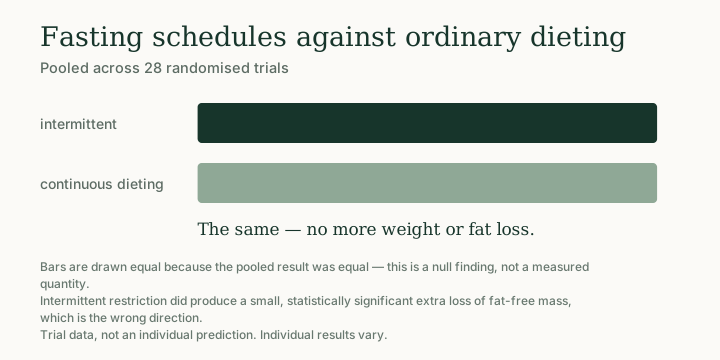
Pooling 28 randomised trials, intermittent fasting produced no more weight loss and no more fat loss than ordinary continuous dieting — and produced a small but statistically significant extra loss of fat-free mass of 0.20 kg (Schroor 2024). Separately, and more consequentially for anyone reading this while on medication: no randomised trial has combined intermittent fasting with a GLP-1 medication. The only published treatment of that combination is a narrative review that proposes a framework and calls for trials to test it (Cozma 2025). This article covers what the head-to-head diet evidence shows, how large the fat-free-mass signal actually is, and why the combination question is open rather than answered.
Intermittent energy restriction: eating fewer calories by restricting when you eat — time-restricted eating (a daily window), alternate-day fasting, or the 5:2 pattern. Continuous energy restriction: eating fewer calories every day, the ordinary version of dieting. The trials below compare the two schedules against each other.
What the head-to-head evidence shows
A 2024 systematic review and meta-analysis in Advances in Nutrition pooled 28 randomised controlled trials in adults, grouped by protocol: time-restricted eating (7 trials), alternate-day fasting (10) and the 5:2 diet (11), with durations from 2 to 52 weeks.
Combining all intermittent protocols against continuous energy restriction:
| Outcome | Difference | 95% CI | P |
|---|---|---|---|
| Body weight | −0.42 kg | −0.96 to 0.13 | 0.132 |
| Fat mass | −0.31 kg | −0.98 to 0.36 | 0.362 |
| Fat-free mass | −0.20 kg | −0.39 to −0.01 | 0.044 |
| Waist circumference | −0.91 cm | −1.76 to −0.06 | 0.036 |
The paper's own summary is that the three intermittent diets combined "did not lead to superior improvements in anthropometrics and cardiometabolic risk markers compared with CER diets" (Schroor 2024). On the two outcomes most people are actually after — weight and fat — the schedule made no statistically significant difference.
Time-restricted eating is the one protocol that behaved differently, and not entirely in its own favour: the paper reports it reduced body weight, fat mass and fat-free mass more than continuous restriction. Losing more of all three is a different result from losing more fat.
The waist-circumference finding should not be read as a fat-distribution result. It tracks the same weight change that produced it, and nothing in this analysis separates where fat was lost from how much was lost.
Two features of that pool are worth holding in view when reading any single number from it. The included trials ran from 2 weeks to 52 weeks — a two-week study and a year-long study are answering different questions about the same diet, and they are averaged together here. And the three protocols are not interchangeable: alternate-day fasting, a 5:2 pattern and a daily eating window place very different demands on a person's week, yet they are pooled into one "intermittent" category for the headline result. The protocol-level analyses are where the differences show up, and they are the reason time-restricted eating comes out looking distinct.
Where that leaves the schedule question is a practical place rather than a metabolic one. If the trials find equivalent weight and fat outcomes between an intermittent and a continuous approach, then the reason to prefer one is whether a person can actually keep to it — not because the biology rewards it. That is our reading of an equivalence result, and it is a different claim from saying fasting is metabolically superior, which the pooled data do not show.
The fat-free-mass finding, at its actual size
The single statistically significant body-composition difference in that meta-analysis is −0.20 kg of fat-free mass, with a confidence interval of −0.39 to −0.01 kg.
Look at the upper bound. It is one hundredth of a kilogram — ten grams. An interval that only just clears zero at one end is a finding that is barely distinguishable from no finding, and it is reported here at its real size rather than at the size the internet gives it.
Two more qualifications keep it honest. The outcome is fat-free mass, which includes water, glycogen, bone mineral and organ tissue as well as skeletal muscle, so it is not a muscle measurement. And a 200-gram difference over trials lasting from two weeks to a year is not a quantity a person could detect on any scan they would realistically have.
So the accurate sentence is: intermittent fasting offers no fat-loss advantage over continuous restriction and, if anything, costs slightly more fat-free mass. What it does not support is the claim that fasting burns muscle, which no pooled comparison shows.
Why the fat-free-mass question matters more than the difference does
The 0.20 kg gap between two diets is small. The lean-mass cost of any substantial deficit is not.
Across a systematic review of dietary and behavioural weight loss, the median share of weight lost as fat-free mass was 14.0% on standard low-calorie diets and 23.4% on very-low-calorie diets, with men at 27% and women at 20% (Chaston 2007). The severity of the restriction correlated with the proportion lost as fat-free mass.
The medication literature lands in the same place. In the SURMOUNT-1 body-composition sub-study, roughly 75% of the weight lost was fat mass and 25% lean mass — and the same ratio held in the placebo arm, which was dieting (Look 2025). The lean-mass share belongs to the size of the weight loss, not to the method.
Which reframes the question. Choosing between an eating window and a daily deficit changes almost nothing about composition. What changes composition is how large the deficit is, how much protein is in it, and whether resistance training is happening.
What has been studied about combining fasting with medication
Nothing, in the sense that matters.
A 2025 narrative review in Biomedicines ran a structured literature search of PubMed, Web of Science and the Cochrane Library covering 2010 to July 2025, and proposed a phased framework combining GLP-1 therapy with intermittent fasting and lifestyle modification. Its own language is explicitly hypothetical: combined application "may preserve lean mass, improve psychological autonomy, and reduce healthcare costs". Its closing recommendation is verbatim: "Future research should validate this hybrid strategy in randomized trials assessing long-term weight durability, functional outcomes, and cost-effectiveness" (Cozma 2025).
That is a citation for an absence. A proposed framework is a hypothesis a research group thinks is worth testing, and it is not a protocol. Anyone presenting a fasting-plus-medication schedule as evidence-based is presenting something that has not been tested.
Meanwhile the medication side of the comparison is measured. In the pivotal trials, semaglutide 2.4 mg produced a mean weight change of −14.9% at 68 weeks and tirzepatide 15 mg −20.9% at 72 weeks on the treatment-regimen estimand (Wilding 2021; Jastreboff 2022). Individual results vary, and those figures describe trial populations under supervised conditions. Against the 0.42 kg that separated two diet schedules, the difference in what is being asked of the evidence is obvious.
Where the combination creates a real problem
The mechanism worth thinking about is not metabolic. It is arithmetic.
GLP-1 medication reduces appetite — that is what it is prescribed to do, and it is covered in how GLP-1 medications work. A compressed eating window reduces the number of occasions available to eat. Stack those and a patient has fewer meals in which to reach a protein target they were already struggling to reach because they are not hungry.
Protein requirements move in the wrong direction for that. In lean, resistance-trained athletes during caloric restriction, protein needs are estimated at 2.3 to 3.1 g per kg of fat-free mass per day, scaling upwards with the severity of the restriction and with leanness (Helms 2014). That population is not a typical clinic patient and the denominator is fat-free mass rather than body weight — both of which matter when converting it to a number. The direction of travel, though, is the relevant part: as a deficit deepens, protein needs rise.
Nothing above says a person on medication must never restrict their eating window. It says that decision belongs with the doctor prescribing, that no trial supports it, and that the failure mode is a protein and energy shortfall rather than anything exotic. Our own approach to that shortfall is set out in protein on GLP-1 medication in Singapore.
What the evidence supports, plainly
Intermittent fasting is a legitimate way to eat less, and for some people the structure of it is easier to hold than counting every day. The pooled trials support exactly that and no more: equivalent weight and fat outcomes to continuous restriction, with a fat-free-mass difference of 200 grams pointing slightly the wrong way (Schroor 2024).
What the evidence does not support is fasting as a superior fat-loss strategy, as a muscle-protective one, or as a tested companion to appetite-suppressing medication. If you are weighing an eating pattern against a medical route, or wondering how the two would interact for you, that is a conversation for a doctor with your full history — you can check your eligibility to start it.
Common questions
Is intermittent fasting better than ordinary dieting for fat loss?
No, on the pooled evidence. Across 28 randomised trials comparing intermittent against continuous energy restriction, body weight differed by −0.42 kg (95% CI −0.96 to 0.13, P=0.132) and fat mass by −0.31 kg (95% CI −0.98 to 0.36, P=0.362) — neither statistically significant (Schroor 2024). The schedule did not change the fat-loss outcome.
Does intermittent fasting burn muscle?
The pooled fat-free-mass difference is real and very small: −0.20 kg, 95% CI −0.39 to −0.01, P=0.044 (Schroor 2024). That is an upper confidence bound of one hundredth of a kilogram, and the outcome is fat-free mass rather than muscle specifically. The defensible statement is that intermittent fasting costs slightly more fat-free mass than continuous restriction, not that fasting burns muscle.
Has anyone tested intermittent fasting together with GLP-1 medication?
No randomised trial has. As of a literature search running to July 2025, the only published treatment of the combination is a narrative review that proposes a phased framework and states that future research should validate it in randomised trials (Cozma 2025). Every claim in that paper about preserving lean mass is written as a hypothesis.
Which forms of intermittent fasting have been studied?
The largest meta-analysis grouped 28 trials into three protocols: time-restricted eating in seven trials, alternate-day fasting in ten, and the 5:2 diet in eleven, over durations from 2 to 52 weeks (Schroor 2024). Time-restricted eating specifically reduced body weight, fat mass and fat-free mass more than continuous restriction did.
Should I fast while taking GLP-1 medication?
That is a clinical question for the doctor prescribing it, and there is no trial evidence to answer it. What is known is that GLP-1 medication already reduces appetite and that a compressed eating window reduces eating opportunities, so the two together narrow the room for hitting protein and energy targets. Protein requirements rise rather than fall as a deficit deepens (Helms 2014).