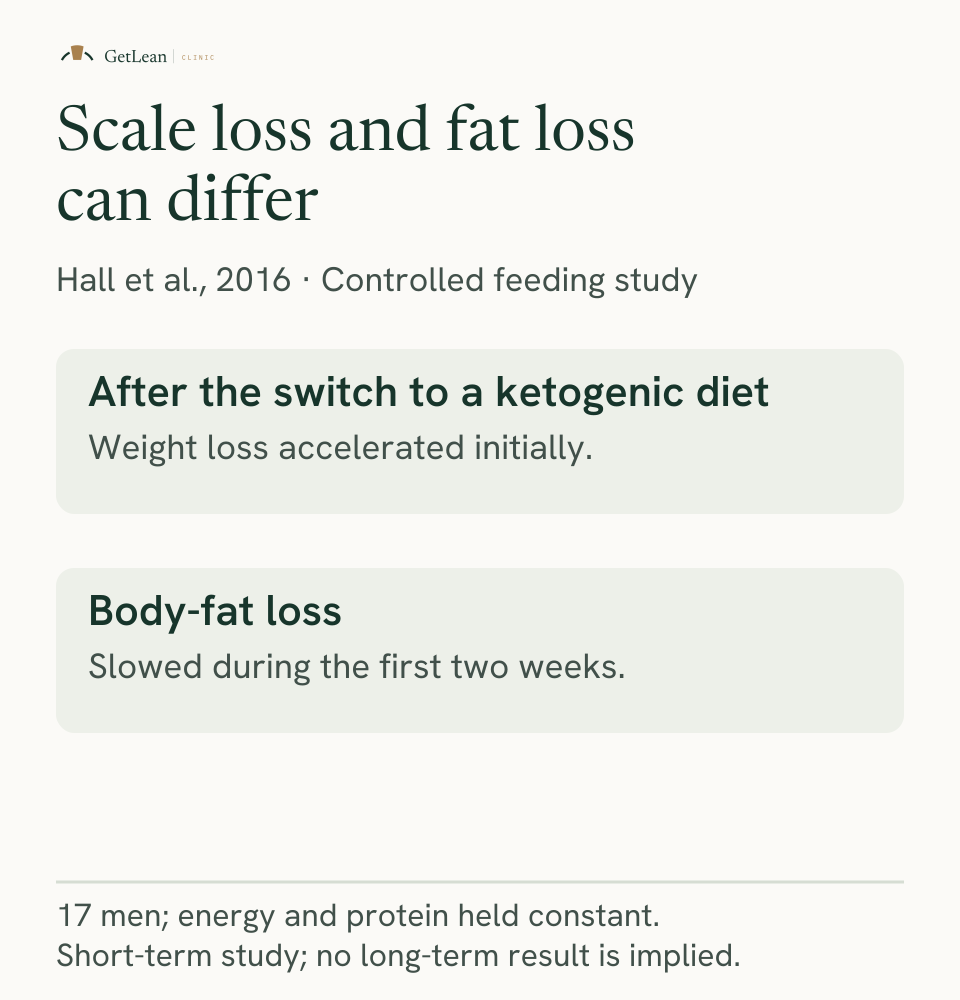
The dramatic first week on a ketogenic diet is largely glycogen and the water stored with it, not fat. The strongest evidence on this comes from a metabolic ward, where 17 men were fed a fixed energy intake with protein held constant and switched from a high-carbohydrate to a ketogenic diet: scale weight loss accelerated in the first week, then returned to baseline rates — while measured body-fat loss slowed, and fat-free-mass loss increased (Hall 2016). The scale and the body moved in opposite directions in the same people at the same time. That dissociation is the subject of this article.
The broader literature does show low-carbohydrate diets reducing weight, BMI and body-fat percentage (Leung 2025). Those trials were not energy- and protein-matched, so the two bodies of evidence answer different questions and are set out here together rather than one at a time.
Ketogenic diet: typically under 50 g of carbohydrate a day, enough to shift the body toward using fat-derived ketones for fuel. Low-carbohydrate diet: a looser category, commonly defined in the trials at 100 g a day or less. The distinction matters, because the meta-analytic results differ between the two thresholds.
What the controlled study actually found
Hall and colleagues ran an inpatient crossover feeding study — the strongest available design for this question, because the participants could not misreport what they ate. Seventeen overweight and obese men spent four weeks on a baseline diet of 15% protein, 50% carbohydrate and 35% fat, then four weeks on an isocaloric ketogenic diet of 15% protein, 5% carbohydrate and 80% fat. Protein was held constant. Overall energy balance ran at about −300 kcal a day throughout, and everyone did 90 minutes of daily low-intensity aerobic exercise.
Energy expenditure did rise on the ketogenic diet: +57 kcal/day by chamber measurement (P=0.0004), +89 kcal/day for sleeping energy expenditure (P<0.0001), and +151 kcal/day by doubly labelled water (P=0.03). Respiratory quotient fell sharply, confirming the fuel shift.
And then the result that matters, verbatim from the paper: "Body fat loss slowed during the KD and coincided with increased protein utilization and loss of fat-free mass" (Hall 2016).
Both halves are true at once. The diet raised measured energy expenditure by an amount the authors themselves treat as small and near the limits of detection, and fat loss got slower. The scale moved faster in week one and then settled back.
Limits worth stating: n=17, men only, four weeks per arm, all food supplied, and 90 minutes of daily exercise built into the protocol. This is not a study of what happens when someone starts keto at home.
Why the first week looks so good
Carbohydrate is stored in muscle and liver as glycogen, and glycogen is stored with water. Cut carbohydrate hard and that store depletes, taking its associated water with it. The scale registers the loss immediately, because a scale weighs everything.
What Hall's study adds is confirmation from the other side: over the same period that scale weight was falling faster, measured fat loss was falling slower (Hall 2016). A person who reports losing three kilograms in five days has observed something real. They have not observed three kilograms of fat.
The same effect works in reverse. Reintroduce carbohydrate and the glycogen and water come back, which is why the first week off a low-carbohydrate diet often shows a rapid "regain" that has nothing to do with fat either.
What the meta-analytic literature shows
A 2025 systematic review and meta-analysis pooled 33 randomised controlled trials in 2,821 adults with overweight or obesity. With carbohydrate intake at 100 g a day or less, ketogenic and low-carbohydrate diets significantly reduced body weight, BMI and body-fat percentage — but not fat mass. Subgroup analyses found significant improvements in body weight, BMI and fat mass for interventions lasting a month or more, and improvements across all parameters at carbohydrate intake of 50 g a day or less. The authors recommend a duration of at least one month and a threshold of 50 g or less (Leung 2025).
No effect sizes are quoted here. The point estimates and confidence intervals were not retrievable from the record used to verify this source, and an unverified number is worse than none.
The critical limitation is what those trials did not control. The record does not state that energy intake or protein were matched between arms — so a low-carbohydrate arm that ate less overall, or ate more protein, would produce the same result for reasons that have nothing to do with carbohydrate. That is precisely the confound Hall's metabolic-ward design removed, and when it was removed, fat loss slowed.
All of these are group averages from trial populations, and individual results vary. Both literatures are legitimate. One asks "do people who cut carbohydrate lose weight?" — yes. The other asks "does cutting carbohydrate cause fat loss, holding calories and protein equal?" — and finds it does not, in the population studied.
Does keto affect training?
A 2024 meta-analysis pooled six randomised trials in 131 resistance-trained men and women — bodybuilders, CrossFit athletes and military personnel — over 8 to 12 weeks. One-rep-max bench press: mean difference −2.78 kg (95% CI −10.40 to 4.85), not significant, n=60. One-rep-max squat: −8.15 kg (95% CI −18.55 to 2.24), not significant, n=54. The authors conclude that ketogenic diets "do not appear to impair 1-RM performance", while adding that a one-rep-max test "does not appear to be the most optimal tool for assessing hypertrophy-based strength session performance" (Vargas-Molina 2024).
Read that carefully. Both point estimates favoured the control group, and the squat interval runs down to −18.55 kg. With 54 to 60 people, this is an underpowered null — an absence of proof, not proof of absence. No pooled fat-free-mass analysis was presented, endurance was not measured, and every participant was already resistance-trained. None of it transfers to someone new to training.
What this means for a reader on medication
None of the trials above was run in people taking weight-management medication, so what follows is reasoning from adjacent evidence rather than a tested combination.
The starting point is that lean-mass loss belongs to the size of a weight loss rather than to its method. In the SURMOUNT-1 body-composition sub-study, roughly 75% of weight lost was fat and 25% lean — and the same ratio held in the placebo arm, which was dieting (Look 2025). Across ordinary dieting, the median share of weight lost as fat-free mass was 14% on standard low-calorie diets and 23.4% on very-low-calorie diets, rising with the severity of the restriction (Chaston 2007).
Against that background, two features of a low-carbohydrate approach on medication deserve attention.
Protein has to hold. Hall's finding was increased protein utilisation and fat-free-mass loss on the ketogenic arm, in a study where protein was fixed (Hall 2016). Protein needs rise rather than fall as a deficit deepens: in lean resistance-trained athletes in caloric restriction, the estimate is 2.3 to 3.1 g per kg of fat-free mass per day, scaling up with severity and leanness (Helms 2014). That population and that denominator are both narrower than a typical clinic patient, so the number does not transfer — the direction does.
Appetite is already reduced. Removing a macronutrient group on top of reduced appetite narrows food choices at the point where eating enough is already the hard part. A rule that removes options is a different proposition for someone who is hungry and someone who is not.
Whether a low-carbohydrate approach suits an individual on medication is a clinical decision for the prescribing doctor, and there is no trial to appeal to.
The Singapore version of the question
Rice, noodles, bread and roti make up the base of most hawker dishes, so a strict carbohydrate ceiling in Singapore usually means eating less of the meal rather than choosing a different one — and eating less of the meal is where protein intake falls first. Our practical version of the same problem, working with what is actually on the stall menu, is in hawker dishes ranked by protein per calorie.
There is a second Singapore-specific wrinkle. Eating out is the default here rather than the exception, and a carbohydrate ceiling is far easier to hold over food you cooked than over a stall order where the portion of rice is decided for you. A rule that only works at home is a rule that gets broken at lunch, and the resulting pattern — strict on some days, abandoned on others — is not what any of the trials above tested.
The measurement that settles it for any individual is a body-composition reading rather than a scale, because the scale cannot tell glycogen and water apart from fat. If you want a clinical view on which approach fits your situation, you can check your eligibility and ask a doctor.
Common questions
Why does keto make you lose weight so fast in the first week?
Because the first week is not mostly fat. In a metabolic ward study where energy intake and protein were held constant, weight loss accelerated during the first week of the ketogenic diet and then returned to baseline rates — while measured body-fat loss actually slowed over the same period (Hall 2016). The scale and the body were moving in different directions.
Does a ketogenic diet burn more fat than other diets?
Not in the one study that controlled for everything else. With energy fixed at about a 300 kcal daily deficit and protein held constant, four weeks of a ketogenic diet raised measured energy expenditure by roughly 100 to 150 kcal a day — and the authors report that body fat loss slowed and coincided with increased protein utilisation and loss of fat-free mass (Hall 2016). It was 17 men over four weeks.
But don't meta-analyses show low-carb diets work?
They do, and the two bodies of evidence answer different questions. Across 33 randomised trials in 2,821 adults, carbohydrate intake of 100 g a day or less significantly reduced body weight, BMI and body-fat percentage, with fat mass reaching significance only in longer trials or below 50 g a day (Leung 2025). Those comparisons were not energy- and protein-matched, so they cannot separate the diet's composition from how much was eaten.
Does keto hurt strength training?
The pooled answer is no significant impairment, with an important caveat. Across six randomised trials in 131 resistance-trained people over 8 to 12 weeks, one-rep-max bench press differed by −2.78 kg (95% CI −10.40 to 4.85) and squat by −8.15 kg (95% CI −18.55 to 2.24), neither significant (Vargas-Molina 2024). Both point estimates favoured the control group and the squat interval runs to −18.55 kg, so this is an underpowered null rather than a demonstration of equivalence.
Should I go low-carb while taking GLP-1 medication?
That is a decision for the doctor prescribing, and no trial in this evidence base was run in people on weight-management medication. The consideration worth raising is that appetite is already reduced, and removing a macronutrient group narrows food choices further — which makes hitting a protein target harder at exactly the point where protein needs rise with the depth of the deficit (Helms 2014).