The belly that arrives on a man in his forties is disproportionately visceral fat — the fat packed around the organs rather than sitting under the skin — and men carry a higher share of their total fat in that compartment than women do. That much holds up. Two things commonly said next do not. Men do not respond better than women to GLP-1 medication; measured, women lose more. And nothing "targets" belly fat: visceral fat falls faster as a percentage because it is the smaller depot to begin with, and that advantage shrinks the more weight comes off. This article works through what is actually established, because the corrections are more useful than the claims they replace.
Visceral fat: fat stored inside the abdominal cavity, packed around the liver, intestines and other organs, as distinct from subcutaneous fat which sits between skin and muscle. It is the depot most consistently linked to cardiometabolic risk.
What the "uncle belly" is actually made of
Two different depots, in a ratio that differs by sex. Visceral adipose tissue accounts for roughly 6–20% of total body fat, with higher values in men than in women, and at comparable total adiposity women carry more of their fat subcutaneously — both abdominally and around the hips and thighs (Karastergiou 2012).
The sex difference has been measured directly on imaging. In a CT study of 89 men and 75 women, men had significantly more visceral adipose tissue after correction for total body fat mass, and each additional kilogram of total fat was associated with a significantly greater increase in visceral fat in men than in women (Lemieux 1993). The authors' conclusion is the useful one: premenopausal women can accumulate more body fat than men of the same age before reaching the visceral amounts found in men.
Note what that does and does not say. It is a difference after adjusting for total fat mass, not a claim about two people at the same BMI, and the paper reports significance rather than magnitude — there is no defensible "men have X times more" figure in it. What it supports is the direction: for a given amount of fat gained, more of it goes inside the abdomen in men.
Why visceral fat is the part that matters
Because it stays associated with risk after the obvious measurements are accounted for. In 3,001 Framingham participants imaged by CT, both fat compartments were associated with blood pressure, fasting glucose, triglycerides and HDL cholesterol. But after adjustment for BMI and waist circumference, visceral fat still contributed significantly to risk-factor variation and subcutaneous fat did not (Fox 2007).
That is why a man can have an unremarkable BMI and still be carrying the pattern that matters — the subject of what "skinny-fat" actually means.
Two international professional bodies state the position jointly: visceral adipose tissue, accurately measured by CT or MRI, is "an independent risk marker of cardiovascular and metabolic morbidity and mortality" (Neeland 2019). Their word is marker rather than cause, and the same statement notes that simple clinically applicable tools for monitoring visceral fat over time still need developing. Subcutaneous fat is also not harmless — in the unadjusted Framingham analysis it was associated with every risk factor tested.
Do men respond better to GLP-1 medication?
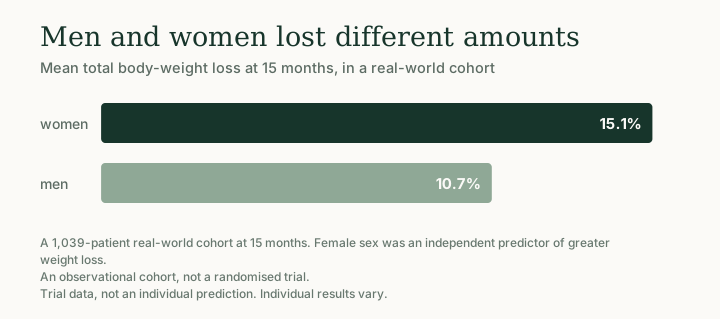
No. The verified direction runs the other way, and it runs that way consistently. In a real-world cohort of 1,039 adults who completed at least twelve months of continuous tirzepatide therapy, women lost 15.1% of body weight against 10.7% in men at 15 months, and in multivariable analysis female sex was an independent predictor of greater weight loss (Castaneda 2026). Age was not an independent predictor. In the Japanese SURMOUNT-J subgroup analysis, weight reduction at 72 weeks was broadly similar across subgroups, with numerically greater percentage reductions in women than in men at both doses (Yokote 2026).
Both of those are tirzepatide datasets, one retrospective and one a manufacturer-funded subgroup analysis, with two of its authors employed by the manufacturer, that the trial was not powered for. They are reported here as research findings. What they establish between them is that no source supports men doing better on any weight-loss endpoint.
So the male story is not about magnitude. It is about what a man is carrying before he starts and where it sits — which is a more interesting question than who loses more kilograms, and one the scale cannot answer.
Does visceral fat come off first?
As a percentage, usually. In kilograms, no. And the effect is weakest at exactly the weight losses this medication produces.
The 89-study meta-analysis that owns this question puts it plainly. The percentage decrease in visceral fat was always greater than the percentage decrease in subcutaneous fat, with no differences between strategies — while the absolute decrease was greater in subcutaneous fat. Its stated conclusion: "No intervention preferentially targets visceral fat. Basal visceral fat depots are smaller than basal subcutaneous fat depots" (Merlotti 2017). The percentage advantage is arithmetic on a smaller starting number, not a mechanism.
The second systematic review adds the part most often left out. Across 61 studies, percentage weight loss was the only variable that predicted the visceral-to-subcutaneous ratio, and the authors concluded: "Visceral adipose tissue is lost preferentially with modest weight loss, but the effect is attenuated with greater weight loss" (Chaston 2008). GLP-1 patients in the registration trials sit at the large end of that range, which is where the preference is weakest. The correlation itself, r = −0.29, is weak.
The GLP-1-specific data does show a differential, with a method caveat that has to travel with it. In the SURMOUNT-1 body-composition sub-study of 160 people, visceral fat fell 40.1% with tirzepatide against 7.3% on placebo, set against a 33.9% fall in total fat mass (Look 2025). Visceral fat there was estimated by DXA software from the android region rather than imaged, which the authors explicitly distinguish from direct measurement, and it was an exploratory analysis added after the fact rather than a planned endpoint.
The same sub-study looked for a sex difference and found none on any measure, including visceral fat. That result should be read as low power rather than proven equivalence: 73% of the 160 participants were female, so every male figure rests on very few men, and the authors flag one male placebo subgroup of 8 to 11 people as a probable outlier.
Telling where you stand, in Singapore numbers
Singapore's national obesity guideline sets waist-circumference action points at more than 90 cm for men and more than 80 cm for women, alongside BMI categories of 23.0–27.4 for overweight and 27.5 and above for obese in the local population (HPB-MOH 2016). For a Singaporean man that 90 cm figure is the number to know.
Treat it as a prompt, not a verdict. In 120 Singaporean men over 60 scanned by CT, visceral fat correlated better with cardiometabolic risk factors, adipokines and C-reactive protein than waist circumference or BMI did — and waist itself tracked visceral fat only moderately, r = 0.48 in Chinese men and r = 0.37 in Indian men (Ng 2012). Notably, that study found Chinese and Indian men had similar visceral fat despite the Indian men having more diagnosed disease, so it does not support an ethnic ranking.
What does hold across populations is that BMI is the weaker instrument here. In 822 adults matched for sex and BMI, BMI underestimated visceral fat in every non-European group, with Chinese and South Asian participants carrying relatively more abdominal and especially visceral fat than Europeans (Lear 2007). That relationship is conditional rather than flat — Chinese participants exceeded Europeans only above 9.1 kg of total body fat, and South Asians exceeded them below 37.4 kg but not above — so it is not a licence for a blanket statement about Asian bodies. A tape measure and the ratio described in waist-to-height ratio remain the practical tools; just do not expect either to move in step with what is happening inside the abdomen.
The other half of the ledger
Everything above is about which fat comes off. The question this clinic exists to ask is what else comes off with it. In the same SURMOUNT-1 sub-study, roughly 75% of the weight lost was fat mass and roughly 25% was lean mass — in the tirzepatide arm and in the placebo arm (Look 2025). The lean-mass cost belongs to substantial weight loss, not to the medicine, which is covered in more detail in muscle loss on GLP-1 medication.
The lever that has been shown to change that ratio is training. Across 114 trials and 4,184 people, lean mass was statistically unchanged where resistance training accompanied caloric restriction (Lopez 2022). For a man whose visceral fat is the thing he wants gone, the sequence worth internalising is that losing weight is what shifts the visceral compartment — no method does it selectively — and resistance training is what decides how much muscle he still has when it is gone.
The organ that most often shows up first on a health-screening report in this group is the liver. Fatty liver and body weight covers how much weight loss the evidence attaches a change to, and how few people in the study reached it; the neighbouring conditions are in weight-related conditions.
Common questions
What is the 'uncle belly' actually made of?
A mix of subcutaneous fat under the skin and visceral fat packed around the organs, and men carry a higher share of their total fat in the visceral compartment than women do (Karastergiou 2012). Visceral fat is roughly 6–20% of total body fat, so it is the smaller depot even in the men who carry the most of it.
Do men lose more weight than women on GLP-1 medication?
No — the measured direction runs the other way. In a 1,039-patient real-world cohort, women lost 15.1% of body weight against 10.7% in men at 15 months, and female sex was an independent predictor of greater loss (Castaneda 2026). A Japanese trial subgroup analysis pointed the same way (Yokote 2026).
Does belly fat come off first?
As a percentage, usually — as kilograms, no. Pooling 89 studies, the percentage fall in visceral fat consistently exceeded that in subcutaneous fat while the absolute fall was larger in subcutaneous fat, and the authors concluded that "no intervention preferentially targets visceral fat" (Merlotti 2017). The preference is also strongest at modest weight loss and weakens as the total grows (Chaston 2008).
What waist measurement should a Singaporean man be watching?
Singapore's national obesity guideline sets the action point at more than 90 cm for men, alongside BMI thresholds of 23 and 27.5 (HPB-MOH 2016). Treat it as a screening prompt rather than a diagnosis — in 120 Singaporean men over 60, waist circumference tracked CT-measured visceral fat only moderately (Ng 2012).
Can you target belly fat with training or diet?
No method has been shown to do it. Across 89 studies covering diet, exercise, weight-loss medication and surgery, the pattern of visceral versus subcutaneous loss was the same regardless of which method was used (Merlotti 2017). What training changes is the other half of the ledger — resistance training alongside a deficit left lean mass statistically unchanged across 114 trials (Lopez 2022).