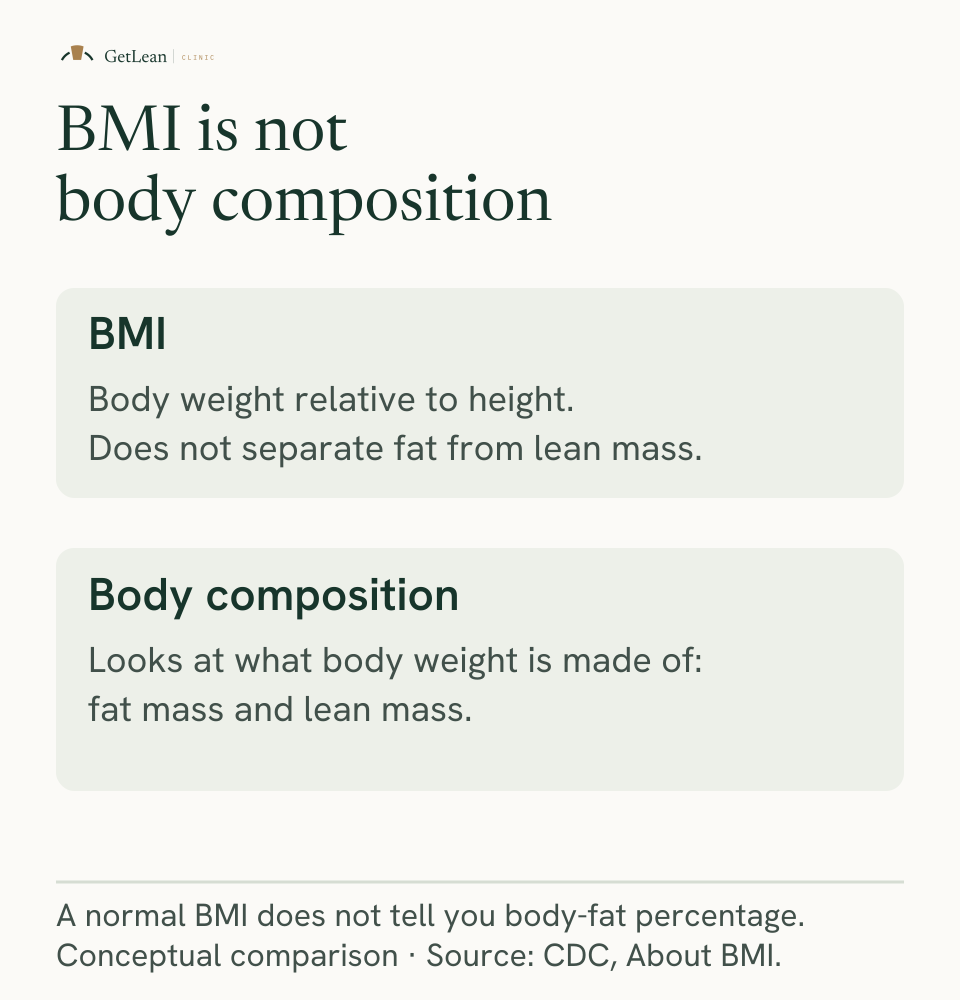
"Skinny fat" describes someone whose body weight and BMI look normal, but who carries a high proportion of body fat and relatively little muscle. It is not a diagnosis. The closest clinical terms are normal weight obesity and, where muscle is genuinely low, sarcopenic obesity. The reason it matters is that a normal number on the scale can sit alongside the same metabolic risk factors that higher body weights carry — which is exactly what BMI is unable to see. This article covers what the evidence shows, why it is common in Singapore, and what actually changes it.
Skinny fat: a normal body weight or BMI combined with a high body-fat percentage and low muscle mass. The scale looks fine; the body composition underneath it does not.
What does "skinny fat" mean in clinical terms?
The research term is normal weight obesity: a BMI in the healthy range of 18.5–24.9 combined with a high body-fat percentage. In an analysis of 6,171 adults, people meeting that description had a higher prevalence of dyslipidaemia and, in men, hypertension, and among women a significantly higher risk of cardiovascular mortality — an adjusted hazard ratio of 2.2 (Romero-Corral 2010). That mortality association was found in women; in the same study, body fat was not associated with cardiovascular mortality in men.
The idea is older than the term. In 1998, researchers revisited what they called the "metabolically obese, normal-weight" individual: people of ordinary weight and height who nonetheless show insulin resistance and raised risk of type 2 diabetes and premature coronary heart disease (Ruderman 1998). Their proposal was that central fat distribution, inactivity and low fitness identify these people, and BMI does not.
There is also a stricter, formally defined condition. Sarcopenic obesity is the co-existence of excess adiposity with low muscle mass or low muscle function, defined jointly by ESPEN and EASO in 2022 with a staged diagnostic process: screening, then confirmation using reduced handgrip strength alongside reduced muscle mass relative to body weight (Donini 2022). It is diagnosed by a clinician, not by appearance.
Is being skinny fat actually a health risk?
The honest answer is that it depends on which version of it someone has, and the strength of the evidence differs across them.
For sarcopenic obesity, where low muscle is formally confirmed, a meta-analysis pooling 23 studies and 50,866 adults found it associated with a roughly 21% higher relative risk of all-cause mortality — a pooled hazard ratio of 1.21 (Zhang 2019). That is an association rather than proof of cause, the definitions used varied between the pooled studies, and the participants were mostly middle-aged and older.
For normal weight obesity more broadly, the risk-factor findings are consistent — more dyslipidaemia, and more hypertension among men — while the mortality finding was specific to women in the study above (Romero-Corral 2010). Anyone presenting this as a uniform, sex-neutral mortality risk is going further than the data.
What is not in dispute is the practical point: BMI did not identify these people. A screening approach that stops at body weight will miss them by design.
Why is this more common in Singapore?
Because the relationship between BMI and body fat is not the same across populations, and Singapore sits on the side of that difference where BMI understates fat.
Using a four-compartment reference model in 291 Singaporean Chinese, Malay and Indian adults, researchers found that a prediction equation derived from Caucasian populations under-predicted body-fat percentage by between 2.7 and 5.6 percentage points. To match the body fat that a Caucasian carries at a BMI of 30, the equivalent threshold was about 27 kg/m² for Chinese and Malay participants and about 26 kg/m² for Indian participants (Deurenberg-Yap 2000). Body-fat percentage at equivalent BMI was highest in Indian participants and lowest in Chinese participants.
The practical consequence is straightforward. A BMI of 23 in Singapore is not the same body composition as a BMI of 23 in a European reference population. Someone here can sit comfortably inside the "normal" BMI band and still be carrying a body-fat percentage that would be flagged elsewhere. It is also why Singapore's own clinical practice guidelines set the overweight threshold at a BMI of 23 and the obesity threshold at 27.5, rather than the international 25 and 30 (HPB-MOH 2016).
Can losing weight make you skinny fat?
Yes — and this is the part that gets missed. Weight loss is not composition-neutral. Some fraction of every kilogram lost is fat-free mass, which includes muscle.
In a systematic review of dieting studies, the median proportion of weight lost as fat-free mass was about 14% on standard low-calorie diets and about 23% on very-low-calorie diets (Chaston 2007). By sex, the pooled figures were 27% in men and 20% in women. The review also found that the severity of the calorie restriction correlated with how much fat-free mass came off.
Read that alongside the definition above and the risk becomes obvious. Someone who starts with a normal BMI and a high body-fat percentage, then loses weight aggressively without protecting muscle, can end up lighter and leaner-looking on paper while the underlying problem — too little muscle relative to fat — is unchanged or worse. Getting smaller is not the same as getting leaner.
At GetLean, our philosophy is that the goal is the composition, not the number — a falling scale reading on its own is an incomplete picture rather than a result.
What actually changes it?
Adding muscle, not subtracting more weight.
The strongest evidence here is a meta-analysis of 114 trials covering 4,184 people with overweight and obesity. Where resistance training was combined with caloric restriction, lean mass was statistically unchanged — an effect size of roughly −0.3 kg that did not reach significance. Resistance training alone was the most effective intervention for increasing lean mass compared with untrained controls, at 0.8 kg (95% CI 0.6 to 1.0) (Lopez 2022).
Three things follow from that.
Train against resistance. This is the input that changes the composition of weight lost, rather than only its amount. It does not require a gym membership or a complicated programme to start.
Eat enough protein. Protein and resistance training work together; neither alone does what both do. Our protein guide covers the target and how to reach it on Singapore food.
Measure something other than weight. If body weight is the only number being tracked, a change in composition is invisible. Waist measurement, strength in the gym, and how clothes fit are all cheap proxies.
Individual results vary, and anyone with an existing medical condition should speak to a doctor before starting resistance training or changing their diet substantially.
Common questions
What does skinny fat actually mean?
It is the informal term for having a body weight or BMI in the normal range while carrying a high proportion of body fat and relatively little muscle. In research the closest equivalent is normal weight obesity, defined as a BMI of 18.5–24.9 with a high body-fat percentage (Romero-Corral 2010).
Can you be skinny fat and still unhealthy?
Yes. In a study of 6,171 adults, people with a normal BMI but high body fat had a higher prevalence of dyslipidaemia, more hypertension among men, and among women, higher cardiovascular mortality (Romero-Corral 2010). The point of the finding is that BMI alone did not identify them.
Why is skinny fat more common in Singapore?
Research in Singaporean Chinese, Malay and Indian adults found that a Caucasian-derived equation under-predicted body-fat percentage by 2.7 to 5.6 percentage points, meaning a given BMI here corresponds to more body fat than the same BMI predicts elsewhere (Deurenberg-Yap 2000). A normal BMI can hide a high body-fat percentage.
Can losing weight make you skinny fat?
It can, if the weight comes off without protecting muscle. Pooled dieting studies found about 14% of weight lost on a standard low-calorie diet was fat-free mass, rising to roughly 23% on very-low-calorie diets, with more restriction associated with more fat-free-mass loss (Chaston 2007).
How do you fix being skinny fat?
By building muscle rather than losing more weight. A meta-analysis of 114 trials found lean mass was statistically unchanged when resistance training accompanied a calorie deficit, and that resistance training alone increased lean mass by about 0.8 kg versus controls (Lopez 2022). Individual results vary. Speak to a doctor first if you have any medical condition.