At a zi char table you do not control the portions, the oil or the serving spoon. What you control is the order sheet, and that is where the outcome is decided. A table that orders four dishes of which one is a protein leaves everyone eating rice; a table that orders four of which three are protein-led leaves everyone, including you, eating protein first. This article covers how to influence the order, what to take when the dishes land, and why no verifiable calorie figure for sweet and sour pork exists.
Protein-led dish: one whose main ingredient is meat, fish, egg or tofu and whose preparation adds little else — a steamed fish, a clear meat soup, a plain stir-fried chicken. The opposite is a dish where the protein is a garnish on rice, noodles or batter.
Start with what nobody can tell you
No per-portion energy or protein figure for a zi char dish appears in the Singapore composition sources cited on this site. Those sources cover named hawker dishes and grocery staples, and zi char is not among them. Nor has any published study sampled several stalls of the same dish to establish how much the same order varies from shop to shop — that range does not exist for any Singapore dish, hawker or otherwise.
That matters because zi char is the most variable food in Singapore. The same dish name covers a wok's worth of decisions — how much oil, how much sugar in the sauce, whether the protein is battered, how big the plate is — and none of them is standardised. Figures circulating online for these dishes do not trace back to a source that can be checked, and a decimal place on an uncheckable number is worse than no number at all.
So this article reasons from ingredients and preparation, which are visible on the menu, rather than from composition figures, which are not.
Naming the gap has a practical use. Once you stop looking for a calorie figure for kung po chicken, the question changes from "how much does this dish cost me" to "what is this dish mostly made of" — and the second question is answerable from the menu, at the table, in about four seconds. It also survives the fact that the answer differs between shops, which no figure would.
Order the sheet, not your plate
The single highest-leverage moment of a zi char dinner happens before any food arrives, while somebody is writing on the pad. Two suggestions from anyone at the table usually go in.
Suggestion one: one more protein dish. Tables under-order protein by default, because protein dishes cost more and rice is what fills people up. Adding a steamed fish or a tofu-and-minced-meat dish to an order changes what is available to everyone for the whole meal, and nobody experiences it as a diet intervention.
Suggestion two: one fewer fried starch. Fried rice, fried hor fun and fried bee hoon are usually ordered alongside white rice rather than instead of it. Dropping one of them costs the table nothing and removes the dish most likely to fill your limited capacity.
Neither suggestion requires announcing anything about your own eating. Both work by changing what is on the table rather than what is on your plate, which is the only lever that survives a group meal.
Which dishes are protein-led
Without per-dish figures the useful distinction is ingredient and preparation, and HPB's own ingredient-level data shows why the ingredient dominates. Raw skinless chicken breast carries 22.5 g of protein per 100 g and plain tofu 6.6 g, while a fried egg comes in at 237 kcal per 100 g, well above what an egg contributes by itself (HPB). Preparation moves the number as much as the ingredient does.
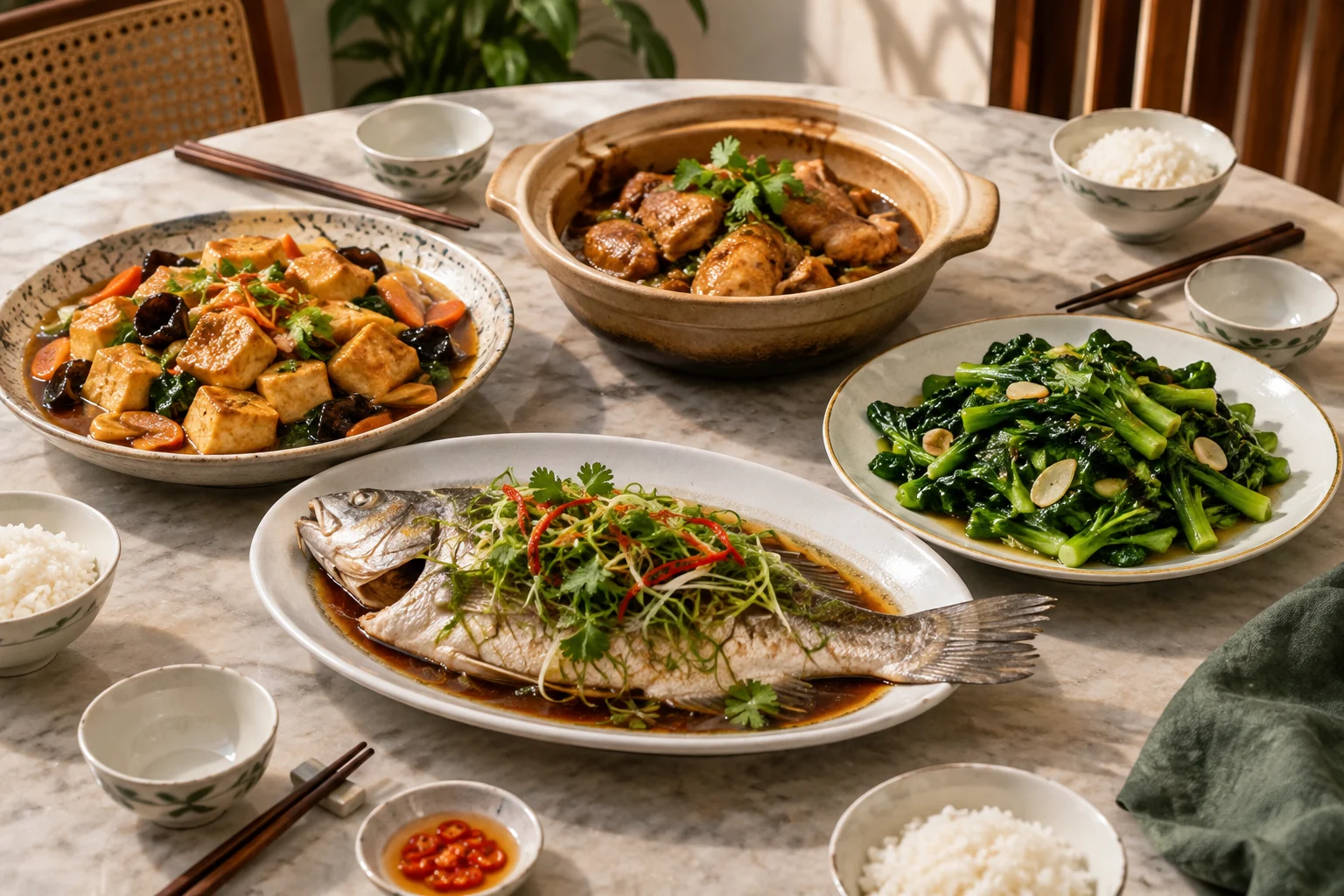
Usually protein-led: steamed fish; steamed or boiled chicken; a clear soup built on meat or fish, such as a peppery pork rib or fish head soup; tofu braised or steamed with minced meat, egg or seafood; plainly stir-fried meat or prawns with vegetables; an omelette where the egg is the dish rather than the binder.
Usually not, whatever the name suggests: anything battered or crumbed before frying, including sweet and sour preparations and cereal-coated prawns, where a substantial part of what arrives is coating; fried rice and fried noodle dishes, where meat and egg are seasoning; dishes finished in a thick sweet sauce, where the sauce is doing work the meat is not.
The vegetables are not the problem, and they are not the solution either. A plate of greens in garlic is a good addition and contributes almost nothing towards a protein target. On a small appetite it competes for capacity with the dishes that do.
The sharing problem: you will be the one who stops first
On appetite-suppressing medication you are usually the person at the table who finishes least. That has a specific consequence at a shared meal: the dishes you reach for in the first five minutes are, in practice, the whole meal. Whatever arrives in the second round arrives after your capacity has gone.
Protein compounds this from the other direction, because it is the most filling macronutrient per calorie. Raising protein from 15% to 30% of calories reduced spontaneous energy intake by about 440 kcal a day in one 19-person study (Weigle 2005). On a normal appetite that is the mechanism doing you a favour. At a zi char table with a suppressed appetite it means the food you most need is also the food that ends the meal fastest — so it has to go first, not last.
The practical version is a single habit: serve yourself once, at the start, from the protein dishes, and eat that before anything else reaches your plate. Rice, if you want it, comes after. Most of the time the meal ends before you get there, which is the point.
Does it matter that it all lands at dinner?
Zi char is a dinner, and a dinner-heavy protein pattern is exactly what a shared evening meal produces — a light day followed by most of the day's protein in ninety minutes. The evidence on whether that costs anything is genuinely split, and the split is instructive.
The same research group studied the same twenty older men with overweight or obesity, eating 1.3 g of protein per kg per day in a moderate energy deficit. Measured acutely over a 13-hour infusion, spreading protein evenly across four meals produced higher fed-state muscle protein synthesis than concentrating it at dinner (Murphy 2015). Measured over two weeks in the same men with a different technique, distribution made no difference at all — while adding resistance training raised synthesis by about 26% and raised the synthesis rate of 175 of 190 individual muscle proteins (Murphy 2018).
Same investigators, same participants, opposite answers depending on the measurement window. Twenty men, older, in one deficit at one protein intake — so neither result settles anything on its own. What both agree on is that the training mattered more than the timing.
There is a second reason to hold per-meal targets loosely. The widely quoted figure of 0.4 g of protein per kg of body weight per meal across four meals is fenced by its own authors, in the paper itself, to "non-dieting (eucaloric or hypercaloric) conditions" (Schoenfeld and Aragon 2018). Anyone losing weight on a GLP-1 medication is in the population that recommendation excludes. Our article on whether protein timing matters on a reduced appetite works through this properly.
The workable position for a zi char dinner: hit the daily total, which sits at roughly 1.2 to 1.6 g per kg of body weight during active weight loss (Leidy 2015), and stop worrying about whether a large share of it arrived at eight in the evening.
Five rules for six people and one appetite
1. Influence the order, not your plate. One more protein dish and one fewer fried starch.
2. Take your protein in the first round. Whatever you are going to eat, put it on your plate before the table settles in.
3. Ask for rice last, or not at all. At a shared table there is always more rice available than you will want.
4. Do not treat a shared dish as unlimited. The serving spoon has no portion size, which is precisely why it is worth deciding your share once rather than continuously.
5. Order for the leftovers. Steamed fish and tofu dishes travel home and reheat as tomorrow's protein. Fried rice does not need to.
For the same problem at a solo hawker meal, see eating at a hawker centre on a small appetite; for a full day of ordering, hawker dishes ranked by protein per calorie.
At GetLean, our philosophy is that the medication is the catalyst and what you keep is the result. Most of what you keep is decided at ordinary meals with other people, which is where a plan has to work or it does not work.
Individual results vary. Anyone with a medical condition affecting diet should speak to a doctor or dietitian.
Common questions
What should I order at zi char if I am trying to stay lean?
Influence the order sheet rather than your own plate. Aim for at least as many protein-led dishes — steamed fish, a clear meat soup, a tofu-and-meat dish, a plain stir-fried meat — as starch-led ones, and let the rice be the thing there is least of.
How many calories are in a zi char dish?
No per-portion figure for a zi char dish appears in the Singapore composition sources cited on this site, and no published study has sampled several stalls of the same dish to give a range. Figures circulating online for these dishes do not trace back to a source that can be checked.
Does it matter that most of my protein lands at dinner?
Less than it is usually made to sound. The same investigators studying the same men found that even distribution beat a dinner-heavy pattern when synthesis was measured acutely, and made no difference at all when measured over two weeks (Murphy 2015, Murphy 2018).
How do I avoid eating too much at a shared table?
Serve yourself once, at the start, from the protein dishes, and eat that before anything else reaches your plate. On a suppressed appetite the meal usually ends before the second round, so the first round decides what you got.
Are steamed dishes always the leaner choice?
Usually, because the preparation adds less oil and no batter, not because steaming does anything to the food. The variable that moves most at a zi char stall is what the dish is cooked in and coated with, and that is decided before the dish reaches the table.