Lean mass is everything in your body that is not fat: muscle, bone, organs and the water they hold. When a diet or a medication makes weight come off, some of it is lean mass — a median of about 14% on a standard low-calorie diet, and roughly 23% on a very-low-calorie one. This article explains what that tissue actually does, why losing it has consequences beyond the mirror, and why it is far easier to protect than to replace.
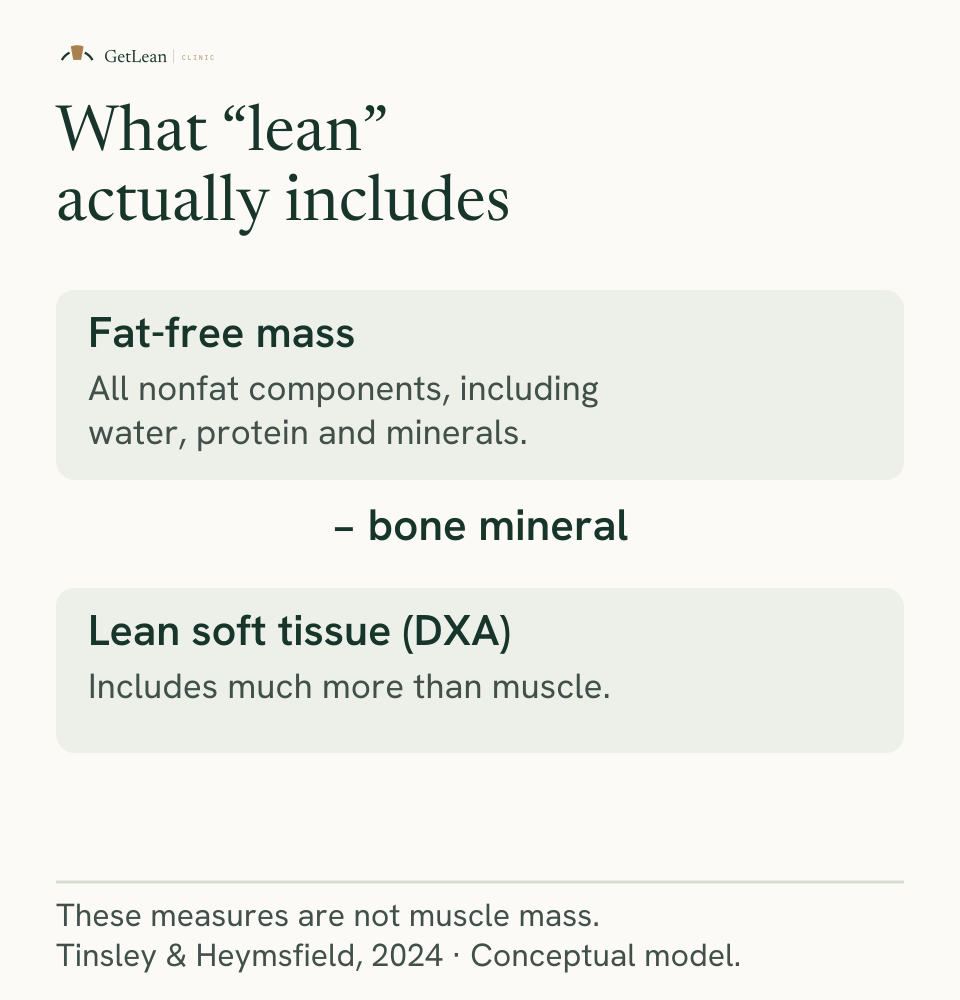
Lean mass: all non-fat tissue. Trials measure lean mass or fat-free mass; muscle is the component that most of the consequences run through.
What lean mass does
Three jobs, none of which is decorative.
It is where glucose goes. Skeletal muscle is the dominant site of insulin-mediated glucose disposal (DeFronzo 2009). Less muscle means less capacity to take glucose out of the bloodstream after a meal. That is physiology rather than a claim about treating any condition — but it is the reason muscle mass sits close to metabolic health.
It is a reservoir. Muscle serves as the body's principal store of amino acids for maintaining protein synthesis in vital tissues and organs, and altered muscle metabolism plays a role in the development, and therefore the prevention, of many chronic conditions (Wolfe 2006). That is a conceptual argument rather than a quantified risk figure, and it is the reason muscle is treated as an organ rather than as ballast.
It correlates with outcomes. In an older-adult cohort of 3,659 people, the highest quartile of relative muscle mass had roughly 20% lower adjusted mortality than the lowest (Srikanthan 2014). In a multinational cohort of 139,691 adults, each 5 kg lower grip strength was associated with a 16% higher hazard of all-cause mortality (Leong 2015).
Both of those are observational, both are associations rather than proof of cause, and grip strength is a measure of strength rather than of muscle mass. They are not nothing.
What happens to your metabolism
The picture is more nuanced than the common version.
The common claim is that losing muscle "wrecks your metabolism". What the evidence actually shows is that after weight loss, total energy expenditure falls by more than the change in body mass alone predicts — and this was measured in people who had never been obese as well as in people who had (Leibel 1995). So the drop is real, and it is larger than simple arithmetic would suggest.
But the drop is not attributable purely to lost muscle. It reflects a coordinated set of responses that defend the reduced weight, of which body-composition change is one part. Anyone who tells you that every kilogram of muscle burns a precisely known number of calories a day, and that this alone explains post-diet metabolism, is oversimplifying two things at once.
The practical implication survives the nuance: you finish a period of weight loss burning less at rest than you did before, and having kept more lean tissue puts you in a better position than having kept less. We cover the wider mechanism in metabolic adaptation, explained.
Why it is easier to protect than to replace
Because the two processes are not symmetrical in speed.
Lean mass comes off during a deficit fairly readily — that is the 14% to 23% figure (Chaston 2007). Putting it back requires a training stimulus, adequate protein, and months rather than weeks, and for anyone past their first year of training it is slower again.
Which is why the intervention that matters happens during the loss, not after it. Across 114 trials covering 4,184 people with overweight and obesity, lean mass was statistically unchanged where resistance training accompanied caloric restriction (Lopez 2022). Muscle that was never lost does not need to be regained.
At GetLean, our philosophy is that the medication is the catalyst and what you keep is the result. This is the mechanical reason behind that sentence: the composition of the weight you lose is decided while you are losing it, and it is much harder to correct afterwards.
What this means in practice
Three things follow, and none of them is complicated.
Track something other than weight. The scale cannot distinguish fat from lean tissue, so it cannot tell you whether a plan is working in the way that matters. Waist measurement and strength both can — see why the scale is the worst way to track progress.
Train against resistance. This is the signal that tells the body to retain muscle rather than break it down for energy. The minimum that works is less than most people assume.
Eat enough protein. Protein is the raw material; training is the signal. Neither alone does what both do together, and how much of each is set out in full.
Individual results vary, and clinical-trial figures describe the populations studied. Anyone with an existing medical condition should speak to a doctor before starting resistance training or substantially changing their diet.
Common questions
What is lean mass?
Everything that is not fat — muscle, bone, organs and water. Muscle is the component most people mean and the one most affected by how weight is lost.
Does losing muscle slow your metabolism?
Energy expenditure does fall after weight loss by more than the change in body size alone predicts, measured in formerly obese and never-obese people alike (Leibel 1995). Lost lean tissue is part of that picture, but the fall is not attributable to muscle alone.
How much muscle do you lose when you diet?
A median of about 14% of weight lost was fat-free mass on standard low-calorie diets, rising to roughly 23% on very-low-calorie diets (Chaston 2007). More severe restriction was associated with more fat-free-mass loss.
Why does muscle matter beyond appearance?
Skeletal muscle is the dominant site of insulin-mediated glucose disposal (DeFronzo 2009) and the body's main amino-acid reservoir (Wolfe 2006). Low relative muscle mass and low grip strength are each associated with higher mortality in large cohorts (Srikanthan 2014, Leong 2015), though both findings are observational.
Can you get lost muscle back?
Yes, with resistance training and adequate protein — but rebuilding is slower than losing, which is why protecting muscle during weight loss is the easier problem (Lopez 2022).