After weight loss, the body burns less energy than its new size alone would predict. That is metabolic adaptation, and it is the single best explanation for why regain is so common: a measured physiological response rather than a lapse in discipline. It is also routinely overstated into "dieting destroys your metabolism", which the evidence does not support. This article covers what was actually measured, in whom, what it implies, and which parts of it are open to influence.
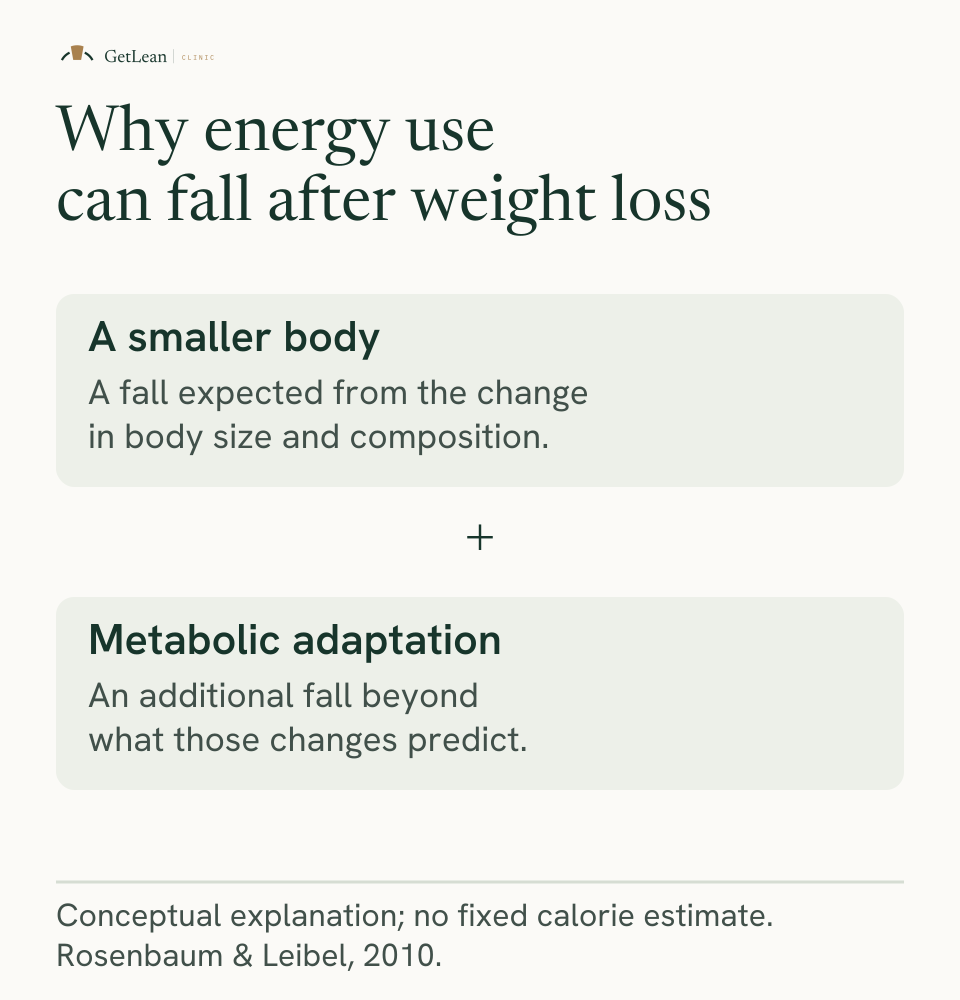
Metabolic adaptation: the reduction in energy expenditure after weight loss that exceeds what the change in body mass predicts. Also called adaptive thermogenesis.
What was actually measured
The foundational work put 41 people through controlled weight perturbation — 18 with obesity, 23 who had never been obese.
Maintaining a body weight at least 10% below usual weight reduced total energy expenditure by more than the change in body composition alone predicted. Gaining 10% above usual weight increased it, again beyond prediction. Crucially, the effect appeared in both groups (Leibel 1995).
That last detail is the one that gets lost. Metabolic adaptation is not a defect found in people who struggle with weight. It is how human physiology responds to being at a reduced weight, and it was demonstrated in people with no history of obesity at all.
The mechanism is broader than metabolism narrowly defined. Reduced body weight is defended by a coordinated set of metabolic, neuroendocrine and behavioural responses that oppose sustained weight loss (Rosenbaum 2010) — hormonal signalling shifts, and appetite moves in the direction of eating more. Energy expenditure is one lever among several, all pulling the same way.
The study everyone quotes, and what it actually says
The Biggest Loser follow-up is the most cited paper in this area and the most misused.
Fourteen former competitors were followed six years after the show. At the end of competition they had lost a mean 58.3 ± 24.9 kg, and resting metabolic rate had fallen 610 ± 483 kcal a day. Six years later they had regained a mean 41.0 ± 31.3 kg — and resting metabolic rate was still 704 ± 427 kcal a day below baseline, with metabolic adaptation, after adjusting for body composition and age, at −499 ± 207 kcal a day (Fothergill 2016).
Those numbers are striking and the study is real. Three things should be attached to them every time.
The cohort is extreme and tiny. Fourteen people, a mean 58 kg lost, under televised competition conditions involving very aggressive restriction and very high exercise volume. That is not a model of medically supervised weight loss.
The authors' own conclusion is more measured than the headlines. They describe metabolic adaptation as persisting over time and being "a proportional, but incomplete, response" to efforts to reduce body weight. Incomplete is doing real work in that sentence.
It does not show metabolism worsening indefinitely. It shows suppression persisting. Those are different claims, and only the second is supported.
So: the phenomenon is real and it can persist. "Dieting permanently destroys your metabolism" is an overstatement of a fourteen-person study of an extreme intervention.
What this means for weight regain
It means the odds are stacked, and it does not mean the outcome is fixed.
Someone who has lost weight is, on average, burning less at rest than a person of the same size who never lost weight, while their appetite signalling pushes in the opposite direction. Maintaining that lower weight therefore takes ongoing effort that the person who never lost it does not have to make. That asymmetry explains why maintenance is hard far better than any story about discipline does.
It is also why we treat regain data as information rather than as a warning. In why two-thirds of the weight comes back, the trial figures describe exactly this physiology playing out.
What is actually modifiable
Not the adaptation itself. No intervention has been shown to prevent it, and anyone selling one is ahead of the evidence.
What is modifiable is two things sitting either side of it.
The composition of the weight you lose. A median 14% of weight lost is fat-free mass on standard low-calorie diets, rising to about 23% on very-low-calorie diets (Chaston 2007) — and across 114 trials covering 4,184 people, lean mass was statistically unchanged where resistance training accompanied the deficit (Lopez 2022). Arriving at maintenance with more lean tissue is a better starting position than arriving with less.
Activity afterwards. The ACSM position stand associates physical activity above 250 minutes a week with improved weight maintenance, drawing on cross-sectional and prospective data — while stating plainly that no randomised trial evidence existed to confirm it (ACSM 2009). Worth knowing in both directions: it is the best available guidance, and it is observational.
At GetLean, our philosophy is that the medication is the catalyst and what you keep is the result. Metabolic adaptation is where that framing comes from — the physiology after weight loss is genuinely working against you, and what you built on the way down is what you have to work with.
Individual results vary, and clinical-trial figures describe the populations studied.
Common questions
What is metabolic adaptation?
The fall in energy expenditure after weight loss that exceeds what the change in body size alone predicts (Leibel 1995), as part of a coordinated response defending the reduced weight (Rosenbaum 2010).
Does dieting permanently damage your metabolism?
That overstates the evidence. The most-quoted study found resting metabolic rate still suppressed six years on — in 14 people who had lost a mean 58 kg under televised competition conditions, with the authors describing the adaptation as "proportional, but incomplete" (Fothergill 2016).
Does metabolic adaptation happen to everyone?
The energy-expenditure fall was demonstrated in people who had never been obese as well as those who had (Leibel 1995), so it is a normal response rather than a defect in particular people. Magnitude varies between individuals.
Can you prevent metabolic adaptation?
No intervention has been shown to prevent it. What is modifiable is the composition of the weight lost — lean mass was statistically unchanged where resistance training accompanied a calorie deficit (Lopez 2022).
Does it mean weight regain is inevitable?
No. It means the physiology is working against maintenance, not that the outcome is decided. Physical activity above 250 minutes a week is associated with better maintenance on observational evidence (ACSM 2009).